Australian Mobile Casinos: Apps, Payments and Rules
 Available in AU
Understand the differences between browser sites, PWAs and native apps, and the checks that matter for deposits, bonuses and withdrawals.

Table of Contents
- How Offshore Casino Sites Reach a Phone
- Mobile Play, Without the App-Store Promise
- Australia’s Rules and the Offshore Divide
- PayID and the Changing Deposit Landscape
- When ‘No Deposit’ Comes With Conditions
- What an Australian Mobile Casino Page Can—and Cannot—Establish
- Games on Small Screens, and the Free-Play Exception
- Free Pokies, Crypto and the Meaning of ‘Free’
- Real-Money Play: Verification, Withdrawals and Limits
- Bonus Terms: The Arithmetic Behind the Headline
How Offshore Casino Sites Reach a Phone
A phone can open a casino website in its browser, save that website to the home screen as a Progressive Web App, or run a native app made for its operating system. These options may look similar once a page is open, but they are different ways of reaching the same kind of service. For offshore crypto-friendly casinos, browser access and PWAs are the formats most often encountered by Australians; native apps are less common.
Browser: the direct route
A mobile browser loads the casino’s website without installing a separate casino program. The page is opened as a website, and the account used there is the same one that can be used on desktop. That continuity is one reason browser access is the ordinary starting point: a punter does not need a separate mobile account or a dedicated app to reach the site.
The browser also makes the distinction between a website and an app visible. Its address bar and navigation controls remain part of the experience, and the site is reached by opening its web address. The browser is the intermediary: it displays the website rather than turning it into a standalone program on the phone.
In Australia, casino apps are seldom found in the Google Play Store or Apple App Store. As a result, most mobile access happens through the browser. This is not an exotic workaround; it is simply the format that is commonly available. The web has always been less ceremonious than the app store: a page opens, and there it is.
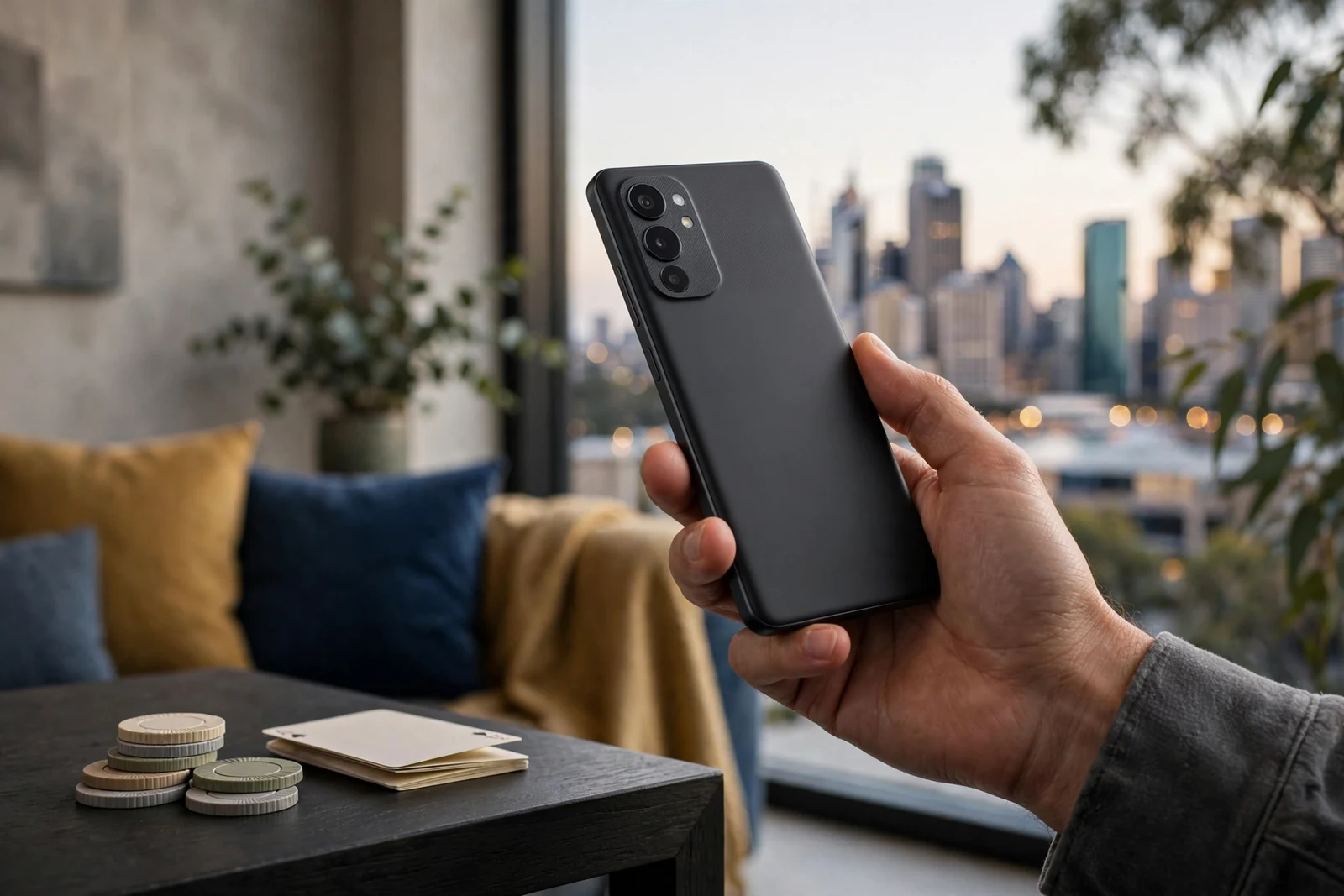
Progressive Web App: a website with a home-screen place
A Progressive Web App, or PWA, remains a casino website, but it can be saved to a phone in a way that makes it behave more like a native app. The distinction matters. Installing a PWA does not mean that a separate casino product has been downloaded from an app store; it means the website has been given a more app-like place on the device.
A PWA can be added from the casino website itself. When an install or add-to-home-screen prompt appears, tapping it and confirming the choice creates a shortcut. The shortcut then gives the site a direct presence among the phone’s other icons. Opening it can feel more like launching an app than revisiting a web address, though the underlying service is still the website.
That arrangement occupies a middle ground. A browser tab is plainly a web page; a PWA offers a more app-like entry point without being a native app. It can make a frequently visited website easier to return to, but the label should not be mistaken for a guarantee of a separate, app-store-reviewed product. The format describes how the site is presented on the device, not who operates it or what protections apply.

Native app: a separate program
A native app is software built for a phone’s operating system and installed as an application. It is distinct from a browser page and from a PWA shortcut, even if all three can lead to a similar-looking account screen. The design may be tailored to the device, but that alone does not establish anything about the operator behind it.
Because casino apps are rarely listed in the major app stores in Australia, an app offered outside those stores needs particular care. Installing software by sideloading carries security risks, and its safety depends on the operator. A polished icon or an app-like interface cannot settle that question. Nor does the word “app” tell whether the file is native software or simply a route back to a website.
The practical distinction can be put simply: browser play opens the site; a PWA saves a website shortcut that behaves more like an app; a native app is a separate program. In the Australian setting, the first two are the formats most commonly offered by casinos that accept Australian players. The browser remains the default because it is direct, uses the existing account, and does not depend on finding a casino app in an app store.
Direct access via a web address; the most common method in Australia as it requires no installation.
A website shortcut saved to the home screen that behaves like an app without being a native program.
Software built for a specific operating system, often requiring sideloading since they are rarely in major Australian app stores.
Mobile Play, Without the App-Store Promise
A mobile casino page can open cleanly and still be difficult to use. The screen is only the visible part of the arrangement: a connection carries each request, the browser renders the page, and the phone has to keep enough working memory available for everything to remain responsive. When one part falters, the symptoms can look alike. A game may stall, a control may respond late, or a session may break off without making clear which link in the chain failed.
A specialist review of mobile play identifies poor connections, limited memory, outdated browsers and too many background apps as common sources of trouble. These are ordinary faults of a device under strain, not necessarily signs that a casino page itself is broken. A weak connection can interrupt the exchange between phone and site; a crowded phone may have less room to keep a demanding page running. An old browser can also struggle with features that a newer version handles more reliably.
The browser is therefore part of the playing experience, not a neutral window around it. Mobile pages depend on the browser to display menus, process taps and maintain a session. If the browser is out of date, or if several apps are competing for the phone’s attention, the page may behave inconsistently. Closing unnecessary background apps and keeping the browser current are practical checks, though neither can repair a poor connection or guarantee that a site will work well.
A pause is not always a failure. Some interruptions come from the network, others from the device, and some may be part of the site’s own behaviour. Repeatedly tapping a control during a delay can make it harder to tell whether the first action registered. Patience is not a technical fix, but it can prevent one uncertain moment from becoming several.
Mobile use also changes the surroundings of play. A phone can follow its owner from a quiet room to a crowded commute, and the same page may be used in circumstances that make attention less steady. The device offers privacy and immediacy; it also makes it easy for a session to become detached from the place and time in which it began. Convenience, in this sense, is a social arrangement as much as a design feature.
Some casinos provide controls intended to put boundaries around gambling activity. A specialist review describes options such as deposit limits, loss limits, wager limits and session-time limits, alongside self-exclusion. Their availability and operation depend on the individual casino; a control should not be assumed to exist merely because another site offers it. Nor does a menu of limits make a service safe by itself. The point of such tools is to make chosen boundaries more concrete, not to remove the risks of gambling.
Limits can address different parts of a session. A deposit limit constrains money added to an account, while a loss limit concerns losses; wager limits and time limits address activity and duration. Self-exclusion is a more decisive step, intended to block further access under the casino’s process. These controls are not interchangeable, and their practical effect depends on how the site applies them. The wording and settings matter.
A mobile page can make play feel contained within a small rectangle. The consequences are not. Connection quality, available memory and browser condition shape whether the page works; the surrounding circumstances shape whether using it is sensible. An app-like screen cannot settle either question.A small screen. Real limits.
Do
- Keep your mobile browser current
- Close unnecessary background apps
- Use deposit and session limits
Don’t
- Repeatedly tap controls during a delay
- Assume limits exist on every site
- Rely on the screen size for safety
Australia’s Rules and the Offshore Divide
Australian law draws a line between the operator supplying a casino game and the person who plays it. Under the Interactive Gambling Act 2001, operators cannot offer online casino-style games to people in Australia. The prohibition covers the service being provided, rather than creating an offence for an individual Australian who plays with an offshore operator. That distinction matters: a rule aimed at supply is not the same thing as a rule that makes every punter on the other side of the screen legally liable.
It is an arrangement with a distinctly Australian shape. The law places the burden on the business, while the practical environment still contains offshore services that can be reached, at least until access is interrupted. This is not a local licensing system in which an operator obtains an Australian casino permit and then serves the domestic market. The legal position of the service and the individual’s position are separate questions.
Blocking and overseas licences
The Australian Communications and Media Authority, or ACMA, works to restrict access to gambling services that breach the rules. Its blocking measures can make an offshore site unavailable from within Australia. A site appearing in a search or opening on a phone does not establish that it is permitted to offer casino games to people in the country; nor does a blocked page amount to a finding about the conduct of an individual who tried to open it.
Some offshore operators that accept Australian users identify licensing jurisdictions such as Curaçao, Malta, or Gibraltar. The Malta Gaming Authority is the regulator associated with Malta’s licence. These are overseas frameworks, not Australian authorisations. Their presence on a site tells something about where its operator claims oversight; it does not displace the Australian prohibition on offering online casino-style games to people located here.

The word “licensed” can therefore do too much work in a sentence. It may describe an operator’s status in another jurisdiction, but it does not turn an offshore casino into a locally approved service. The legal map has two layers, and they should not be mistaken for one.
The age threshold
A person must be at least 18 to register and gamble in Australia. That threshold applies whether the service is encountered on a desktop or through a mobile casino interface. A smaller screen changes the surroundings, not the age rule.
For anyone considering mobile casinos in Australia, the distinction between operator and individual is useful context, but it is not an assurance about a particular site. The prohibition remains directed at operators offering online casino-style games to people in the country, while ACMA’s blocking activity is part of how that restriction is enforced. Offshore licences belong to another jurisdiction; they do not erase the local framework.
The result is neither a domestic market of approved casino operators nor a rule that treats every individual punter as an offender. It is a divided position: supply is prohibited, personal play is not made illegal by the Act, and access to offshore services may be blocked. Clear enough in outline. Less tidy in practice.
Legal Status
Under the Interactive Gambling Act 2001, operators are prohibited from offering online casino-style games to people in Australia.
PayID and the Changing Deposit Landscape
Funding an account from a phone can involve several different rails: PayID, BPAY, cards, cryptocurrency or, historically, POLi. A specialist casino-payment review lists these as mobile deposit options, while noting that processing times differ. The names alone do not tell the whole story; a payment method may appear on one offshore site and not another, and the time taken to register a deposit can vary by method.
PayID is often presented as the quick, low-cost option. A specialist review describes deposits made this way as near-instant and typically free. That is a report about the method, not a promise that every casino will support it or handle every payment identically. Availability depends on the operator’s payment menu, and the conditions displayed there matter more than a familiar label.
The appeal is easy to understand. PayID is a way of directing a payment using an identifier rather than entering conventional bank-account details for each transfer. On a small screen, fewer fields can make a payment flow feel simpler. But ease of entry is not the same as a guarantee of acceptance: a payment can only proceed through the arrangements the site offers.
Cards, BPAY and cryptocurrency also appear among the methods identified in specialist payment coverage.
The familiar logo can outlast the service. POLi once formed part of Australia’s online payment landscape, but its local operations ended in September 2023. It no longer handles Australian transactions. A payment menu that still invokes the name should therefore be read with care: the brand’s former presence is not evidence that it remains a working local option.

This matters particularly on a mobile casino page, where short menus and compact buttons can make the funding step look more settled than it is. A displayed method is a claim about what the operator says it accepts, not a universal feature of mobile banking. A punter considering an offshore crypto-friendly casino still needs to establish that the site accepts their location before making any deposit. No payment method changes that condition.
Nor does a phone-based payment page make the wider arrangement ordinary. Offshore casinos are not Australian operators, and the convenience of a familiar payment label should not be mistaken for local oversight. An Australian government body cannot be relied upon to resolve a refusal by an offshore casino to pay winnings.
Payment menus change. Names remain.
When ‘No Deposit’ Comes With Conditions
A “no-deposit” offer sounds like a small exception to the usual bargain: a bonus appears without money being added first. On a phone, that promise can look especially simple, reduced to a banner or a code field. But the label describes only one part of the offer. It does not, by itself, explain what must happen before bonus funds—or any winnings connected to them—can be used or withdrawn.
A mobile casino no-deposit bonus may still come with a minimum-deposit condition elsewhere in its terms. That condition can determine whether the offer is available at all, or whether a balance can progress beyond its restricted state. The distinction matters: “no deposit” may refer to the first step, not every step. If a bonus code is advertised, its eligibility rules belong to the offer too; entering a code does not settle what the code requires.
Attention: A “no-deposit” label may only refer to the first step, as minimum-deposit conditions may still apply to withdraw winnings.
Wagering requirements are another dividing line between a headline and a usable offer. They specify how much qualifying play is required before bonus funds can be cleared. The sum involved, the games that count and any restrictions on play can all alter the practical value. A mobile pokies offer may therefore be easy to activate yet difficult to complete. The small screen makes the promotion visible; it does not make its conditions smaller.
A specialist review of bonus offers notes that wagering requirements, minimum deposits and time limits help determine whether an offer is worthwhile. That is a useful way to read the category, rather than treating “free” as a verdict. A short deadline can turn a nominal benefit into an obligation to play at a pace set by the promotion, not by the punter. The terms, not the banner, establish the bargain.
The same review reports that some bonuses have clearing windows of seven to ten days, with the bonus forfeited if the deadline is missed. That is not a universal timetable: the offer’s own rules determine the actual expiry. Before claiming, the full terms need to be checked for wagering requirements, game restrictions, expiry dates and cashout caps. An offer can be free to enter and still carry limits on what can be kept.
Any recommendations on this page concern offshore, crypto-friendly casinos. Whether a site accepts someone’s location must be confirmed before depositing. Using a VPN to reach a blocked casino may void winnings and lead to account closure; if an offshore casino refuses payment, there is no Australian government body to complain to. A bonus does not soften those risks.
What an Australian Mobile Casino Page Can—and Cannot—Establish
Choosing a mobile casino in Australia involves more than finding a site that works on a phone. This list gives you a concise reference to the licensing, deposit and payout details available for each operator.
License: Curacao · Payout speed: crypto 30-60 minutes, fiat 1-5 days · Min. deposit: A$10 Wild Tokyo lists a A$10 minimum deposit and offers separate payout timeframes: 30–60 minutes for crypto and 1–5 days for fiat. Its stated licence is from Curacao.
License: Curacao Golden Pokies is listed with a Curacao licence. That is the licensing information available here.
License: international iGaming licence – jurisdiction not named in the source · Payout speed: PayID 1-24 hours · Min. deposit: A$30 (PayID from A$10) House of Pokies lists PayID payouts of 1–24 hours and a minimum deposit of A$30, reduced to A$10 for PayID. Its source describes its licence as an international iGaming licence without naming the jurisdiction.
License: Curacao eGaming (Dama N.V.) JeetCity Casino is listed under a Curacao eGaming licence held by Dama N.V.
License: Curacao Gaming Control Board JustCasino is listed with a Curacao Gaming Control Board licence.
License: Curacao Gaming Control Board OGL/2023/176/0095 (Hollycorn N.V.) Rollero Casino is listed with Curacao Gaming Control Board licence OGL/2023/176/0095, held by Hollycorn N.V.
License: Curacao (operating since 2017) · Min. deposit: A$20 Uptown Pokies is described as operating since 2017 and lists a minimum deposit of A$20. Its stated licence is from Curacao.
License: Curacao Gaming Authority (Jumpman Gaming Ltd) DragonSlots Casino is listed with a Curacao Gaming Authority licence held by Jumpman Gaming Ltd.
License: Curacao Gaming Control Board OGL/2023/176/0095 (Hollycorn N.V.) Neospin is listed with Curacao Gaming Control Board licence OGL/2023/176/0095, held by Hollycorn N.V.
Payout speed: crypto under 1 hour, PayID 1-3 business days · Min. deposit: A$20 (A$30 to qualify for the bonus) Ricky Casino lists crypto payouts under 1 hour and PayID payouts of 1–3 business days. The minimum deposit is A$20, or A$30 to qualify for the bonus.
A page about the best Australian mobile casinos cannot turn a recommendation into a guarantee. The phrase may suggest a settled league table, as though every site had been tested against the same conditions and would remain available tomorrow. In practice, an assessment can describe what an operator says it offers; it cannot establish that the service will accept every Australian visitor, stay reachable, or resolve a dispute fairly.
Any recommendations on this page concern offshore, crypto-friendly casinos. That description matters: these are not Australian operators backed by an Australian government body for complaints about unpaid winnings. If an offshore casino refuses to pay, there is no Australian government body to which a punter can take the case. The distance is not just geographic. It changes where responsibility can be pursued, and how little local recourse may exist.
A site’s presence on a page does not confirm that it accepts a particular person’s location. Acceptance can depend on the operator’s own terms and checks, and those can change. The point to establish is specific: the site must confirm that it accepts a player located in Australia before any deposit is made. A general statement that a casino serves an international audience is not the same confirmation.
Nor does a working page settle the question. An offshore service can be inaccessible from Australia, including because access has been blocked. A VPN may appear to offer another route, but using one to reach a blocked casino may breach the operator’s terms. The consequences can include voided winnings or account closure. A connection is not permission. Neither is a workaround.
Using a VPN to reach a blocked casino may breach the operator’s terms, potentially leading to voided winnings or account closure.
There is also a distinction between a page’s description and the legal position of the person who reads it. Under the Interactive Gambling Act 2001, playing at an offshore mobile casino is not illegal for an individual Australian player. That does not make the operator’s service locally approved, create a local complaints process, or guarantee that an account will be treated as eligible. Legal non-liability and practical protection are different things.
The word “best” is therefore a claim that should be handled carefully, not treated as a certificate. A comparison can make its criteria visible and identify uncertainties, but it cannot promise a particular outcome for an individual account. It should not imply that a listed site is endorsed by Australian authorities or that a mention removes the need to check the operator’s own conditions.
Even the means of access can carry a separate risk. If a casino offers an app for installation outside the official app stores, sideloading it depends on trusting the operator and the file supplied. Such apps carry security risks; their safety depends on the operator. A polished screen proves very little.
Games on Small Screens, and the Free-Play Exception
A casino game on a phone is still built around the same basic elements as its larger-screen counterpart: a screen presents the game, controls invite taps or swipes, and the result is displayed in a compact space. The difference is not necessarily the rules, but the setting. A small screen makes each choice feel close at hand; menus, balances and game controls have to share a surface that may already be busy.

That intimacy can make mobile casino gaming feel less like an outing and more like a passing habit. A game can be opened between other tasks, then left behind just as quickly. The design does not tell anyone how long to stay, and ease of access is not the same thing as harmlessness. Real-money play carries the possibility of losing money, whether it takes place on a phone or another device.
There is also a separate category that can look similar at first glance. Social and free-play casino apps use virtual credits rather than money staked for cash winnings. In Australia, these apps are available directly through the Google Play Store and Apple App Store, and they are legal to use. Their presence in an app store does not make them a gateway to real-money casino play. They are a different product, with a different kind of credit and a different expectation attached to the result.
That difference matters because “casino” describes a style of play as well as a money arrangement. A virtual balance may let an app reproduce familiar casino imagery or mechanics, but it does not turn those credits into a cash balance. Nor does a free-play label establish that a game can produce withdrawable winnings. The distinction is structural, not a minor detail hidden behind an icon.
Real-money casino games offered to people in Australia sit in another category, even when the screen looks much the same. The resemblance can blur the boundary for a moment; the underlying transaction does not. Free-play apps from the major stores should therefore be understood on their own terms, not as evidence that offshore access is available through those stores.

For a reader comparing mobile casino games, the useful first question is not which title has the brightest interface. It is whether the app uses virtual credits or involves real money. That simple distinction separates entertainment designed around a simulated balance from gambling in which actual funds are at stake. Small screen, different stakes.
Free Pokies, Crypto and the Meaning of ‘Free’
“Free” can describe two different things on a phone: a game played with virtual credits, or an offer attached to a real-money account. The word is the same; the arrangement is not.
Social casino apps use virtual credits and are available through the Google Play Store and Apple App Store. Their play-money format separates them from real-money gambling. A balance of virtual credits is not a cash balance, and the word “free” should not be read as a promise that play will produce money to withdraw. These apps occupy a different category from offshore casino services.
The distinction matters because mobile entertainment borrows the language of gambling while changing what the balance means. A screen can show reels, a running total and a celebratory animation without representing withdrawable funds. The visual grammar stays familiar; the financial consequence does not. Free mobile pokies, in this context, means play using virtual credits rather than a cash stake.
A free signup offer at an offshore crypto-friendly casino belongs to the other category. It is connected to a real-money account, even if the offer is described as requiring no initial payment. “Free” there is a promotional label, not a guarantee of cash winnings or unrestricted access to any resulting balance. The offer’s actual conditions determine what can be done with it. The label does not.
Crypto is a separate question from whether play is free. It is a payment method, not a type of bonus and not a promise of a particular outcome. A specialist review reports that crypto withdrawals are typically processed in under 24 hours. That is a reported processing time, not a universal commitment: the timing at a particular offshore crypto-friendly casino depends on its own procedures, and processing does not itself establish that funds have arrived in a personal wallet.
This distinction keeps two meanings from collapsing into one another. Virtual-credit apps provide free-play entertainment, while an offshore account may involve real money and conditions attached to an offer. A crypto withdrawal concerns money moving out, not whether the original play was “free.” Different balances, different stakes.
Real-Money Play: Verification, Withdrawals and Limits
For an offshore, crypto-friendly casino, a withdrawal is not simply a deposit in reverse. The account may need to pass checks before funds leave, and the method used to request payment may be constrained by the casino’s own rules.
A first withdrawal commonly triggers know-your-customer verification. This can mean providing identification, a selfie and proof of address. The purpose is to connect the account to the person requesting the funds, but the timing matters: until documents are reviewed, a withdrawal can remain pending. It is worth knowing what evidence is required before an account is funded, rather than discovering the requirement at the point of cashing out.
Verification and Withdrawal
- Check required KYC documents (ID, selfie, proof of address)
- Verify if the site requires the same method for deposit and withdrawal
- Review the operator’s weekly or monthly payout caps
- Confirm the typical processing window for the chosen payment route
Payment routes also differ. E-wallets such as MiFinity, Skrill and Neteller are used for both deposits and withdrawals. One specialist review reports that e-wallet payments may arrive within 24 hours after the casino’s pending period; that is a reported processing window, not a promise that applies to every operator. The casino’s review time and the payment provider’s handling time are separate parts of the wait.
Bank transfers can take longer. A specialist review gives a window of up to five business days for a withdrawal by bank transfer, after processing. Weekends and public holidays may further complicate the calendar, so a payment marked as approved is not necessarily already in a bank account.
Some casinos require a withdrawal to return by the same method used to deposit, while other methods may be available only for deposits. These rules can make a payment route that worked when funding the account unsuitable for cashing out. The method-matching requirement should therefore be checked alongside the withdrawal instructions, not inferred from the list of deposit options.
Limits can matter even when verification is complete. Some casinos set weekly or monthly payout caps, which can divide a larger balance into instalments and extend the time before all funds are received. A specialist review describes caps in the thousands of dollars per week, but the amount is operator-specific and may change. The relevant figure is the one in the casino’s current terms.
A mobile casino platform can make account activity easy to view; it cannot make the operator’s processing rules disappear. Withdrawal status, document requests, method restrictions and payout caps all shape when money becomes available. The fine print does the counting.
Bonus Terms: The Arithmetic Behind the Headline
A bonus headline gives a figure; its terms decide what that figure can actually do. Wagering requirements, minimum deposits and time limits all affect whether an offer is usable. The calculation begins with the wagering base: a requirement may apply to the bonus alone or to the bonus plus the qualifying deposit. Those are different sums, even when the headline looks identical.
A specialist casino review describes welcome-bonus wagering requirements in the 30x–50x range and treats anything above 40x as steep. These are useful reference points, not a substitute for the terms attached to a particular offer. The rule should say what amount must be wagered, which games contribute and whether different games count at different rates. A large requirement combined with restricted game contributions can make progress slower than the headline suggests.
The deposit condition matters too. An offer may require a qualifying deposit before it can be claimed, so a bonus advertised as generous can still be out of reach below that threshold. The deadline then adds pressure: a specialist casino review reports that many bonuses have a 7–10-day clearing window, after which an uncleared bonus may be lost. A short clock can turn an apparently substantial offer into a poor fit for ordinary play.
Other clauses determine what happens at the end. Game restrictions can exclude some categories or limit their contribution; expiry dates specify when the offer ends; cashout caps can limit the amount withdrawable from bonus-related winnings. The practical value therefore depends on the whole set of conditions, not on the promotional number alone. Bonus codes do not change that arithmetic: the terms attached to the activated offer still matter.
Before claiming any mobile casino bonus, the wagering requirement, eligible games, expiry date and cashout cap need to be read alongside the minimum deposit. A no-deposit label does not make those conditions irrelevant. Nor does a Bitcoin option alter them; payment method and bonus rules are separate matters.
Any recommendations in this context concern offshore, crypto-friendly casinos, and acceptance of an Australian location must be confirmed before depositing. The terms are the substance. The headline is decoration.
Can I play mobile casinos for real money without an app?
Yes. Most casinos that accept Australian players can be accessed through a mobile browser using your existing account, and some offer a PWA shortcut that behaves like an app.
Can I play for free at Australian mobile casinos?
Yes. Social and free-play casino apps with virtual credits are available in Australia through the Google Play Store and Apple App Store.
Can players limit their losses on mobile casinos?
Yes. Responsible gambling controls can include loss limits, deposit limits, wager limits, session time limits and self-exclusion.
Is mobile casino gambling legal in Australia?
Playing at offshore mobile casinos is not illegal for individual Australian players, but the Interactive Gambling Act 2001 prohibits operators from offering online casino-style games to users in Australia. Players must be 18 or over.
What is the fastest way to get a withdrawal from a mobile casino?
Crypto and e-wallet withdrawals are typically processed in under 24 hours. E-wallets usually arrive within 24 hours after the casino’s pending period; first withdrawals may require identity and address verification.
Prepared by the Cuntspin Casino editorial staff.