Aussie Online Pokies: Play, Payments and Limits
 Available in AU
The guide separates demo play from wagering and explains the legal, payment and access questions around Australian online pokies.

Table of Contents
- Free Play, Random Spins and the Limits of the Demo
- What Real-Money Play Means Under Australian Law
- The Australian Pokies Search, Without a False Promise of a Ranking
- PayID, Bank Transfers and the Friction of Getting Money Through
- Casino Language, Social Play and the Missing Domestic Casino
- A New Web Pokie Is Not Necessarily a Different Game
- Pokies and the Public Rules Around Gaming Machines
- Bonus Credit and the Arithmetic Behind the Offer
- Why a ‘Top’ Pokie Cannot Be Named Here
- Downloads, Site Blocking and the Limits of Access
Free Play, Random Spins and the Limits of the Demo
The appeal of playing pokies without staking money is easy to understand. It seems to offer a way to learn the rhythm of a game, see how its features appear and enjoy the small theatre of a spin without putting a balance at risk. But “free play” can describe different things, and the phrase alone does not establish that a particular game, mode or offer is available. Nor does it turn a run of results into a guide to what will happen next.
The fixed point is the spin itself. A pokie’s Random Number Generator (RNG) determines the outcome of each spin, and each one is separate from the spins before it. A sequence that looks meaningful to a person watching it is not, for that reason, a message from the game. A win does not make a loss due; a loss does not make a win overdue. The machine has no memory in the human sense.
That separation matters especially in free play, where there is no money changing hands to interrupt the sense of experiment. A player may spin repeatedly and begin to feel that a pattern is forming: several near misses, a feature appearing after a long wait, or a pleasing cluster of wins. Those impressions are part of how people read events. They are not evidence that the next outcome has been shaped by the previous one. The next spin is still an independently determined event.

A demo, where one is offered, can therefore show only the experience of playing through a particular set of spins. It cannot reveal a future sequence. Nor can a session establish that the same pattern will recur elsewhere. Free spins in ordinary language may also mean spins offered as part of a promotion, rather than a no-money practice mode; the wording can blur two different ideas. The label does not, by itself, explain what is available or what conditions attach to it.
This is why free online pokies should not be treated as a rehearsal with a dependable script. A person can become familiar with the controls and the appearance of a game if those are presented in a free-play setting. But the outcomes remain outcomes of separate random events. Practice may change how quickly someone recognises a button or feature; it does not train the RNG to produce a favourable result. The distinction is less exciting than a system for spotting a “due” spin. It is also more honest.
Humans are excellent at finding shape in noise. We remember the striking win more readily than the uneventful sequence around it, and a near miss can feel like evidence of movement toward a prize. The mind supplies continuity because continuity is useful in most of life. A random sequence does not owe that story any attention. Each spin begins on its own terms.
The word “free” can also make a session feel exempt from the usual cautions attached to gambling. Yet the central question about randomness does not change with the price of a spin. Whether the setting involves no stake or real-money play, one result does not dictate the next. Anything beyond that—an alleged hot streak, a guaranteed route through a feature, or a method for turning a demo into a forecast—would confuse a story about results with a rule of the game.

That leaves free play with a narrower, but still intelligible, purpose. It may let someone observe what a game looks like in motion, if such a mode is available. It cannot certify how a future session will unfold, and it cannot make a sequence of spins predictable. A demo is a window, not a map.
The distinction is worth keeping in view when “free” is used as though it described a single, uniform experience. It may refer to a practice setting, or to promotional spins, and those are not interchangeable merely because neither phrase begins with a deposit. The terms of a specific offer or mode would need to be considered on their own; the word itself says nothing about them. No particular free-play option should be assumed from the label.
There is a quiet irony in the idea that enough free spins can uncover a machine’s hidden temperament. Repetition can make random results feel intimate, as though the game has begun to reveal its habits. But familiarity is not influence. Each new result is determined afresh by the RNG, not by the emotional weight of the previous one.
So free play can be entertainment, or a way to look at a game’s presentation where that option exists. It is not a forecast, and it does not make randomness negotiable. The spin starts over.
What Real-Money Play Means Under Australian Law
The central legal distinction is between the business offering an online casino game and the person who plays it. The Interactive Gambling Act 2001 prohibits companies from providing real-money online pokies to people in Australia unless they hold a domestic licence. No such licences have been issued. The prohibition therefore leaves no Australian-licensed online casino through which real-money pokies can lawfully be offered.

That rule is directed at operators, not individual players. Australians are not made criminally liable merely for playing on an offshore site that accepts them. The difference matters: the law can prohibit a company’s service without turning every customer who reaches it into an offender. It is a distinction about responsibility, not a seal of approval.
A site may describe itself as licensed overseas, but that does not make it licensed to provide online casino games in Australia. A foreign authorisation and an Australian licence are not interchangeable credentials. The Australian rule concerns the service offered to people here, rather than the location or branding an operator chooses for itself. In practical terms, there is no domestic licence for an online casino to display as proof that its real-money pokies are authorised in this market.
Nor does the absence of player liability create the protections that would come with a local legal framework. If an offshore casino refuses to pay winnings, an Australian player has no legal recourse in Australia against it. A dispute may be described in the language of customer service, account terms or complaint handling, but those labels do not create an Australian remedy. The distance between being allowed to play as an individual and being protected when a business fails to pay is wide. No local backstop.

This is the awkward shape of real-money play in Australia: the operator’s conduct is prohibited, while the player is not criminally punished simply for using an offshore service that accepts them. Those are not contradictory positions. They answer different questions. One concerns whether a company may provide the service; the other concerns whether an individual commits an offence by playing. Confusing them can make a risky arrangement sound either safer or more dangerous than it is.
Access and legality are also separate matters. An offshore site may accept Australian customers, but that does not alter the domestic status of the service. Conversely, the fact that a site is offshore does not by itself establish what protections it offers, whether it will honour a withdrawal, or how a dispute would be handled beyond Australia. A login page, a polished account area or a familiar payment label can make a remote business feel close at hand. Legally, it remains outside the local licensing framework.
BetStop needs particular care in this context. It applies to Australian-licensed operators; it does not bind offshore sites. Since no Australian online-casino licences have been issued, registration with BetStop cannot be treated as a block on access to offshore casino accounts or as a guarantee that those businesses will respect an exclusion request. That limit is important for anyone relying on self-exclusion as a barrier. A measure that applies within one regulatory system cannot automatically govern businesses beyond it.
No Legal Recourse
If an offshore casino refuses to pay winnings, an Australian player has no legal recourse in Australia against it.
The same distinction cautions against reading the word “legal” too broadly. Saying that an Australian player is not liable for playing on an offshore site does not mean that the site is authorised to provide real-money pokies in Australia. It does not mean that an Australian regulator can resolve a payment dispute, or that a foreign licence supplies the missing domestic one. Player liability, operator legality and practical protection are different questions, and an answer to one is not an answer to the others.
The arrangement reflects a choice about where the law places its force: on companies supplying prohibited interactive gambling services, rather than on individual customers. That may sound like a narrow technical distinction. For a person considering real-money pokies, it has a plain consequence: the lack of a player offence is not the same as having a locally accountable casino. The law leaves that gap visible.
The Australian Pokies Search, Without a False Promise of a Ranking
“Best” is a small word carrying a large and often unspoken burden. It can mean the most entertaining game, the clearest rules, the strongest sense of familiarity, or simply the option that appears easiest to understand. In discussions of online pokies, those meanings are easily folded together. A confident ranking can make them look settled, even when they are not.
The Australian setting calls for a more careful distinction. There is no Australian-licensed online casino. That fact is not a footnote to a catalogue of choices; it changes what such a catalogue would mean. A page promising the best Australian online pokies can sound as though it is describing a domestic casino market with an established local footing. It is not. A familiar national label cannot supply the licence that the market lacks.

This is why a ranking would be a poor substitute for explanation. A numbered order suggests that somebody has applied a common measure and compared like with like. But “best” is not a single quality. A player might care about the shape of a game; another might care about its rules or the way those rules are presented. A ranking that fails to say what it measures is mostly a display of certainty. The numbers do not make the judgement more reliable.
The word “Aussie” can do similar work. In ordinary use, it may signal a local audience, a familiar style of speech or a sense of national belonging. In a commercial setting, it can also be used as a label that makes an online product seem closer to home. Yet naming an audience is not the same as being part of a domestic licensed market. The distinction is easy to lose when a page places local language beside a list of games or operators.
That loss matters because gambling is not only a matter of taste. It is also an arrangement between a person, a product and the institutions that set boundaries around the activity. In Australia, the absence of an Australian-licensed online casino is the central fact for anyone trying to understand the setting. A list of supposed favourites cannot answer the more basic question of what kind of market is being described.
The phrase “online pokies” often sounds like a straightforward extension of a familiar pastime. The screen changes; the name stays. But familiarity can make a new setting appear more continuous with an old one than it really is. A word used for gaming machines in one context can be carried into another, where the surrounding institutions are different. The vocabulary travels more easily than the arrangements behind it.

There is a social reason that local phrasing has such pull. People tend to trust what sounds recognisable. Local expressions can make information feel addressed to a community rather than imported from elsewhere. That feeling is not inherently misleading; language can be genuinely useful. The trouble begins when a familiar tone is allowed to stand in for evidence about the status of the service being described. A national adjective is not a regulatory credential.
A restrained account therefore has to resist two temptations. One is to turn “best” into a promise, as though a definitive set of winners could be produced without explaining the measure. The other is to retreat into vague praise: popular, exciting, trusted, or made for Australian players. Such words can give a page the warmth of a recommendation while leaving its meaning hard to test. Dry comfort, that.
The useful question is not which title deserves a crown. It is what the language around online pokies is implying, and whether the market behind that language matches the impression it creates. Here, it does not describe a domestic licensed online casino sector, because none exists. That is a narrower statement than a ranking, but it is also a clearer one.
A careful introduction can still acknowledge why the subject attracts attention. Pokies are embedded in Australian speech and public life; online versions inherit that familiar name. But inherited familiarity should not be mistaken for local institutional standing. The distinction is neither dramatic nor decorative. It is the frame within which any later comparison has to be read.

The resulting picture is less like a league table and more like a map with an important boundary marked plainly. That boundary does not identify a favourite game or endorse a particular operator. It tells what kind of domestic market is absent. In a subject crowded with confident labels, that is useful context—and a more honest beginning than a promise to name the best.
PayID, Bank Transfers and the Friction of Getting Money Through
PayID is not a separate pool of money or a promise that a transfer will pass without interruption. It is an alias system attached to Australia’s New Payments Platform (NPP): instead of entering bank account details, a sender can use an email address, mobile number or Australian Business Number as the destination. The NPP carries the transfer; PayID supplies a simpler label for where it is meant to go.
That distinction matters when the destination is a gambling merchant. A PayID identifier does not remove the bank account from the transaction. For real-money use at an online casino, the PayID must first be linked to a bank account. The payment route therefore still passes through the financial institution holding that account, with its own processes and decisions.
For people looking into playing pokies online, the attraction of an alias is plain enough: fewer account details to copy and a familiar transfer method. But ease at the point of entry is not the same as acceptance by every institution involved. A payment can be technically possible in the NPP and still be stopped by a bank before it reaches a merchant. Payment plumbing is not a guarantee of passage.
Payment Blocking
Some Australian banks, including members of the Big Four, may block PayID transfers to recognised gambling merchants.
A specialist gambling review has reported that some Australian banks, including members of the Big Four, sometimes block PayID transfers to gambling merchants they recognise. That is a report about a changing practice, not a fixed rule applying to every bank account or every transfer. The important point is narrower: a failed payment may reflect a bank’s decision about the merchant, rather than a fault in the PayID alias itself.
This is one of the oddities of modern payment systems. The front end looks personal and direct—an email address or phone number standing in for a string of banking details—while the decision-making remains institutional. Banks can identify a recipient and choose whether to allow a transfer. The alias makes the instruction easier to express; it does not make the destination invisible or compel the bank to honour it.
Nor does PayID say anything reliable about the qualities of the site receiving a payment. A merchant’s ability to display PayID details is not proof of licensing, fair play or transparent return-to-player information. The payment mechanism is designed to move money between accounts. It is not an independent assessment of the business at the other end, and it should not be read as one.

That distinction can be lost in the shorthand of “PayID pokies”, where a payment option seems to become part of the description of the entertainment itself. In practice, it belongs to a different layer: the transfer method. Whether a transaction can be made depends on the linked bank account and the bank’s treatment of the recipient. The label alone settles neither question.
A familiar interface can create a sense of ordinary domestic routine. An alias is easy to recognise; the platform beneath it is part of Australia’s payment infrastructure. Yet familiarity should not be mistaken for endorsement. The path from an account to a merchant may still be interrupted, and the availability of a transfer method does not establish anything about the legal or commercial standing of that merchant.
A short alias. A longer chain of decisions.
Casino Language, Social Play and the Missing Domestic Casino
“Casino” is a compact word with a crowded social life. It can suggest a building, a night out, a table game, or the familiar visual language of lights and spinning reels. Online, the same word travels easily between real-money gambling and forms of play described as social. The label sounds decisive. It is not.

Australia has no domestically licensed online casino. That absence matters more than the polish of a website or the vocabulary used to describe an activity. A casino-style name, a local reference or a social-sounding description cannot create an Australian licence where none exists. The distinction is not a matter of taste; it is the line between a phrase and the regulatory status of an operator.
“Social casino” can be read in several ways, and the phrase alone does not establish what a particular product involves. It does not, by itself, tell whether play uses real money, whether anything of value can be won, or what rules apply. Those details cannot be supplied by the label. The useful point is narrower: social language should not be mistaken for proof that an online casino is locally licensed.
Melbourne adds a place name, not a separate online-casino framework. A service that invokes the city does not thereby become a domestic casino, and the word “Aussie” is no substitute for a licence. Search phrases often bundle place, style and product into one breath; regulation is less impressionistic. It asks what is being offered and to whom, rather than whether the branding feels familiar.
There is a further mismatch in the language of protection. BetStop applies to Australian-licensed operators; it does not bind offshore sites. Since Australia has no Australian-licensed online casino, BetStop should not be treated as a safeguard against access to offshore casino services. The name may sound comprehensive. Its reach is not.
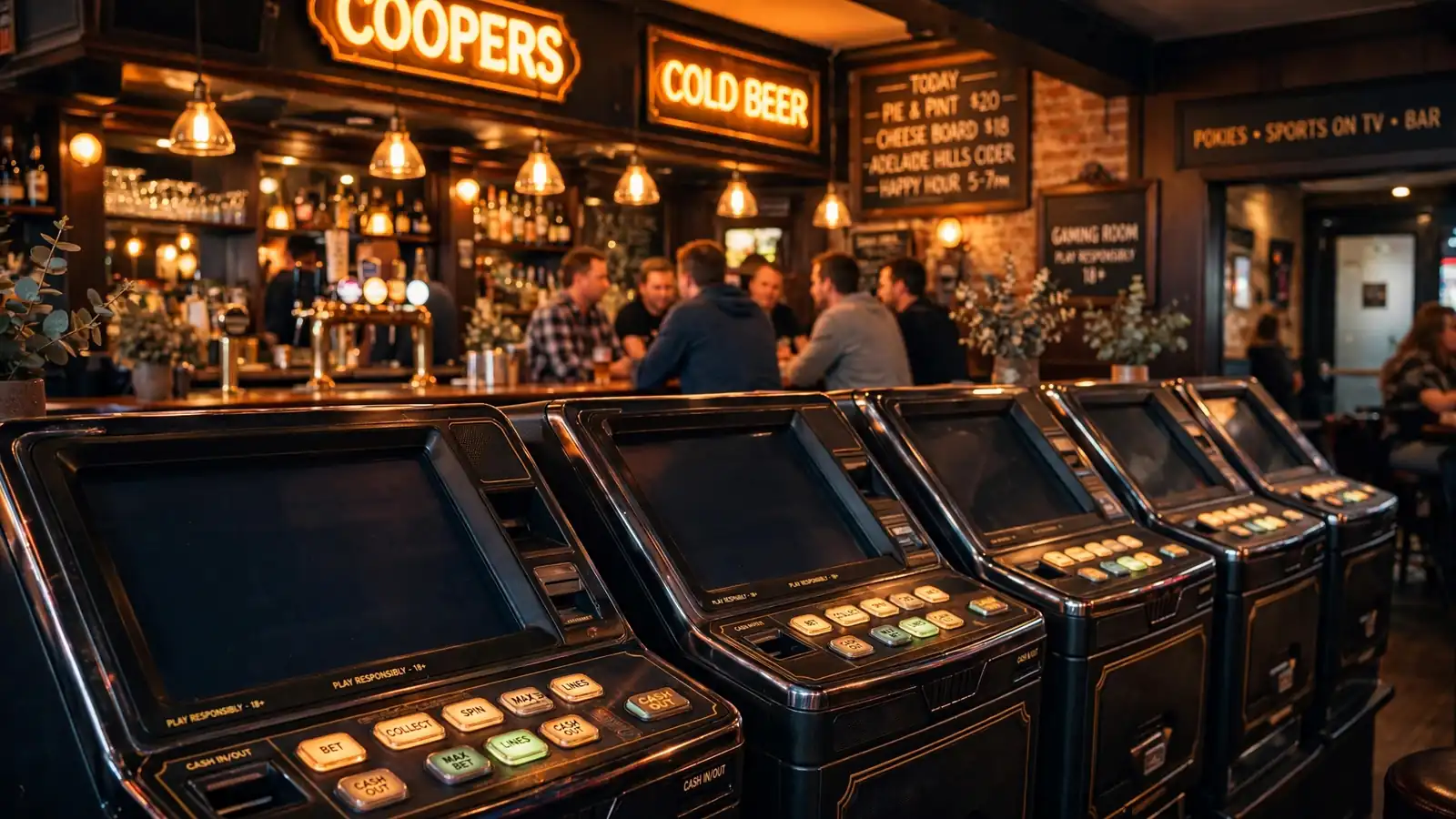
The wider culture of gambling has long made room for playful disguises: a game can borrow casino imagery without answering every question that imagery raises. Online, that can leave “social” doing more work than it should. It is a description, not a verdict on licensing, and certainly not a guarantee about the nature of play.
The missing domestic casino is therefore not a minor technical footnote to a Melbourne-themed page or a social label. It is the context that keeps those phrases from being mistaken for something they cannot establish. Familiar words are not credentials.
A New Web Pokie Is Not Necessarily a Different Game
A fresh listing can look like a fresh game. The title may appear in a new catalogue, or an older pokie may turn up under a different casino’s name for its collection. But a change of setting or storefront does not, by itself, establish that the underlying game has changed.
There is a less visible distinction: some providers allow casinos to choose from several return-to-player settings for the same pokie. A specialist review reports that this can mean one game has different return percentages at different casinos. The title and play may look familiar while the selected setting differs. That is a configuration choice, not necessarily a new version of the game.
The word “return” can invite an overly tidy interpretation. RTP is a percentage associated with a game setting, not a promise about what an individual session will return. Nor does the appearance of a new web listing disclose which setting has been selected. A catalogue entry may identify a title; it need not explain the configuration behind it.

That leaves a gap between what is visible and what is knowable from a page of game tiles. A familiar name cannot confirm that two listings use the same setting, and a different-looking listing cannot prove that the underlying game has changed. Where the selected RTP is not stated clearly, the percentage cannot be read from the title or guessed from the way the game is presented.
Payment details do not fill that gap. A deposit route says how funds are sent; it does not establish a game’s RTP setting, fairness or transparency. Treating one as evidence for the other confuses separate parts of an online service.
The appeal of new Australian web pokies is easy to understand: novelty is a powerful part of how digital catalogues keep attention moving. Yet “new” may describe the listing, not the mathematics beneath it. And “fun” is a judgement about experience, not a measurable property that settles what configuration is in use.
The distinction is modest, but useful. A game’s name can stay the same while its selected return setting varies between casinos; a new entry can also be only a new presentation of an existing title. Without clear information about the setting, neither impression settles the question. A catalogue is not a specification sheet.
Pokies and the Public Rules Around Gaming Machines
Aussie pokies belong to more than a vocabulary of games. In physical venues, they sit within a public set of rules about who is present, what must be recorded and how a venue responds when gambling appears to be causing harm. That setting is different from the language of online play: the obligations described here concern gaming-machine venues.
A report by regionriverina.com.au says that, from 1 July, a venue operating more than 20 gaming machines must have a dedicated responsible gambling officer (RGO) on duty for as long as those machines are running. The role places a named responsibility inside the venue rather than leaving concern about gambling harm as an abstract policy. The requirement is tied to the machines’ operating hours, not simply to the venue’s general opening.
The same report describes a one-month grace period for venues to remove signage and put responsible gambling officers in place. That transition period recognises the practical work involved in changing a venue’s arrangements. It also makes clear that the new duty is not just a matter of placing a title on a roster; the premises and the people responsible for oversight must be brought into line.
Venues are also to keep a gambling incident register. It is intended to capture details of occurrences, including situations in which a patron’s behaviour suggests they may be at risk of gambling harm or already affected by it. A register turns an encounter that might otherwise pass as an isolated moment into something the venue is required to document. The rule makes attention to distress part of the institution’s record, not merely an individual employee’s recollection.
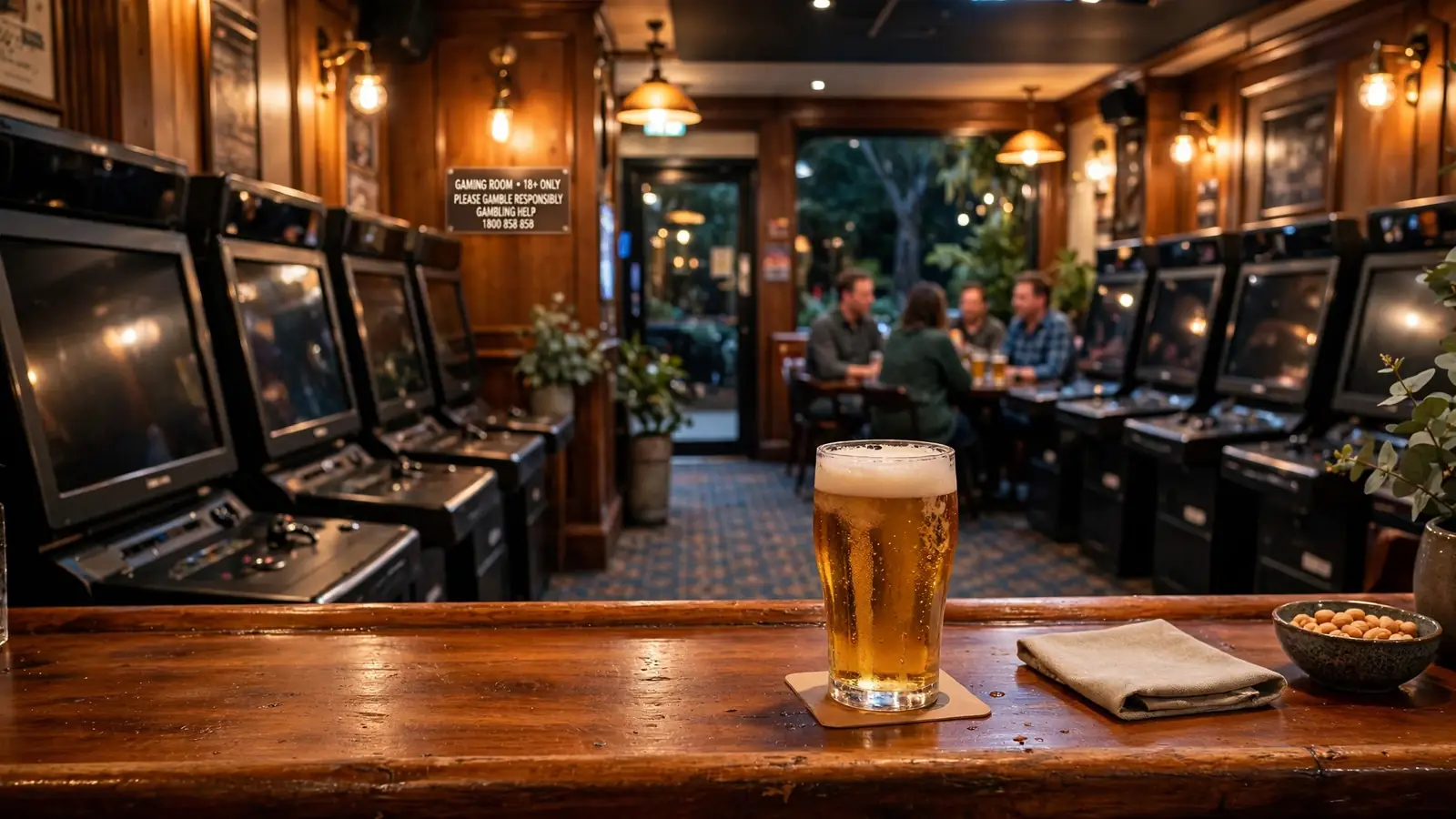
There is an understated shift in this approach. Gaming machines are not treated solely as equipment or entertainment: the setting in which they operate acquires duties of observation and response. An officer on duty and a written record cannot settle every question about harm. They can, however, make responsibility more visible.
Paperwork has a purpose.
Bonus Credit and the Arithmetic Behind the Offer
Bonus credit is not the same thing as withdrawable money. Its value depends on the wagering requirement attached to it: the amount that must be bet before winnings become eligible for withdrawal. The multiplier can apply to the bonus alone or to the deposit and bonus together. That distinction changes the arithmetic substantially.
One specialist review describes a requirement of 35x or lower as a more tolerable benchmark and calls anything above 40x punishing. Those are the review’s judgements, not a universal measure of fairness. The essential detail is what the multiplier applies to. A large-looking credit can carry a large obligation behind it.
Consider a $500 bonus with a 40x requirement applied to the bonus. The calculation is $500 multiplied by 40, producing $20,000 in required bets before any winnings can be withdrawn. The balance shown on screen is therefore not a sum that can simply be collected. It is conditional credit, tied to repeated play and the terms governing that play.
Bonus Requirement Calculation
Determine if the multiplier applies only to the bonus (e.g., $500) or to the combined deposit and bonus (e.g., $1,000).
Multiply that base amount by the wagering requirement (e.g., $500 × 40 or $1,000 × 35).
Calculate the final sum of required bets (e.g., $20,000 or $35,000) that must be placed before winnings are withdrawable.
The base changes when the requirement covers the deposit as well as the bonus. With a $500 deposit and a $500 bonus, the combined $1,000 multiplied by 35 produces $35,000 in required bets. The lower multiplier does not make this lighter than the first example: the amount it acts on is twice as large. Small print, large consequences.
That is why a bonus is best understood through its complete formula rather than its headline value. The key questions are whether the turnover applies to the bonus alone or to the combined amount, and what must happen before withdrawal is permitted. Without that distinction, two offers with different-looking multipliers cannot be compared sensibly.
Free spins have their own condition to inspect. A specialist review notes that winnings from them may be subject to a cash-out cap. A winning spin can therefore add less to a withdrawable balance than its displayed result suggests. Credit, turnover and any cap belong to the same calculation; none is merely decorative.
The arithmetic is plain. The offer is not.
Why a ‘Top’ Pokie Cannot Be Named Here
Choosing an online pokies site in Australia means weighing practical details such as payment options and licensing information. This list offers a concise reference to the details available for each operator.
License: Curacao · Payout speed: crypto 30-60 minutes, fiat 1-5 days · Min. deposit: A$10 Wild Tokyo lists a A$10 minimum deposit and provides separate payout estimates for crypto and fiat: 30–60 minutes and 1–5 days, respectively. Its stated licence is Curacao.
License: Curacao Golden Pokies lists a Curacao licence. That licensing detail is the available basis for including it in this reference.
License: international iGaming licence – jurisdiction not named in the source · Payout speed: PayID 1-24 hours · Min. deposit: A$30 (PayID from A$10) House of Pokies lists PayID payouts in 1–24 hours and a A$30 minimum deposit, reduced to A$10 for PayID. Its source describes the licence as international iGaming but does not name the jurisdiction.
License: Curacao eGaming (Dama N.V.) JeetCity Casino lists a Curacao eGaming licence held by Dama N.V. That licence information is its notable detail here.
License: Curacao Gaming Control Board JustCasino lists a Curacao Gaming Control Board licence. This licensing information is the available detail for this reference card.
License: Curacao Gaming Control Board OGL/2023/176/0095 (Hollycorn N.V.) Rollero Casino lists Curacao Gaming Control Board licence OGL/2023/176/0095, held by Hollycorn N.V. Its licence reference is the notable detail provided.
License: Curacao (operating since 2017) · Min. deposit: A$20 Uptown Pokies lists a Curacao licence and says it has operated since 2017. Its minimum deposit is A$20.
License: Curacao Gaming Authority (Jumpman Gaming Ltd) DragonSlots Casino lists a Curacao Gaming Authority licence held by Jumpman Gaming Ltd. That licensing detail is the information available here.
License: Curacao Gaming Control Board OGL/2023/176/0095 (Hollycorn N.V.) Neospin lists Curacao Gaming Control Board licence OGL/2023/176/0095, held by Hollycorn N.V. Its licence reference is the notable detail provided.
Payout speed: crypto under 1 hour, PayID 1-3 business days · Min. deposit: A$20 (A$30 to qualify for the bonus) Ricky Casino lists crypto payouts in under 1 hour and PayID payouts in 1–3 business days. Its minimum deposit is A$20, or A$30 to qualify for the bonus.
A title can be called “top” for many reasons: familiarity, presentation, or a run of memorable wins. None of those labels tells what the next spin will do. No particular pokie can be named as the top choice here, and replacing that missing recommendation with a confident-sounding list would turn an uncertain judgement into a false promise.
The reason is not mysterious. Each spin is an independent event, determined by a Random Number Generator. A previous result does not make a win due, and a streak does not establish that a game has become more generous. The machinery offers no narrative arc, however insistently a player may find one in a sequence of outcomes.
That independence also limits what a ranking can mean. A list might express preference, but it cannot make one pokie a reliable route to a better result on the next turn. “Best” is an appealing word because it seems to compress choice into certainty. Here, it cannot do that work.
There is a small cultural comfort in rankings: they make a crowded field look orderly and suggest that someone has already done the difficult choosing. But a ranked label is not a forecast. Without a defensible basis for naming particular games, restraint is more useful than an invented shortlist.
The distinction is plain. A favourite may be personal; a top pick presented as a dependable advantage is another claim altogether. Each spin remains random, whatever its place on a list.
Downloads, Site Blocking and the Limits of Access
A request for pokies in downloadable form can make access sound like a matter of choosing a file or installing software. In Australia, however, the legal landscape is not rearranged by the format through which a gambling service is reached. The regulator responsible for enforcing the Interactive Gambling Act 2001 is the Australian Communications and Media Authority (ACMA).
ACMA maintains a blocklist covering illegal offshore gambling sites. Internet service providers must act on that list, restricting access to the sites it identifies. The mechanism places a public rule between a person and a destination online: the connection is not simply a private arrangement between a user and an offshore operator.
That distinction matters when a site or its games are described as downloadable. A download label does not settle whether the underlying gambling service may lawfully be offered to people in Australia, and it does not remove the role of the regulator or the provider’s obligations. The rules concern the service, not merely the route used to reach it.
Blocking is also a limit on access, not a seal of approval for whatever remains reachable. Nor does a blocked page turn into an invitation to find another route. Australia’s approach is to restrict access to identified illegal offshore gambling services through the systems internet providers operate. A technical detour would not change the nature of the service at the other end.
The language of software suggests a simple transaction: download, install, open. Regulation is less tidy. Here, the state’s boundary is enforced partly through the ordinary infrastructure of internet access, with ACMA setting the blocklist and providers expected to implement it. A download is no exemption.
Can I play pokies for free?
Yes, if a game offers a demo or free-play mode, you can use it to try the controls and see how the game looks. Free spins may instead be promotional, and neither type of play predicts future results.
How do I know if an online casino is safe to play at?
A foreign licence does not mean an online casino is authorised in Australia: no Australian-licensed online casinos exist. If an offshore casino refuses to pay, Australian players have no legal recourse in Australia.
What is the cost-benefit calculation of casino promotions?
Check the wagering requirement and calculate the total bets it demands before you can withdraw. For example, a $500 bonus with 40x wagering requires $20,000 in bets; a 35x requirement on a $500 deposit plus a $500 bonus means $35,000 in bets.
Are online pokies legal for Australian players?
Australians are not criminally liable merely for playing on an offshore site that accepts them. However, offering real-money online pokies to Australians requires a domestic licence, and none have been issued.
Created by the ”Cuntspin Casino” editorial team.