Real-money online pokies in Australia: legal and payment
 Available in AU
Australian players are not criminally liable simply for playing, but offshore operators are not locally licensed.

Table of Contents
- The legal line behind offshore real-money play
- PayID is a payment rail, not a seal of approval
- Playing for money, and what a spin can tell nobody
- When a bonus turns into a large turnover
- Deposits, cards and the cost of getting money in
- What “Australian” means in an offshore market
- Apps, identity checks and the first withdrawal
- Mobile play in the browser, without a separate app claim
- New sites do not remove the withdrawal question
- PNG searches and the limits of the available facts
The legal line behind offshore real-money play
Australia’s rules draw a sharp line between the person playing and the company providing the game. Under the Interactive Gambling Act 2001, offering real-money online pokies to people in Australia without a domestic licence is illegal for an operator. No domestic online-casino licences have been issued. The result is not a local casino market with a licensing ladder to climb, but a prohibition on companies supplying these services to Australians.
That distinction matters because the law does not make the individual player its target. Australians are not criminally liable simply for playing on an offshore site that accepts them. This does not make the operator’s service lawful in Australia, or turn an overseas licence into an Australian one. It means the legal responsibility falls on the business offering the gambling service, not on the person placing a bet.
The difference is easy to blur in casual descriptions of “online pokies in Australia”. The phrase can suggest a domestic industry, subject to local approval and supervision, when the actual arrangement is offshore. A company may be based elsewhere and may refer to a licence issued elsewhere; neither fact supplies the domestic licence that Australian law would require. There is no Australian-licensed online casino.
Choosing an online pokies site for real-money play in Australia means checking the practical details as well as the licence information. This list gives you a concise reference to the details available for each operator.
License: Curacao · Payout speed: crypto 30-60 minutes, fiat 1-5 days · Min. deposit: A$10 Wild Tokyo lists a A$10 minimum deposit and gives separate payout estimates: 30–60 minutes for crypto and 1–5 days for fiat. Its stated licence is Curacao.
License: Curacao Golden Pokies lists a Curacao licence. That is the available operator-specific detail for this reference card.
License: international iGaming licence – jurisdiction not named in the source · Payout speed: PayID 1-24 hours · Min. deposit: A$30 (PayID from A$10) House of Pokies lists PayID payouts of 1–24 hours and a A$30 minimum deposit, reduced to A$10 for PayID. Its source describes the licence as an international iGaming licence but does not name the jurisdiction.
License: Curacao eGaming (Dama N.V.) JeetCity Casino lists a Curacao eGaming licence held by Dama N.V. This provides a specific licensing detail for readers reviewing the operator.
License: Curacao Gaming Control Board JustCasino lists a Curacao Gaming Control Board licence. This is the available operator-specific detail for this reference card.
License: Curacao Gaming Control Board OGL/2023/176/0095 (Hollycorn N.V.) Rollero Casino lists Curacao Gaming Control Board licence OGL/2023/176/0095, held by Hollycorn N.V. The licence reference is a specific detail to consider when reviewing the operator.
License: Curacao (operating since 2017) · Min. deposit: A$20 Uptown Pokies lists a Curacao licence, says it has operated since 2017, and sets a A$20 minimum deposit. These details give readers a concise overview of its stated credentials and entry amount.
License: Curacao Gaming Authority (Jumpman Gaming Ltd) DragonSlots Casino lists a Curacao Gaming Authority licence held by Jumpman Gaming Ltd. This is the available operator-specific detail for this reference card.
License: Curacao Gaming Control Board OGL/2023/176/0095 (Hollycorn N.V.) Neospin lists Curacao Gaming Control Board licence OGL/2023/176/0095, held by Hollycorn N.V. The licence reference is the operator-specific detail available here.
Payout speed: crypto under 1 hour, PayID 1-3 business days · Min. deposit: A$20 (A$30 to qualify for the bonus) Ricky Casino lists crypto payouts in under an hour and PayID payouts in 1–3 business days. Its minimum deposit is A$20, or A$30 to qualify for the bonus.
The Australian Communications and Media Authority, or ACMA, is the principal federal regulator enforcing the Act. Its role includes blocking access to illegal offshore gambling sites. Internet service providers must comply with ACMA’s blocklist, so access can be disrupted even when a site continues to operate beyond Australia. A familiar logo, a working page or an account that remains open does not settle the legal question. Nor does a block mean that every offshore service disappears at once. Enforcement has a practical, uneven edge.
That is the first risk: availability is not the same thing as legal approval. An offshore operator may accept Australian customers while still providing a service that it is not permitted to offer them under Australian law. The player’s lack of criminal liability does not create Australian oversight of the operator, and it does not guarantee that a dispute will be handled by an Australian body.
The sharper consequence appears if the operator refuses to pay winnings. Australian players have no legal recourse in Australia in that situation. The promise of a payout may be made on a screen, but a screen is not a local court or regulator. Where the company is outside the domestic licensing system, the ordinary protections associated with a locally regulated service cannot simply be assumed. Any dispute may be left to the operator’s own process or to remedies available elsewhere, if any apply.
This is not a technical distinction reserved for lawyers. It shapes what “real money” means in this market. A balance shown in an offshore account is not equivalent to money held by an Australian-licensed casino, because there is no such casino. The legal gap is part of the transaction, not a footnote that appears only after something goes wrong. The display can look settled. The jurisdiction is not.

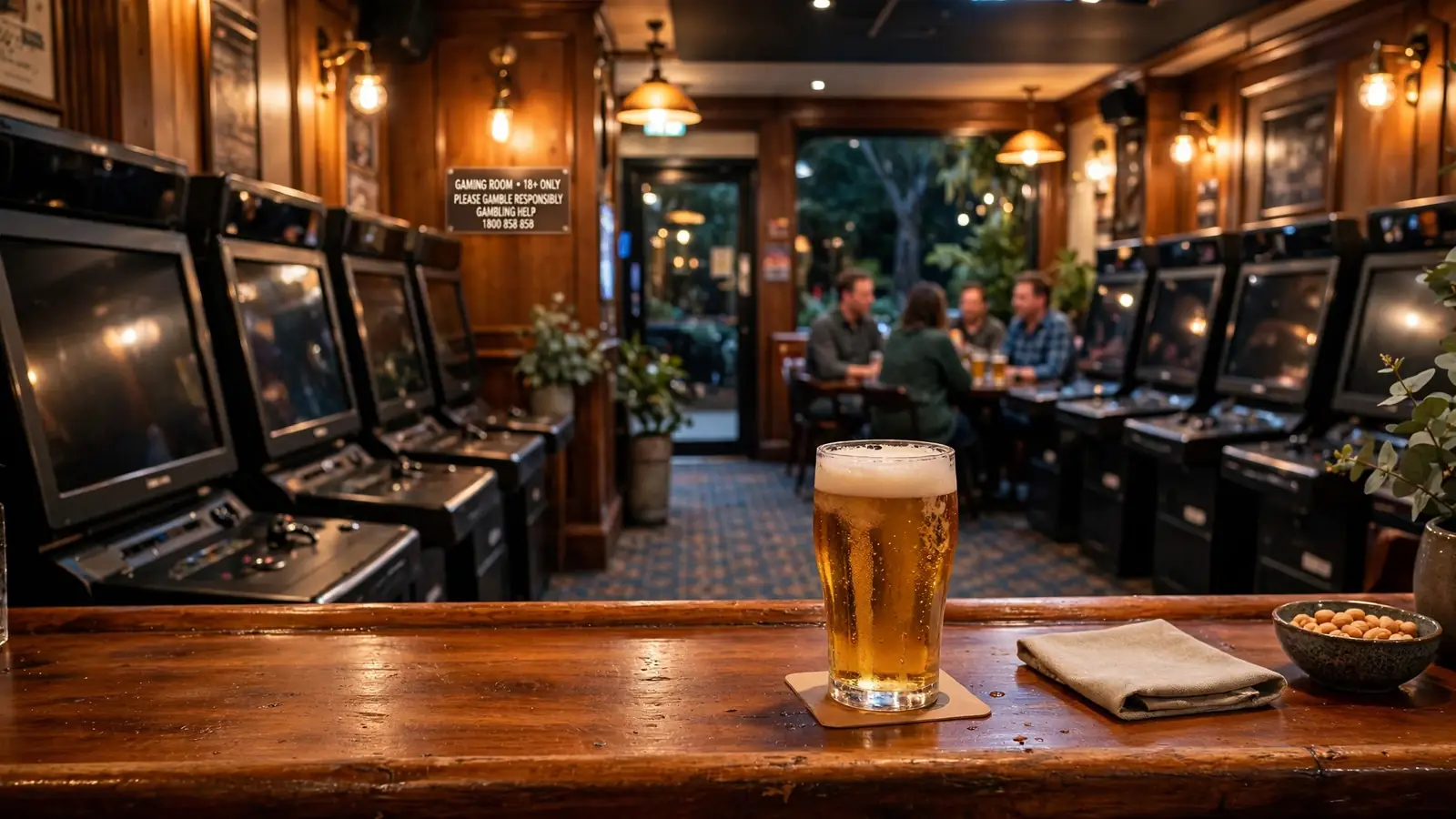
Age rules remain clear: gambling in Australia, including online pokies, is restricted to people aged 18 or older. That requirement does not alter the operator’s position under the Interactive Gambling Act, and it does not bring an offshore casino under Australian licensing. One rule concerns who may gamble; the other concerns which services companies may provide. They are related, but not interchangeable.
The broader policy is revealing. Australia has not built a domestic online-casino system in which operators compete under local licences. Instead, the law prohibits companies from offering these games to people in the country, while the regulator works to restrict access to illegal offshore services. The system places the legal burden on providers and directs enforcement toward them, rather than treating the player as the offender. Yet that arrangement leaves a practical space between prohibition and complete disappearance: offshore sites may still reach, or be reached by, Australians, while offering no Australian legal recourse if a dispute arises.
So the phrase “best online pokies real money Australia 2026” cannot be read as a straightforward request for a choice among locally licensed casinos. There are none. It points instead to offshore play in a market where the law bars operators from supplying the service, ACMA blocks access to illegal sites, and players are not themselves criminally liable merely for playing. Those facts sit together uneasily, but they are not contradictory. The operator’s legal exposure and the player’s practical vulnerability are different matters.
Legal Recourse
Australian players have no legal recourse in Australia if an offshore operator refuses to pay winnings, as these services operate outside the domestic licensing system.
A border crossed by a website is still a border.
PayID is a payment rail, not a seal of approval
PayID is a way to address a bank transfer, not a separate account holding money. It sits on top of Australia’s New Payments Platform (NPP), which carries the payment between participating financial institutions. Instead of entering a long account number and BSB, a sender can use an alias such as an email address, mobile number or Australian Business Number (ABN). The alias points to the account chosen by its owner; it does not replace the account itself.
The NPP is available through all major Australian banks, and transfers on the platform use end-to-end encryption. Those are features of the payment infrastructure. They do not mean that every transfer will be accepted by every bank, or that a merchant using PayID has passed some broader test. A payment rail describes how money can travel. It does not explain what the recipient does with it.
For real-money play at an online casino, PayID must first be linked to a bank account. That link is the practical hinge. A person may have a PayID alias, but a transfer still depends on the account behind it and on the bank’s handling of the particular payment. The alias makes the destination easier to identify; it does not detach the transaction from the bank that holds the funds.

This is where the neatness of the system meets the discretion of institutions. A specialist review reports that some Australian banks, including members of the Big Four, sometimes block PayID transfers when the recipient is recognised as a gambling merchant. The wording matters: this is a report about certain banks and certain recognised recipients, not a guarantee that every transfer will be stopped, nor an assurance that one will proceed. Bank controls can make a payment route available in principle and unavailable in practice.
A blocked transfer is not a defect in the alias itself. PayID can identify a destination correctly while a bank declines to send the money. The payment platform, the account provider and the merchant are separate parts of the chain, and a problem at one point can interrupt the whole journey. For someone trying to play real money pokies online, the distinction between “PayID is supported” and “this transfer will be accepted” is therefore more than technical fine print.
A specialist review also describes PayID as being treated like other qualifying deposit methods at the sites it covers. That is a statement about the way those sites classify a deposit option, not a universal rule for every operator or bank. A method appearing in a cashier menu says what the site says it can receive; it cannot compel a bank to send funds. Payment labels are not magic words.
The Australian habit of using aliases for transfers reflects a wider preference for convenience without abandoning the ordinary bank account. The apparent simplicity can make a payment feel almost frictionless: select a destination, confirm the details, and let the bank process it. But the underlying movement remains a bank-to-merchant transfer. The alias does not anonymise the account from the bank, and it does not create a protected balance separate from the banking relationship.
PayID Nature
PayID is a payment rail that links an alias to a bank account; it is not a separate account or a seal of approval for the recipient.
This is especially relevant when “PayID pokies” is treated as if it named a distinct kind of game or a special class of account. It names a payment route attached to a bank account. The games and the transfer are different things. PayID can be the means by which money reaches a gambling merchant; it does not change what the merchant provides, nor does it establish that a transaction will clear. A deposit button is a request, not a promise.
The same distinction helps explain why the technology’s security features should be read narrowly. Encryption protects information as it moves through the payment system. It is valuable, but it is not a judgement on the recipient, a guarantee of a successful transfer or a seal placed on every service that accepts the method. A secure road can still lead to a destination whose conduct has nothing to do with the road.
PayID is thus neither a loophole in banking controls nor a private wallet floating beyond them. Its convenience comes from linking a simple alias to an account within Australia’s payment infrastructure. That linkage is also why the bank remains part of the decision. The rail can be modern; the gatekeeper is still the bank.

Playing for money, and what a spin can tell nobody
“Playing for money” describes the stake, not a special kind of spin. In real-money play, a person risks funds on an outcome that may return a prize; in a free-play mode, no money is being risked on that spin. The two labels can sit beside the same game, but they describe different conditions of play. A screen may look much the same in either mode. The financial meaning does not.
That distinction matters because familiar imagery can make unlike experiences feel interchangeable. Reels turn, symbols settle, a win animation may flash: the visual grammar is shared. Yet a result shown in a free mode does not establish what would happen in a money-staked spin. Nor does a money-staked result reveal anything about the next one. Similar appearances are not evidence of a shared sequence or a pattern waiting to be decoded.

A pokie spin is generated as a separate random event by a Random Number Generator (RNG). Its independence is the point. The outcome of the previous spin does not tell the RNG what to produce next, and a run of losses does not make a win “due”. A recent win does not make another win more likely, either. Each spin begins without a memory of the last.
That can feel counterintuitive. People are skilled at finding patterns, and games supply plenty of material for the habit: recurring symbols, near misses, streaks and sudden changes in pace. A sequence of results may look like a story with a direction. But the story is being read into the sequence by the mind; it is not a signal that the next outcome has been disclosed in advance.
A near miss is especially persuasive. When symbols fall just short of a winning arrangement, the eye can read intention into the almost-there result. But “nearly” is a description of how the image appears, not a clue about what follows. The RNG does not owe the player completion of a pattern. It has no account to settle.

The same applies to streaks. Several wins in succession may seem to announce a run; several losses may seem to demand an ending. Neither impression provides a dependable forecast. Random sequences can contain clusters that look meaningful precisely because people expect randomness to look evenly distributed, like alternating outcomes. Independence does not promise a tidy rhythm. It means the earlier result is not a basis for predicting the next one.
This is why a history panel, if a game displays one, can describe past outcomes without becoming a map of future ones. Records can answer “what happened?” They cannot, on that basis alone, answer “what happens next?” The distinction is easy to state and less easy to live with when money is at stake. Memory turns a list into a theory; the mechanism does not have to agree.
The question of whether a game is worth playing cannot be answered by treating recent results as evidence of an impending change. Nor does a single spin disclose the overall behaviour of a game. One event is one event. A pleasing outcome is not proof that the next will resemble it, and an unpleasant one is not proof that the next will compensate for it.

The word “random” is sometimes mistaken for “evenly spread across a short session”. It does not mean that every small run will contain a balanced mix of wins and losses. It means the outcome of an individual spin is not determined by the preceding spin. In a short sequence, apparent imbalance can persist without turning into a forecast.
There is also a difference between understanding the mechanism and controlling it. Knowing that an RNG determines outcomes does not give a player a way to influence them. Watching closely, changing a routine or waiting after a loss cannot make the previous result instruct the next one. The ritual may alter the experience of playing, but it does not convert chance into information.
So “online pokies for real money” is a description of play with financial stakes, not a promise that skill can read the reels. Free play can familiarise someone with the look and rhythm of a game, but it cannot serve as a preview of a particular real-money outcome. The visual resemblance is real; predictive value is not.
A spin says what it says when it stops. Nothing more.

When a bonus turns into a large turnover
A bonus is not simply extra money placed beside a balance. Its practical value depends on the conditions attached to it, especially the wagering requirement: the amount that must be bet before bonus-related winnings become withdrawable. The multiplier may look small in a promotion. Applied to a cash amount, it can describe a substantial volume of play.
A specialist review uses 35x or lower as a benchmark to look for and calls requirements above 40x punishing. Those are the review’s judgments, not a guarantee that an offer at a lower multiplier is worthwhile. The amount to which the multiplier applies matters just as much. Terms may calculate turnover against the bonus alone or against the deposit and bonus combined. The distinction is easy to overlook in the headline and expensive to misunderstand.
Consider the stated example of a $500 bonus with a 40x requirement. If the multiplier applies to the bonus, the required turnover is $20,000 before any winnings can be withdrawn. That figure describes bets placed, not a sum that must be deposited, nor a promise that the player will end with money to withdraw. It is the hurdle written into the offer.
Bonus Turnover Calculation
Determine if the multiplier applies to the bonus alone ($500) or the combined deposit and bonus ($1,000).
Multiply the base by the requirement (e.g., 40x for the bonus alone or 35x for the combined amount).
Determine the total betting volume required ($20,000 for the first case or $35,000 for the second) before winnings are withdrawable.
The calculation changes when the terms apply the multiplier to both deposit and bonus. With a $500 deposit and a $500 bonus, a 35x requirement on the combined $1,000 means $35,000 in bets. The multiplier is lower than in the first example, yet the turnover is greater because the base amount has doubled. A percentage-like figure in a banner cannot explain this on its own; the small print must say what is being multiplied.
This is where bonus language quietly shifts the frame. The headline describes what is offered. The terms define what must happen before that offer can be converted into withdrawable funds. “Bonus” sounds like an addition; a turnover condition makes it a contract about future activity. The arithmetic is less glamorous than the banner.
Free-spin promotions have a different-looking entrance but can carry a related restriction. A specialist review notes that an offer may cap the winnings that can be cashed out from free spins. In that case, the result shown during play is not necessarily the amount eligible for withdrawal: the cap sets a ceiling under the promotion’s terms. The exact limit needs to be read in the offer itself; no universal cap can be assumed.
That distinction also matters when a promotion is described as a chance to win real money on online pokies. The phrase does not tell how turnover is calculated, whether the deposit is included, or whether free-spin winnings are capped. A free-play label and a free-spin offer are not interchangeable descriptions of what can be withdrawn. The terms, not the promotional shorthand, determine what the offer permits.

The useful comparison is therefore not between a large headline bonus and a small one. It is between the amount used in the calculation, the multiplier applied to it, and any ceiling on cash-out. Those details turn a promotional figure into a practical obligation. The banner can wait. The arithmetic cannot.
Deposits, cards and the cost of getting money in
A small minimum deposit can make an offshore account appear inexpensive to fund. A specialist review reports that many operators set minimums between AU$10 and AU$20, while some accept AU$5. Those figures describe the threshold for a transaction, not its full cost: the bank or card issuer may apply charges of its own, and a payment can be declined before any account balance changes.
Card deposits carry a particular uncertainty. A specialist review notes that a credit or debit card payment for gambling may be processed as a cash advance rather than an ordinary purchase. In that case, a fee of 3–5% may apply, and interest may start immediately. The final cost can therefore exceed the amount deposited, even when the operator itself lists no deposit fee. The classification is made by the financial institution, not necessarily by the gambling site, so the payment screen may not tell the whole story.
There is another obstacle before fees enter the picture. A specialist review reports that Australian banks and card companies are increasingly blocking transactions to known gambling sites. A declined payment is not proof of a technical fault, nor does a successful one establish anything about the recipient. The bank’s decision is a separate part of the transaction, and its policies can change.
Attention: Card deposits may be processed as cash advances by financial institutions, potentially incurring fees of 3–5% and immediate interest.
E-wallets such as Skrill and Neteller are described as popular for their speed and relative anonymity in a specialist review. “Relative” matters: an intermediary can change how a transfer is made, but it does not make the movement of money invisible or remove the operator’s terms. Nor does the availability of a payment method settle whether a deposit will be accepted, returned, or subject to checks.
The language of “no deposit” can also muddy the arithmetic. A real-money account still involves money entering an account if a deposit is made; a phrase attached to an offer does not by itself describe the funding conditions. Those conditions sit alongside the minimum amount and the payment route, and may differ between operators. A low entry point is not the same as a low-cost transaction.
This is an awkwardly divided system: the operator sets an account’s minimum, while banks and card issuers can determine whether a payment proceeds and how it is treated. A figure printed beside a deposit button answers only one small question. The charge, classification, or block may belong to another institution entirely.
What “Australian” means in an offshore market
In descriptions of real-money pokies, “Australian” often identifies the people and setting involved: players located in Australia, deposits and losses measured in Australian dollars, and the rules that apply to services offered here. It does not mean there is a domestic online-casino licensing system behind the label. Australia has no licensed online casinos.

That distinction matters because a familiar national label can sound like a guarantee of local oversight. It is not. The Interactive Gambling Act 2001 prohibits operators from providing online casino-style games, including pokies, to people in Australia. The law’s focus is on the provider rather than the individual player, but that does not make an offshore service an Australian-regulated one. Nor does an Australian-facing description establish that a service can be held to account through Australian casino licensing.
The country’s approach to gambling reflects a particular division: land-based venues are subject to domestic rules, while online casino services offered to Australians are prohibited. The Australian Communications and Media Authority enforces the federal law and blocks access to illegal offshore gambling sites. A site’s presence or accessibility at a given moment is not evidence that it has local approval. The label describes the market it seeks to reach, not a licence it holds.
Responsible-gambling controls belong in this picture, but they have limits. Deposit limits, loss limits, session time limits and self-exclusion are familiar tools for containing exposure. They can help structure behaviour; they cannot turn an offshore casino into a locally licensed service or guarantee a remedy if a dispute arises. A control is a boundary within a system, not a substitute for the protections that system lacks.
BetStop requires particular care in this context. It applies to Australian-licensed operators and does not bind offshore casino sites. That difference can make a self-exclusion measure less comprehensive than its name suggests when gambling occurs across different kinds of services. The tool remains meaningful within its scope; the scope is the point.
So “Australian real-money pokies” is best understood as a description of Australian players and the legal environment around them, not as a category of domestically licensed online casinos. The wording may be familiar. The protections are not thereby local.

Apps, identity checks and the first withdrawal
An app changes the route into an account, not the account’s obligations. For anyone considering real-money pokies through an app, the practical checkpoint may arrive not at sign-up or deposit, but when winnings are requested. Access method does not settle identity: the same account can face verification whether it was opened in an app or another way.
A specialist review reports that casinos commonly ask for identity checks before a first withdrawal. The documents described include a photograph of an identity document and proof of address; some operators may also ask for a selfie showing the account holder with that document. These requests are not decorative paperwork. They are a condition that can stand between a balance displayed on screen and money being released.
That distinction matters because “withdrawal available” and “withdrawal completed” describe different stages. A request may be waiting on documents, and a submitted file may still need to be checked. The exact requirements are set by the operator, so the document list should not be treated as universal. Nor does an app’s polished interface establish what evidence will be accepted.

Identity checks can also make the first withdrawal the moment when account details are scrutinised together. A name or address that does not align across account information and documents may invite questions or delay. It is sensible to understand the operator’s stated verification process before putting money into an account; finding out only at cash-out is a poor time for surprises.
There is a further imbalance in offshore play. A player may have supplied sensitive documents to a business operating beyond the ordinary Australian casino framework, while having limited practical recourse if a dispute arises. The ease of uploading a photograph does not answer how the material is handled, how a decision can be challenged, or whether a payout will follow. Convenience is not custody.
The word “app” tends to suggest a self-contained product: install, open, transact. In this setting it can obscure the more consequential relationship, which is between an account holder and an operator deciding whether its evidence is sufficient. A small screen does not make that decision smaller.

Before a first withdrawal, identity and address proof may therefore become part of the process, and sometimes a selfie as well. The app is merely the doorway. The account remains the gate.
Mobile play in the browser, without a separate app claim
A phone changes the size of the screen, not the nature of online play. When a real-money pokie is offered through a mobile browser, the browser is simply the route to the service; it does not turn the game into a different kind of product. Nor does a mobile-friendly page, by itself, establish anything about the operator or the terms attached to play.
That distinction matters in Australia. The Interactive Gambling Act 2001 prohibits operators from providing real-money online casino games, including pokies, to people in Australia without a domestic licence, and no such licences have been issued. The legal position does not shift because a service is opened on a handset rather than a computer. Australians are not criminally liable merely for playing offshore, but an offshore operator’s willingness to accept a player does not supply Australian licensing or local protection.
A browser-based route also should not be confused with a promise of universal access. Whether a particular page works on a particular device depends on the service and the device; no general claim about compatibility or performance follows from the word “mobile.” An app claim would require separate evidence too. The existence of a browser option does not prove that an official app exists, or that one is necessary.
The phone makes the transaction feel closer at hand. That is a design fact of modern life, not evidence that the underlying arrangement has become safer or more accountable. Offshore sites remain subject to access blocking by ACMA, and a site being reachable at one moment is no guarantee that it will remain so.

There is another quiet separation. The screen may shrink, but each pokie spin remains an independent random event determined by a Random Number Generator. A small display does not make outcomes more legible, and a larger one does not make them predictable. The interface can show symbols; it cannot disclose what the next result will be.
Mobile access, then, is best understood as a means of reaching online play, not a mark of approval. A browser is a doorway. Nothing more.
New sites do not remove the withdrawal question
A recently encountered name can feel like a fresh option, but newness is not evidence of better terms, reliable payment or a safer experience. An unfamiliar operator may simply be unfamiliar. The useful distinction is between what looks new and what its written conditions actually allow.
Withdrawal limits deserve particular attention because the amount shown as a balance is not necessarily an amount that can be received at once. A specialist gambling review reports that some casinos set weekly or monthly cash-out ceilings of $5,000–$10,000. Under such a cap, a $50,000 jackpot could be paid in instalments over several years rather than as a single transfer. The figure is not a universal rule; it illustrates how a limit can change the practical meaning of a large win.
The details matter: whether the ceiling applies per week or per month, whether it covers all withdrawal methods, and how the operator treats a balance above the limit. Those are questions of contract, not novelty. A newly discovered site may have terms that are clear, restrictive, or difficult to interpret; its age alone tells none of that.
PayID appearing among the available deposit options does not settle the withdrawal question either. A payment method on the way in says little about the amount or pace permitted on the way out. The relevant conditions are the operator’s stated cash-out rules, including any cap and the unit of time to which it applies.

A name can be new to the market, or merely new to the person who has come across it. Neither version changes a payout ceiling. The balance may be visible all at once; access to it may not be.
PNG searches and the limits of the available facts
A reference to Papua New Guinea can suggest a location, a company’s base or simply a label attached to an online service. Those are not interchangeable things, and the label alone establishes little about who runs a site or which rules apply to it.
For people in Australia, the relevant legal question is whether a company is offering real-money online pokies to Australian residents. The Interactive Gambling Act 2001 prohibits that service unless the operator holds a domestic licence. No domestic licences for online casinos have been issued. A claim that a service is connected with PNG does not create an Australian licence, or alter the Australian rule.
Nor does the wording establish that a particular operator is based in PNG, that it is authorised there, or that its games or payment arrangements meet any particular standard. Those conclusions require evidence about the service itself. A place name in a description is not that evidence.
The distinction matters because internet services can cross borders with little ceremony, while the legal framework does not disappear into the distance with them. Australian rules concern the provision of the service to people in Australia; a foreign location label does not, by itself, answer that question. The name on a page and the legal position are separate matters.
There is no sound basis for treating “PNG” as a shortcut for safety, legality or a different set of protections. The Australian position remains the relevant frame for online pokies offered to people here. A geographic hint is not a licence.
Written by the editors at Cuntspin Casino.