Best Pokies in Sydney: Venues, Hours and Online Limits
 Available in AU
A guide to checking Sydney locations, gaming-room information, online protections and the limits of payout claims.
Table of Contents
- Near Sydney: the Location Question and the Online One
- Online Pokies and the Limits of Australian Protection
- Opening Hours, Machine Hours and the Missing Timetable
- What “Best Paying” Can—and Cannot—Tell About a Pokie
- Airport and North Sydney Searches: What the Evidence Can Confirm
- Crown Sydney: A Venue Search, Not an Online Licence
- Sydney Pokies Venues and the New Duties Around Gaming Rooms
- The 24-Hour Search and the Limits of What Can Be Verified
- Sydney CBD Clubs and Responsible Gambling Measures
- Parkes and the Problem of a Place Name Without a Verified Venue
Near Sydney: the Location Question and the Online One
“Near Sydney” sounds like a simple instruction to geography. In practice, it can point in two different directions: towards a physical place where pokies are available, or towards online play that happens to be sought from Sydney. Those are not interchangeable meanings. A venue has an address; an online service does not become local merely because someone opens it from a local screen.
The distinction matters because the language of proximity is elastic. “Near me” may mean within a short trip, in a familiar part of the city, or simply somewhere that feels easier to reach than an unfamiliar alternative. “Near central Sydney” narrows the imagined map, while a reference to the airport gives it a different centre. Each phrase expresses a practical hope, not proof that a particular venue exists at that point or offers the facilities being sought.
Sydney itself is also a name that can be made untidy by a search box. A request about Sydney, New South Wales, is not automatically a request about every place called Sydney, nor does adding “Victoria” settle what the person had in mind. Location words can be incomplete, misspelled or attached to the wrong place. They are clues about intent, not a reliable substitute for identifying an actual address.
That is one reason a search for pokies around Sydney should not be read as a confirmed local directory. A phrase can bring together people looking for a nearby venue and people looking for online pokies while physically in the area. The words overlap; the questions do not. One concerns where a place is. The other concerns what kind of service is being accessed. Treating them as one subject would make a map appear to answer a question about the internet, or an online result appear to supply a street address.
The difference is not merely technical. A physical venue belongs to the ordinary geography of movement: streets, transport, neighbourhoods and the decisions involved in going out. Online play belongs to a different arrangement, even when it is searched for from the same suburb. The screen brings a remote service into the room, but it does not move that service into Sydney. Convenience has a way of disguising distance.
The legal age for gambling in Australia, including online pokies, is 18. That threshold applies regardless of whether the activity is imagined as a visit to a local venue or as play on a screen. The change in setting does not turn gambling into something for children or make age irrelevant. In this respect, the map and the device arrive at the same boundary.
A local phrase can also conceal several ordinary decisions. Someone may be trying to orient themselves by a familiar district rather than by a street address; someone else may be trying to distinguish Sydney from another place with the same name. A reference to “nearby” is often less a declaration of exact distance than a request for useful bearings. Without an identified venue, those bearings remain a matter of interpretation.
The words “open now” add urgency, but not certainty. They can express a wish to act immediately, yet the phrase itself establishes neither a venue’s location nor its operating arrangements. That is separate from the basic distinction between a physical destination and online activity. A clock in a search phrase does not turn an unconfirmed place into a known one.
The same caution applies when an airport or central district appears in the wording. A named landmark gives the search a point of reference, not a verified answer about what is nearby. The landmark may be the actual destination, a starting point, or simply the nearest name the person knows. Geography in a search box is often approximate; geography on the ground is less forgiving.
So “near Sydney” is best understood as a request for orientation, not as a description that settles the matter. The first question is whether the intended subject is a place to visit or online play from the area. The second is what location the words actually mean. Only after those are separated can the different questions be considered on their own terms. A map cannot do all the work.
Online Pokies and the Limits of Australian Protection
An online pokie can look like a Sydney venue translated onto a screen: familiar reels, a balance displayed in dollars, a button to play for money. Legally, the resemblance is misleading. A website’s Australian audience does not turn it into a local casino, and a Sydney address in its branding does not supply an Australian licence.
The Interactive Gambling Act 2001 prohibits companies from providing real-money online pokies to people in Australia unless they hold a domestic licence. No such licences have been issued. There is no Australian-licensed online casino. The rule is directed at the operator offering the service, not at the individual who plays. Australians are not made criminals simply by playing on an offshore site that accepts them.
That distinction is easy to flatten into a headline: online pokies are illegal. The fuller account is less tidy. The law bars the business from supplying the service here; it does not impose that same prohibition on the player. This does not make offshore gambling an Australian-regulated activity, or bring it within the protections attached to a local venue. A narrow distinction, but an important one.
The difference matters to anyone weighing real-money play from Sydney, whether the offer is dressed up as a casino experience, a no-deposit bonus, or a high-limit game. Those labels describe a promotion or a product, not a change in legal status. An offshore operator does not become licensed in Australia by taking Australian dollars, accepting a local customer, or using language that suggests a connection to a city. A polished interface is not a regulator.
Nor does the absence of player liability amount to a guarantee of safety. Australian law does not give a player a domestic route to recover winnings when an offshore casino refuses to pay. If a dispute arises, the operator is outside the Australian licensing system that might otherwise provide a local avenue for complaint or remedy. The screen may show a balance; the balance is not the same thing as money secured under Australian oversight.
This is the awkward gap in the arrangement. The operator’s conduct is prohibited, yet the player is not punished merely for taking part, and may still find an offshore site willing to accept them. The legal distinction protects neither a disputed payout nor the promise printed beside a play button. It says who the law targets. It does not make the player whole.
For Sydney residents, therefore, “online casino” and “Sydney casino” are not interchangeable descriptions. The first can refer to a remote offshore service, with no Australian online-casino licence behind it; the second may evoke a physical venue, governed by a different set of questions. A website using local imagery does not bridge that divide. Geography in a web address or advertisement is not jurisdiction.
The restraint is deliberate in one sense: Australia has not created a domestic licensing route for real-money online casino games. But a prohibition on operators does not erase demand, and the law’s boundary does not neatly follow the customer from a web page to a payment screen. That is why the legal position can sound contradictory when compressed into a slogan. It is not permission backed by Australian protection. Nor is it a criminal ban on the player.
The practical limit is plain. If an offshore casino withholds winnings, Australian players have no legal recourse in Australia to compel payment. The operator may display terms, support channels and reassuring language, but those are not substitutes for domestic recourse. In this market, the word “online” can carry a great deal of polish and very little local protection.
Legal Recourse
Australian players have no legal recourse in Australia to compel payment if an offshore casino withholds winnings.
Opening Hours, Machine Hours and the Missing Timetable
A venue’s opening time and the hours when its pokies are running are related, but they are not the same piece of information. A hotel, club or other venue may open for food, drinks or other services while its gaming room is not operating. Conversely, a venue’s general opening hours do not, by themselves, confirm that pokies are available throughout that period.
That distinction matters when trying to plan an early or late visit in Sydney. A listing that says a venue is open does not necessarily answer whether its gaming room is open, and a reference to gaming facilities does not establish the hours of machine operation. The wording can appear to promise one continuous schedule where, in practice, the two timetables need to be treated separately.
There is no Sydney-wide timetable that can be inferred from the general rules described here. Nor does a search for pokies available at a particular hour establish that a venue operates then. Exact hours are a venue-level matter; without a current schedule for the named place, an early opening or a late finish should not be assumed. The clock in the search phrase is not a clock on the gaming room door.
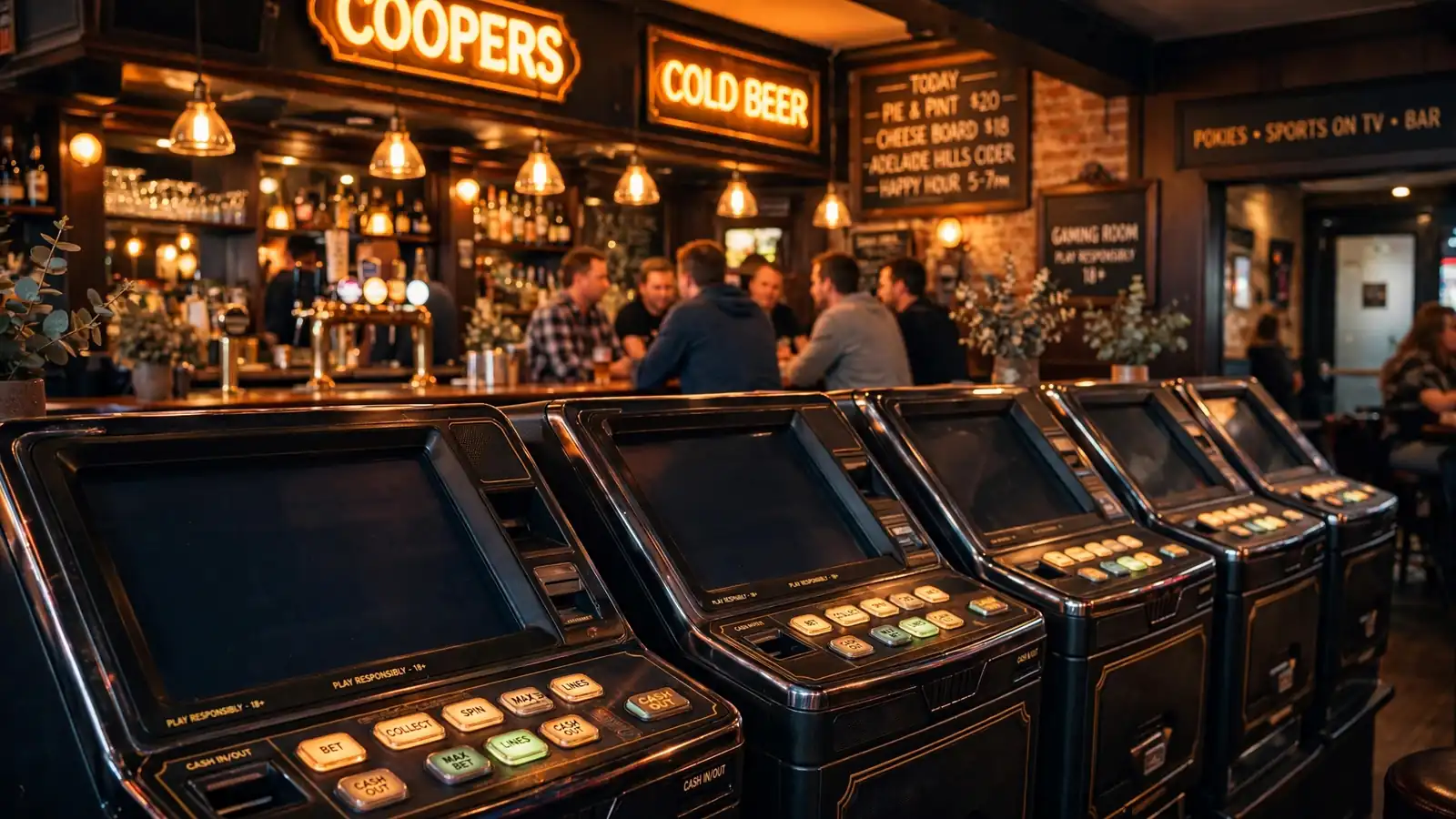
A staffing rule offers one clue about the period in which machines are operating, but not a schedule for any particular premises. A report published by regionriverina.com.au says that, from 1 July, venues operating more than 20 gaming machines are required to have a dedicated Responsible Gambling Officer (RGO) on duty while those machines are in use. This describes a staffing condition tied to machine operation. It does not say when a Sydney venue starts or stops operating its pokies, and it should not be mistaken for permission to operate at any particular hour.
The difference is useful because venue opening hours are often the easiest information to find, while machine hours may be less visible. A restaurant’s service times, a hotel’s general trading hours and a gaming room’s operating schedule answer different questions. A single “open” label cannot reliably stand in for all three.
For anyone comparing a hotel with another kind of venue, the same distinction applies. The word “hotel” identifies a type of premises, not a guaranteed timetable for its pokies. Even a venue that trades late may have gaming-room hours that do not match its broader business hours. And a venue open early in the morning is not, on that fact alone, evidence of early machine operation.
The practical point is modest but important: confirm the gaming-room schedule itself, rather than relying on a venue’s general opening time or on a phrase suggesting that pokies are available late. Where the schedule is not stated clearly, the operating hours remain uncertain. That is not a timetable.
What “Best Paying” Can—and Cannot—Tell About a Pokie
Choosing pokies in Sydney means weighing the details that matter for your own play, including licensing, deposit requirements and payout options. Use these operator notes as a starting point and check the terms that apply before signing up.
License: Curacao · Payout speed: crypto 30-60 minutes, fiat 1-5 days · Min. deposit: A$10 Wild Tokyo lists a A$10 minimum deposit and offers crypto payouts in 30–60 minutes, while fiat payouts take 1–5 days. Its listed licence is Curacao.
License: Curacao Golden Pokies is listed with a Curacao licence. That is the available operator-specific detail for this reference.
License: international iGaming licence – jurisdiction not named in the source · Payout speed: PayID 1-24 hours · Min. deposit: A$30 (PayID from A$10) House of Pokies lists PayID payouts in 1–24 hours and a A$30 minimum deposit, or A$10 when depositing by PayID. Its source describes the licence as an international iGaming licence but does not name the jurisdiction.
License: Curacao eGaming (Dama N.V.) JeetCity Casino lists a Curacao eGaming licence held by Dama N.V. This makes its licensing detail the key factual point available here.
License: Curacao Gaming Control Board JustCasino is listed as licensed by the Curacao Gaming Control Board. No other operator details are provided here.
License: Curacao Gaming Control Board OGL/2023/176/0095 (Hollycorn N.V.) Rollero Casino lists a Curacao Gaming Control Board OGL/2023/176/0095 licence held by Hollycorn N.V. Its stated licence details are the available point of note.
License: Curacao (operating since 2017) · Min. deposit: A$20 Uptown Pokies is listed as operating since 2017 and has a A$20 minimum deposit. Its licence is listed as Curacao.
License: Curacao Gaming Authority (Jumpman Gaming Ltd) DragonSlots Casino lists a Curacao Gaming Authority licence held by Jumpman Gaming Ltd. This is the available operator-specific detail for this reference.
License: Curacao Gaming Control Board OGL/2023/176/0095 (Hollycorn N.V.) Neospin lists a Curacao Gaming Control Board OGL/2023/176/0095 licence held by Hollycorn N.V. Its licensing information is the key factual detail provided here.
Payout speed: crypto under 1 hour, PayID 1-3 business days · Min. deposit: A$20 (A$30 to qualify for the bonus) Ricky Casino lists crypto payouts in under 1 hour and PayID payouts in 1–3 business days. The minimum deposit is A$20, while A$30 is required to qualify for the bonus.
“Best paying” sounds like a stable quality, as though a machine carried a publicly visible promise from one venue to another. With pokies, the phrase is less decisive than it looks. A return figure may describe a particular setting of a game, not an unchanging property that follows it wherever it appears. That distinction matters when a familiar title is treated as proof that a Sydney venue will pay more.
A specialist review reports that some game providers let casinos choose among several return-to-player settings for the same pokie. The title can therefore be identical while its configured return differs between casinos. A figure attached to a game elsewhere cannot, by itself, establish the setting in a Sydney casino. Nor does the game’s name settle what a particular machine is configured to return.
That is a narrow point, but an important one. A return percentage is not a forecast for a visit, and it does not promise that a particular session will produce a particular result. It describes a setting associated with the game, not a personal outcome. Treating it as a cash prediction confuses a broad measure with the uncertainty of individual play.
The machinery behind that uncertainty is the Random Number Generator. Each spin is processed as a separate random event, rather than as a step in a sequence that remembers what happened before. A run of losses does not make a win due; a recent win does not make the next result less likely to win. The machine has no memory in the human sense. It does not owe anyone a correction.
This independence also makes stories about “warming up” or being “ready to pay” poor guides to what happens next. A pattern visible in recent outcomes may feel persuasive, particularly when the money and attention involved make each result vivid. But a sequence does not turn separate random spins into a promise about the next one. Chance is not a ledger balancing itself in public.
For anyone comparing pokies around Sydney, the sensible distinction is between a claim about a game’s return setting and a claim about what a venue will pay. The former may vary when a provider gives casinos a choice of settings; the latter cannot be inferred simply from a title, a rumour, or a result someone recalls. A “best paying” label can sound like a local ranking, but without a confirmed setting for the actual machine, it does not establish that ranking.
The same caution applies to games discussed online. A return figure associated with a pokie does not show that every casino using that game has selected the same setting. It also says nothing certain about the next spin. Those are separate questions: configuration concerns the version in use; randomness concerns the outcome of each play. Neither converts a name into a reliable forecast.
The phrase “best pokies in Sydney” may invite a table of winners, but a game cannot be ranked on a local payout basis merely because its return is advertised or assumed. The details that matter are specific to the setting, while each result remains uncertain. A percentage is not a prophecy.
Airport and North Sydney Searches: What the Evidence Can Confirm
A request for pokies at Sydney Airport sounds precise: it names a place and an activity, and seems to invite a simple answer. But a place name is not a venue listing. Without dependable location-specific information, it cannot establish that pokies are available at the airport, identify a room or machine, or say what conditions apply there. The same restraint applies to North Sydney.

That distinction matters because a plausible-sounding answer can quickly become a false direction. An airport is a recognisable landmark, and “North Sydney” a familiar district name; neither is evidence that a particular gaming venue operates at the named location. Repeating an unconfirmed claim does not make it more useful. It only gives uncertainty the appearance of local knowledge.
The wording can also blur different kinds of places. A person may mean a venue inside an airport, somewhere close to it, or a broader area reached from it. Those are not interchangeable descriptions. Likewise, “North Sydney” may identify a destination in the mind of the person looking, but it does not, by itself, tell whether a result refers to a nearby address, a club, or another kind of venue. The name alone settles none of that.
Sydney City searches carry the same problem. A broad label can cover several possible interpretations, while a result that uses the city name may not establish that its premises are where the wording suggests. A useful location claim needs more than a familiar phrase: it needs a specific venue and a reliable basis for associating that venue with the place. Otherwise, the careful answer remains narrower than the search wording.
The question of a maximum cash payout is narrower still, but it cannot be answered from a suburb or district name. A location does not identify a particular pokie, its settings, or the terms attached to a payout. Nor does the word “maximum” make one figure meaningful across every machine or venue. Without a named, confirmed machine and relevant information about it, a single amount would be guesswork dressed as certainty.
This is not an argument that no such place exists. It is a limit on what can responsibly be asserted. The difference is small in wording and large in consequence: “there are pokies there” directs someone to a real-world destination; “the place name appears in a request” says only what the words say.
The better standard for airport and North Sydney claims is therefore plain: distinguish a confirmed venue from a location someone hopes to find, and do not turn an unverified association into a recommendation. A map pin, a district label or a confident sentence cannot substitute for confirmation. Local detail is valuable precisely because it can be checked. Without that, specificity is theatre.
Crown Sydney: A Venue Search, Not an Online Licence
The name Crown Sydney can point to a place people want to know about; it does not, by itself, describe an online service. That distinction matters because the same word, “casino”, is used for a physical venue and for gambling offered through a website. They may sound like one category in a search box. Legally and practically, they are not interchangeable.
A request for information about pokies at Crown Sydney is a venue question. It concerns what may be found at a particular location. It does not establish which machines are present, how a gaming area is arranged, or what facilities are available. Nor does attaching “best pokies room” to the place name settle what “best” means. It might refer to atmosphere, access, choice or a personal preference; the phrase supplies no measure by itself.
The online version of the question has a different answer. There is no Australian-licensed online casino. A physical casino name appearing on a website, in an advertisement or in a payment description would not create such a licence. A recognisable name is not a regulatory category, and familiarity is no substitute for legal status.
That difference can be obscured by language. People use “casino” as though it named a single kind of business, while the word can describe a building, a gaming room or a remote gambling service. The setting changes the question. A venue search asks about a place; an online-casino search asks whether real-money gambling is lawfully offered over the internet in Australia. One answer cannot simply be carried across to the other.
Crown Sydney, in particular, should not be treated as shorthand for an Australian-licensed online casino. The name alone says nothing about an online product, its authorisation or its connection to a physical venue. That is an important boundary in a market where familiar branding can make unlike things look continuous. Branding travels easily. Legal status does not.
The word “best” adds another small complication. It turns a location question into a judgement, but without a stated criterion it cannot identify a reliable ranking. A room may be “best” to one visitor because of its setting and to another because of something entirely different. The phrase conveys an expectation, not evidence about particular machines or facilities.
So the two meanings should remain separate: Crown Sydney as a place-name in a venue enquiry, and an online casino as a service category for which Australia has no domestic licence. The first does not prove details about a gaming room; the second cannot be inferred from a venue’s name. Same vocabulary. Different questions.
Sydney Pokies Venues and the New Duties Around Gaming Rooms
A venue’s reputation is an easy thing to print and a harder thing to measure. A search for the best pokies venue in Sydney may suggest a contest over machines or atmosphere, but the room also has a less theatrical dimension: the rules governing how a venue responds when gambling appears to be causing harm. Those duties say little about which place is “best”. They say more about what the place must be prepared to notice.
A report by regionriverina.com.au describes a requirement applying from 1 July to venues operating more than 20 gaming machines: a dedicated responsible gambling officer (RGO) must be present while those machines are running. The threshold matters. This is not a blanket description of every room in Sydney; it concerns venues above the stated machine count. Nor is the officer’s duty defined by the venue’s public image. It is tied to the period when the machines are in use.
The same report describes a one-month grace period for venues to remove signage and bring in responsible gambling officers. That interval frames the change as an operational transition, rather than a sign that the new arrangements are already in place everywhere. A venue’s compliance cannot be inferred from a polished website, a familiar name or its position in a list. Governance is less photogenic than a gaming floor, but it is the part that gives a duty its practical meaning.
The report also says venues will have to keep a gambling incident register. The record is intended to capture occurrences that include a patron showing behaviour suggesting they may be at risk of gambling harm or already affected by it. The register turns an impression into something the venue is expected to document: not a diagnosis, but an account of an incident that might otherwise vanish into the noise of an ordinary shift.
Venue Obligations
- Venues with over 20 gaming machines must have a dedicated Responsible Gambling Officer on duty during machine operation.
- A gambling incident register must be kept to document patrons showing signs of gambling harm.
- Compliance is an operational requirement tied to machine use, not a reflection of venue image.
That requirement places responsibility on the institution as well as the individual. Gambling harm is often spoken of as a private misfortune, as though it begins and ends with the person at a machine. A register acknowledges another part of the scene: staff and management may witness signs of difficulty, and the venue has a role in recording what occurs. Paperwork, in this setting, is not quite a cure. It is evidence that someone was expected to pay attention.
For anyone comparing pokies venues in Sydney, these duties offer a more grounded question than a superlative: what obligations apply to the room, and how are they carried out? The reported threshold, staffing requirement and incident records describe venue-level responsibilities, not machine quality or the likely outcome of a session. A rule can require attention. It cannot promise what attention will achieve.
The 24-Hour Search and the Limits of What Can Be Verified
A request for a 24-hour pokie venue in Sydney sounds like a simple matter of finding a door that stays open. The phrase carries a stronger claim than it first appears to: not merely that a venue exists, but that it admits patrons throughout the day and night. Without a current, venue-specific timetable, that claim cannot be made responsibly.
“Open now” is more fragile still. It depends on the time of the search and on whether the information being consulted has been updated. A listing can remain visible after its details have changed; a general description of a venue cannot settle whether it is open at a particular moment. Search results may point towards an answer, but appearance in a result is not confirmation.

That distinction matters because “24-hour pokies” can compress several different things into one phrase: a venue that operates around the clock, a venue with late hours, or a place where someone expects to find pokies at an unusual time. Those are not interchangeable descriptions. Nor does a request for Sydney opening hours establish that any particular venue is open, let alone that it operates without a daily break.
The sensible standard is modest. A current notice issued by the venue, or direct confirmation from it, is more useful than an undated directory entry or a confident snippet detached from its context. Even then, the detail should match the question: general venue access is not automatically a statement about every facility inside. A search for opening hours can produce a tidy answer before the underlying information is tidy at all.
The attraction of the round-the-clock idea is easy to understand. Cities are organised around shifts, flights, late finishes and the stubborn refusal of appetite to follow office hours. But convenience is not evidence. A phrase repeated across listings can acquire the look of a fact without becoming one.
For anyone trying to establish whether a Sydney venue is open at a particular time, the distinction between a broad description and a current confirmation is the useful one. No blanket statement about 24-hour pokies venues in the city should be inferred from the wording of a search or from a stale listing. The clock keeps moving. The listing may not.
Sydney CBD Clubs and Responsible Gambling Measures
Interest in pokies at Sydney CBD clubs often carries an assumption that a venue can be judged by the machines it offers. That is a narrow measure. In gambling settings, the more consequential distinction may be whether play can be bounded, interrupted or stopped. Responsible-gambling tools do not make a pokie predictable; they change the conditions around the person playing it.
Sets a ceiling on the amount of money that can be added to an account.
Defines the specific amount a person is prepared to lose during play.
Makes the time spent gambling visible to prevent it from becoming blurred.
Allows a person to bar themselves from gambling access for a set period or permanently.
Deposit limits put a ceiling on money added to an account. Loss limits address a different point: the amount a person is prepared to lose. Session time limits make time itself visible, a resource easily blurred by repetitive play. Self-exclusion goes further by allowing a person to bar themselves from gambling access for a period or altogether, depending on the arrangements available.
These measures are not interchangeable. A deposit limit can slow the route from bank balance to machine, but it does not necessarily define an acceptable loss. A time limit may end a session without changing how much has been spent. Self-exclusion is the broadest interruption, but it requires a person to choose separation rather than merely a boundary. Each tool works on a different part of the habit.
That distinction matters when club or CBD pokies are being considered. A venue’s name or location says little about how an individual will experience a session, and “best” cannot be inferred from a cluster of machines or a busy room. Safeguards are more useful as questions of control than as badges of quality: what can be limited, what can be paused, and what can be shut off?
There is no virtue in treating a limit as a guarantee. It is a rule set around behaviour, not a forecast of winnings or a correction to the randomness of play. Nor does a tool remove the social character of clubs, where gambling may sit alongside other forms of leisure and routine. The machinery is individual; the setting is shared.
Self-exclusion is especially relevant to people seeking a way to step away from pokies in Sydney. Its practical reach depends on the scheme and setting involved, so the term should not be mistaken for a universal switch covering every gambling service. The useful principle is less dramatic: limits can create friction, and friction can matter. Not a promise. A boundary.
Parkes and the Problem of a Place Name Without a Verified Venue
A place name can do more work in a phrase than it can in reality. “Parkes” beside “Sydney” may look like a location, a suburb, a venue name or simply two terms brought together; the wording alone cannot settle which. Nor does the appearance of “pokies” establish that machines are available at a particular address.
That distinction matters when “best pokies in Sydney” is treated as a request for a local recommendation. A ranking would need identifiable venues and a basis for comparing them. A place label, however suggestive, supplies neither. It is not evidence of a club, a gaming room or a machine, and it cannot support a claim that a venue belongs among the city’s best.
The same caution applies to Parkes. Pairing it with Sydney does not verify a Sydney-area venue called Parkes, or show that a venue in Parkes offers pokies. Turning that phrase into a confident location claim would give a few words the authority of a directory entry. They have not earned it.
There is a small civic lesson here. Places are not interchangeable tags: a name may point to a neighbourhood, a town, a business or an error of association. In a subject where people may travel, spend money or make plans, the difference between a label and an address is not pedantic. It is the difference between a lead and a fact.
For anyone comparing Sydney venues, useful information would identify the venue itself and state what is actually available there. Without that connection, “pokies in Parkes, Sydney” remains ambiguous wording, not a dependable description of a place. It should not be dressed up as a verified listing, still less as a recommendation.
The city’s reputation cannot fill the gap. “Sydney pokies” may sound like a settled category, but a broad location and a gaming term do not identify a particular room or establish its facilities. A name is a beginning, not a map.
Are online pokies legal for Australian players?
Yes, Australians can legally play on offshore sites that accept them, but companies cannot legally offer real-money online pokies to Australians without a domestic licence, and no such licences have been issued. Players have no legal recourse in Australia if an offshore casino refuses to pay.
Are online pokies rigged?
Each spin is an independent random event determined by a Random Number Generator. However, some providers let casinos choose between different RTP settings for the same game, so the return percentage may vary between casinos.
What is the cost-benefit calculation of casino promotions?
Check the wagering requirement and calculate the total bets needed before withdrawing. For example, a $500 bonus with a 40x requirement means $20,000 in bets; if the requirement applies to a $500 deposit plus a $500 bonus at 35x, it means $35,000 in bets.
What is the best payment method for fast withdrawals in Australia?
Skrill and Neteller are popular e-wallets because of their speed and relative anonymity. PayID is another transfer option, but some Australian banks block transfers to known gambling merchants.
What does “wagering requirement” actually mean?
It is the turnover multiplier that sets how much you must bet before bonus-related winnings can be withdrawn. A $500 bonus with a 40x requirement, for example, requires $20,000 in bets.
Published by the Cuntspin Casino team.