Bitcoin Cash Casinos in Australia: Law and Access
 Available in AU
BCH acceptance confirms a payment option, not Australian authorisation or player protection; the guide separates those questions.

Table of Contents
- The Online Casino Question Begins With Australian Law
- What “Best” Can Mean When No Australian Licence Exists
- Choosing an Offshore BCH Casino Without Mistaking Access for Protection
- Bonuses, Slots and the Deposit Conditions Behind the Offer
- Which Casinos Accept BCH—and What the Evidence Can Actually Confirm
- Casino Games and the Boundary Set by the Interactive Gambling Act
- Crypto Withdrawals: Processing, Confirmations and the Wallet
- Starting a Session: Deposits, Detection and Irreversible Transfers
- Slots and the Limits of What Can Be Verified
- Live Dealers, Offshore Offers and the Same Legal Boundary
The Online Casino Question Begins With Australian Law
A search for a Bitcoin Cash casino in Australia can sound like a question about payment: which site takes BCH, and how might a deposit work? But the first distinction is legal, not technical. Australian law focuses chiefly on the business offering online casino gambling to people in Australia. The currency named on a payment page does not settle that question.
The central law is the Interactive Gambling Act 2001. It places the prohibition on the entity providing the service, rather than making the Australian player’s act of using an offshore site a crime. An Australian resident is not, simply by playing at an offshore-licensed online casino, breaking the law. That distinction matters: the legal exposure described by the Act falls on the operator offering the prohibited service.
This does not mean that online casino gambling has an Australian licensing route waiting to be checked. Australia does not issue a domestic licence for online casino games. An offshore licence is issued elsewhere; it is not an Australian authorisation, and the presence of a foreign licence does not create a local one. The operator’s location and paperwork may explain how it presents itself, but they do not alter the basic boundary established by Australian law.
That boundary often gets blurred in ordinary descriptions of offshore gambling. A site may accept Australian customers, display familiar payment options or describe itself as licensed abroad. Those details can make the service feel settled and official. Yet access, a payment method and an overseas licence are different things from permission to provide online casino gambling under Australia’s domestic framework. A polished interface is not a legal category.
The same distinction applies when the proposed payment is Bitcoin Cash. Phrases such as “Bitcoin Cash online casino” or “online casino with BCH” describe a combination of gambling and a payment method; they do not describe a separate legal class. A bitcoin cash casino online is still an online casino service. Whether a site accepts BCH cannot, by itself, answer whether its offer to Australians complies with the Interactive Gambling Act.
That is a useful corrective in a market where payment language can take over the conversation. Crypto may be the most visible feature of a site, especially when its branding is built around digital currencies. But Australian law is concerned here with the service being offered and who offers it, not with the novelty of the token. The payment rail does not turn an online casino into something outside the law’s scope.
There is also a difference between the legality of an operator’s conduct and the position of an individual player. The Act’s focus on providers does not amount to a declaration that offshore casinos are locally approved. Nor does the absence of a player-side prohibition amount to a recommendation to use such a service. These are separate statements: one identifies where the law places its restriction; the other identifies what it does not criminalise.
The distinction can seem oddly asymmetrical. A person may not be committing an offence merely by playing at an offshore site, while the business offering the service to Australians faces the law’s prohibition. That is not a contradiction so much as a choice about whom the legislation regulates. The state draws its line around the supply of the service.
For anyone considering a bitcoin cash casino in Australia, this is the context that should come before comparisons of payment features. The phrase “Australian casino” can imply a local operator or domestic approval, neither of which follows simply because a site is reachable from Australia or accepts Australian customers. And “offshore licensed” describes a status in another jurisdiction, not an Australian casino licence.
Legal Distinction
Australian law focuses on the entity providing the online casino service rather than the act of an individual playing at an offshore site.
The practical vocabulary can be misleading. “Bitcoin Cash mobile casino,” “Bitcoin Cash live casino” and “Bitcoin Cash pokies” may sound like distinct products, but adding a device, a live format or a game category does not change the underlying operator question. The legal issue begins with the offer of online casino gambling to people in Australia. The details of how that offer is branded come after.
A foreign licence may matter in the jurisdiction that issued it, but it should not be mistaken for a domestic licence Australia does not provide for online casino games. Meanwhile, the player’s position should not be confused with the operator’s. In this legal arrangement, the prohibition is aimed at the provider, not imposed on the Australian resident merely for playing.
The distinction is narrow, but consequential. Access is not approval. And a payment method is not a licence.
What “Best” Can Mean When No Australian Licence Exists
Use this list as a starting point when considering casinos for a Bitcoin Cash search in Australia. The information provided does not confirm BCH support, so check whether a site accepts BCH before depositing.
License: Curacao · Payout speed: crypto 30-60 minutes, fiat 1-5 days · Min. deposit: A$10 Wild Tokyo lists a Curacao licence and a minimum deposit of A$10. Its stated payout speeds are 30–60 minutes for crypto and 1–5 days for fiat.
License: Curacao Golden Pokies is listed with a Curacao licence.
License: international iGaming licence – jurisdiction not named in the source · Payout speed: PayID 1-24 hours · Min. deposit: A$30 (PayID from A$10) House of Pokies lists an international iGaming licence, though the jurisdiction is not named. Its stated PayID payout time is 1–24 hours, and the minimum deposit is A$30, or A$10 for PayID.
License: Curacao eGaming (Dama N.V.) JeetCity Casino is listed with a Curacao eGaming licence under Dama N.V.
License: Curacao Gaming Control Board JustCasino is listed with a Curacao Gaming Control Board licence.
License: Curacao Gaming Control Board OGL/2023/176/0095 (Hollycorn N.V.) Rollero Casino lists a Curacao Gaming Control Board licence, OGL/2023/176/0095, under Hollycorn N.V.
License: Curacao (operating since 2017) · Min. deposit: A$20 Uptown Pokies is listed as operating since 2017 under a Curacao licence. Its minimum deposit is A$20.
License: Curacao Gaming Authority (Jumpman Gaming Ltd) DragonSlots Casino is listed with a Curacao Gaming Authority licence under Jumpman Gaming Ltd.
License: Curacao Gaming Control Board OGL/2023/176/0095 (Hollycorn N.V.) Neospin lists a Curacao Gaming Control Board licence, OGL/2023/176/0095, under Hollycorn N.V.
Payout speed: crypto under 1 hour, PayID 1-3 business days · Min. deposit: A$20 (A$30 to qualify for the bonus) Ricky Casino lists crypto payouts in under an hour and PayID payouts in 1–3 business days. The minimum deposit is A$20, or A$30 to qualify for the bonus.
“Best” is an awkward word in a market where Australian licensing is not available for online casino games. A comparison of offshore crypto casinos may describe how sites present themselves or organise their services; it cannot turn any of them into Australian-licensed operators. Crypto casinos sit outside Australia’s regulatory framework. The distinction matters because a polished review and a local licence are not two versions of the same reassurance.
The word still has ordinary uses. It can mean that a review finds one site easier to understand than another, or that a particular feature better suits a stated preference. But such judgements are comparisons, not official approvals. A label such as “best online casino with Bitcoin Cash” does not establish that a casino accepts BCH, that its service is authorised in Australia, or that a player receives protections associated with a domestic regulatory system. Those are separate questions, and a ranking cannot answer them by implication.
That separation is especially important when payment language dominates the description. Bitcoin Cash may appear in a site’s headline, in a reviewer’s category, or in a search for a casino accepting the currency. None of those appearances, by itself, settles what the operator actually supports. Nor does a crypto payment option change the regulatory position of the casino service. The currency is a means of payment; it is not a licence.
A “best” claim therefore needs to be read as a limited verdict. What is being compared, and on what grounds? Is the description about payment support, the range of games, or an offer? Is it an independent assessment, an operator’s own presentation, or advertising dressed in the language of review? These distinctions do not certify a site. They help show what kind of statement is being made, and how little the adjective alone can carry.

The Australian setting adds another complication: availability is not the same as permission or protection. The Australian Communications and Media Authority focuses on blocking unlicensed offshore gambling sites, and it has blocked sites and banned operators from Australia. A page that appears in a review, or can be reached at one moment, is not thereby endorsed by the regulator. Nor does a blocked site’s absence from view prove anything about the quality of another one.
Blocking is an instrument of enforcement, not a consumer rating system. It can affect whether an offshore service is accessible from Australia, while leaving the larger question of what “best” means untouched. A comparison may continue to circulate even as access changes. The internet has always been better at preserving claims than guaranteeing their relevance.
This makes rankings of offshore sites a particularly slippery form of guidance. They can place services side by side, but cannot supply the domestic oversight that does not exist for online casino games in Australia. A favourable review is not a local licence; a crypto label is not a regulatory safeguard; and an accessible website is not evidence of approval. These are simple distinctions, though commercial language often works hard to blur them.
For anyone encountering a claim about the best BCH casino online, the useful first move is not to treat “best” as a legal category. It is a reviewer’s or marketer’s judgement, bounded by what that person has actually assessed. The claim can be weighed as a comparison, but not mistaken for a public authority’s decision or a promise of Australian protection.
Attention A favourable review or an accessible website is not evidence of approval or a local licence, as crypto casinos sit outside Australia’s regulatory framework.
That is the limit.
Choosing an Offshore BCH Casino Without Mistaking Access for Protection
An offshore crypto casino may be reachable from Australia, and Australian individuals are not specifically prohibited from using offshore crypto gambling sites. That narrow distinction can sound more reassuring than it is. The Interactive Gambling Act 2001 places its main prohibition on operators offering online casino games to people in Australia; a player’s ability to open a site does not turn the service into an Australian-licensed one.
Australia issues no domestic licence for online casino games. Crypto casinos therefore sit outside the country’s regulatory framework, rather than inside a local system of oversight and recourse. An offshore licence, where a site has one, is not an Australian licence and does not confer Australian regulatory protection. Access is not approval. The distinction is less a loophole than a map of who carries the legal burden.
That matters when comparing what is sometimes described as the best Bitcoin Cash casino in Australia. A polished site, a familiar game category or a cryptocurrency option cannot establish that the service is authorised for Australian residents. Nor should a deposit page be treated as proof that BCH is supported: the currency must be explicitly available for both deposits and withdrawals, and its terms must be checked before funds are sent. A list of Bitcoin Cash casino sites, however carefully arranged, cannot substitute for that verification.
The practical questions are less glamorous than the word “best”. What entity operates the site? Which jurisdiction, if any, issued its licence? What happens if an account is restricted or a payment is disputed? Are the rules for identity checks and withdrawals stated clearly? These questions do not create Australian protections where none exist. They do help distinguish a site’s claims from the protections actually available under Australian law.


Crypto does not change that underlying relationship. Transactions recorded on a blockchain may be traceable, but that record is not the same as a regulator able to resolve a complaint or compel an offshore operator to act. Cryptocurrency prices can also move between deposit and withdrawal, changing the Australian-dollar value of funds or winnings. A balance shown in BCH is not a stable measure of value.
The transfer itself carries a separate risk. Crypto payments are irreversible: sending funds to the wrong address or network can mean permanent loss. Before any transfer, the selected network must match the casino’s stated requirements, and the address must be checked carefully. The casino’s support for BCH withdrawals should be confirmed before depositing; support for deposits alone leaves a player with an obvious problem. Identity documents may also be required before a withdrawal can be processed.
There is no virtue in disguising the boundary. Using a VPN to get around geographic restrictions can breach a casino’s terms and put an account or winnings at risk. Anyone registered with BetStop or a state-based self-exclusion program must also self-exclude directly with each offshore platform; registration in an Australian scheme does not automatically carry across to a foreign site.
For someone weighing a Bitcoin Cash casino deposit, the relevant comparison is therefore not simply bonus against bonus or pokies against table games. It is the difference between a site’s own promises and the safeguards enforceable in Australia. The individual is not specifically barred from using an offshore crypto gambling site, but that absence of a player prohibition should not be mistaken for a local licence, local oversight or consumer protection.
Do
- Verify if BCH is available for both deposits and withdrawals
- Check the required network and address carefully
- Self-exclude directly with each offshore platform
Don’t
- Treat a deposit page as proof that BCH is supported
- Assume a VPN usage complies with casino terms
- Rely on Australian self-exclusion schemes for foreign sites
A door can open without being a safety net.
Bonuses, Slots and the Deposit Conditions Behind the Offer
A Bitcoin Cash welcome bonus can look like extra play, but its value depends on the conditions attached to it. The headline may promise a deposit match or a no-deposit offer; the terms determine whether the bonus can be used, what counts toward wagering, and whether any resulting balance can be withdrawn. No particular BCH bonus or free-pokies offer should be treated as confirmed without checking the operator’s current terms.
The first distinction is between bonus funds and withdrawable cash. A wagering requirement may require qualifying play before bonus-related winnings become eligible for withdrawal. The rule should say which games count and whether different game categories contribute differently. A promotion that mentions slots does not, by itself, establish that every slot contributes equally—or that a particular Bitcoin Cash game is available.
Then come the boundaries. Check for excluded games, maximum cashout conditions and payment methods that disqualify a deposit from a promotion. A casino may set different terms for a bonus-funded balance and for deposited funds; the offer’s wording should make clear which rules apply. If the terms are unclear, the value advertised is not the value established.
What a BCH promotion needs to say
For a Bitcoin Cash casino deposit bonus, the payment clause matters as much as the promotional headline. It should state whether BCH deposits qualify, whether the offer must be claimed, and what happens if the deposit is made using a payment method excluded from the promotion. A bonus advertised on a page is not proof that BCH is an eligible method.
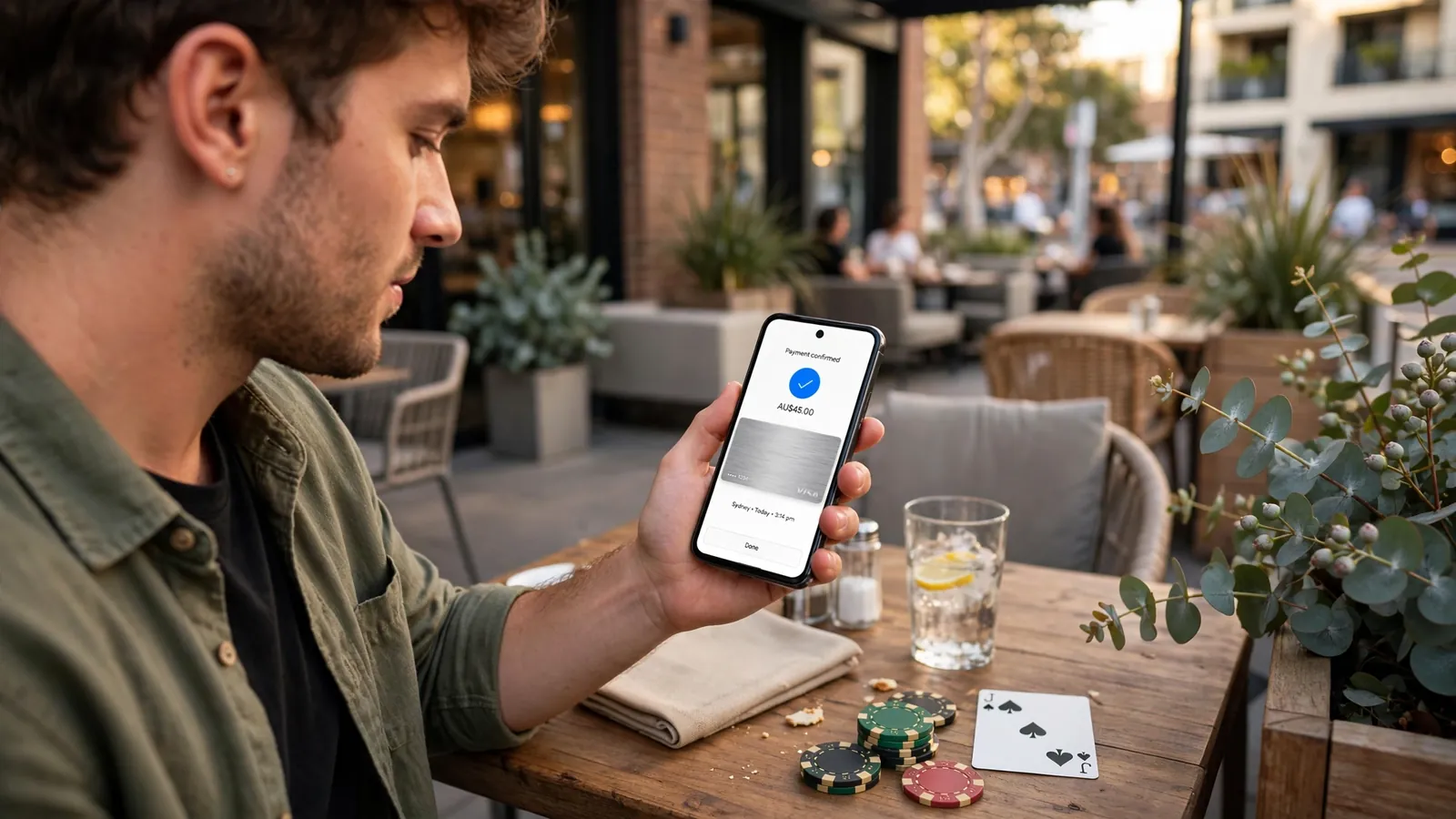
The practical payment arrangement can involve sending cryptocurrency from a personal wallet to an address supplied by the casino, as described in a specialist review. That general description does not confirm that a given operator accepts BCH, or that BCH deposits qualify for a bonus. Cryptocurrency transfers are irreversible; a wrong address or network can mean permanent loss. The value of BCH can also change while funds are held, affecting the deposit’s or winnings’ value in Australian dollars.
“Free” is not the same as unrestricted. A no-deposit Bitcoin Cash offer may still carry wagering conditions, game exclusions or a maximum cashout. The absence of an initial deposit does not remove the need to read the conditions governing play and withdrawal. Nor does the word “free” establish that the promotion is available to Australian residents.
Identity documents must be provided before withdrawals can be processed. A bonus should therefore be assessed alongside the operator’s verification requirements, not as though the advertised balance were immediately payable. People registered with BetStop or a state-based self-exclusion program must self-exclude directly with each offshore platform; registration elsewhere does not do that work on their behalf.
There is a further boundary the promotion cannot soften: Australia does not issue a domestic licence for online casino games, and the Interactive Gambling Act prohibits operators from providing those games to Australian residents. A foreign licence is not Australian authorisation. No bonus changes that position.
Bonus Verification
- Check if BCH deposits qualify for the promotion
- Read the wagering requirements for bonus funds
- Identify any excluded games or maximum cashout limits
- Confirm identity verification requirements for withdrawals
Which Casinos Accept BCH—and What the Evidence Can Actually Confirm
A casino that accepts Bitcoin Cash should say so explicitly in its payment information or cashier. A general “crypto” label is not enough: it does not establish which currencies are supported, whether BCH can be used for deposits, or whether it is also available for withdrawals. Those are separate details, and the word “Bitcoin” should not be treated as shorthand for Bitcoin Cash.
That distinction matters because payment names can look deceptively similar. Bitcoin Cash (BCH) is not Bitcoin (BTC). Selecting the wrong currency or network can send funds somewhere they cannot be recovered. A BCH option should be identified by its full name or ticker, with the required network stated clearly; the address and network need to match before any transfer. Crypto transactions are irreversible, so a mistake may mean permanent loss.
A “Bitcoin Cash casino test” would therefore need to establish more than a logo or a passing mention on a promotional page. The cashier should show BCH as a selectable payment method, and the terms should explain whether it applies to deposits, withdrawals, or both. A claim on a third-party page can become stale or refer to a different currency. The payment screen and the operator’s own terms are the relevant places to check, without assuming that a general crypto claim proves BCH support.
The same standard applies to mobile play. A site’s mobile layout does not establish that its payment options match those on desktop, nor does an app or mobile page make a casino specifically a BCH casino. What matters is whether the payment details available to the account identify Bitcoin Cash and specify the route for using it. A casino with a crypto cashier may still offer only selected currencies.
The legal question is distinct from the cashier question. The Interactive Gambling Act 2001 does not name Bitcoin or cryptocurrency, so BCH does not create a separate category of legal online casino play. The relevant issue is the service being offered, not whether the deposit arrives in dollars or digital currency. A payment method cannot turn an online casino service into something outside the law.

For people in Australia, that distinction is especially important: offshore access and a displayed BCH option should not be mistaken for Australian licensing or protection. Nor does a payment label establish that an operator is entitled to offer casino games to people located in Australia. The legal position attaches to the service and its provider, not to the coin used to pay.
So the answer to “which casino accepts Bitcoin Cash?” cannot responsibly be supplied by substituting a broad crypto claim for a specific BCH confirmation. A named operator belongs in that answer only when its current cashier and terms clearly identify BCH and explain its use. Otherwise, the claim remains just that: a claim.
Casino Games and the Boundary Set by the Interactive Gambling Act
The legal line around casino games in Australia is drawn around the service being offered, not around the name attached to a payment method. The Interactive Gambling Act 2001 treats online casino-style games supplied to people in Australia as prohibited interactive gambling services. That category includes slots, poker, blackjack and roulette. Whether a site labels its games “BCH casino games” or accepts Bitcoin Cash does not change the character of the games or the operator’s position.
The distinction matters because a payment choice can look like the defining feature of an online casino. It is not. Bitcoin Cash may be presented as a deposit method, but it does not turn an online table game into a different kind of service. A game remains casino-style gambling when played with BCH; the relevant legal question is whether an operator is providing that game to people in Australia.

Nor does an Australian licence provide a route for offering online casino games here. The Act prevents operators from supplying those games to Australian residents under a domestic licence. Australia does not have a local licensing path that makes a real-money online casino service lawful by dressing it in familiar regulatory language. The law is less interested in a payment label than in what the business is actually doing.
That is why searches for a Bitcoin Cash casino game can blur two separate matters: whether a site accepts BCH, and whether its games may lawfully be offered to Australians. The first is a question about payment support. The second concerns the operator and the provision of the games. Evidence of one does not answer the other. A cashier listing BCH, for instance, would not establish that a site is authorised to provide slots or table games in Australia.
The same reasoning applies across formats. A poker room does not become legally distinct from an online casino merely because cards replace reels; blackjack and roulette do not escape the category because they imitate a physical table. The statute names these familiar forms of play among the services it prohibits operators from providing to Australian residents. Digital presentation changes the setting, not the legal character.
Promotional language can obscure that boundary. A casino bonus tied to a BCH payment is still an offer attached to casino play; the cryptocurrency does not confer a separate legal status on the promotion or the underlying game. Likewise, “anonymous” branding says nothing about whether the operator may provide casino-style games to people in Australia. Labels are plentiful. Permission is another matter.

The broader cultural habit is to treat a casino as a place, then assume that moving the table onto a screen simply moves the place. Australian law instead looks at the service and its audience. A virtual roulette wheel is still roulette when offered online to an Australian resident, whatever currency sits beside the balance. New payment rails; old boundary.
Crypto Withdrawals: Processing, Confirmations and the Wallet
A withdrawal has two clocks, and they belong to different systems. First, the casino reviews and processes the payout request. Only after it sends the transaction does the blockchain begin recording its progress. A delay at the first stage is not a network delay; a transaction waiting for confirmation is not still being reviewed by the casino. The distinction matters more than the word “instant” on a payment page.
A specialist review of Bitcoin casino withdrawals reported casino-side processing taking 12–48 hours before a payout was sent. That is one review’s account, not a reliable timetable for every operator or a promise about Bitcoin Cash. The same kind of source described Bitcoin payouts reaching a personal wallet within an hour after processing. These are Bitcoin observations, not BCH estimates: different networks have different mechanics, and the available timing figures cannot be transferred to Bitcoin Cash.
Once a Bitcoin transaction has been broadcast, confirmation depends on the network. A specialist review put the time for one confirmation at 10–60 minutes, varying with congestion and the fee paid. It also reported that casinos commonly wait for 1–3 confirmations before crediting funds. Those figures describe reported Bitcoin practice, not a standard applied by every casino, and not a forecast for BCH. The operator sets its own payout and confirmation rules.
Withdrawal Process
The player submits a payout request, which the casino reviews and processes (reported as taking 12–48 hours in some cases).
Once processed, the casino sends the transaction to the blockchain.
The transaction awaits network confirmations (often 1–3) before funds are credited to the personal wallet.
For a Bitcoin Cash casino withdrawal, the useful questions are therefore specific: does the casino support BCH payouts, which network must be used, how does it define processing time, and how many confirmations does it require? Support for BCH deposits does not by itself establish support for withdrawals. Nor does a casino’s use of the word “instant” explain whether it means prompt approval, quick broadcasting or early credit before full confirmation.
The wallet address is part of the transaction, not a clerical detail. A payout request must use an address compatible with the currency and network specified by the casino. A mismatch can send funds somewhere they cannot be recovered. Crypto transfers are irreversible, so a mistaken address or network may mean permanent loss. The price of the asset can also move while a payout is pending, changing its value in Australian dollars even if the number of coins stays the same.
Before a withdrawal can be processed, players must provide identity verification documents. That requirement can create a separate pause before the casino even begins its review of the payout. It is distinct from blockchain confirmation, and calling all waiting time “network speed” obscures who is holding the transaction.
There is no single clock. For BCH, the operator’s stated rules and the selected network are more relevant than Bitcoin timing reported elsewhere. A fast label is not a settlement record.
Starting a Session: Deposits, Detection and Irreversible Transfers
A crypto deposit begins outside the casino: funds move from a personal wallet to an address supplied by the platform. A specialist review describes this wallet-to-address route and notes that transactions are recorded on the blockchain, where they can be checked. That record can show a transfer; it cannot reverse one.

The address and network need careful checking before funds are sent. A mismatch, typo or transfer to the wrong address can mean permanent loss. The casino must also support Bitcoin Cash (BCH) for deposits and withdrawals specifically. Support for another cryptocurrency, or for BCH deposits alone, does not establish that BCH can be used for a later payout. The distinction belongs before the transfer, not after it.
Timing depends partly on what the platform counts as a deposit. A specialist review reports that some casinos make play available once a transaction is detected, before it has received full confirmation. This is not a universal feature, and detection should not be confused with final settlement. The same kind of review describes Bitcoin deposits being credited after blockchain confirmations; that observation concerns Bitcoin and should not be treated as a BCH timing rule. Conditions can vary with the casino and the network.
An apparent balance is not proof that every later step will be frictionless. Identity documents may be required before a withdrawal can be processed, so account verification is part of the practical picture even when the initial deposit is made from a wallet. Someone registered with BetStop or a state-based self-exclusion program must also self-exclude directly at each offshore platform; the registry does not do that on the platform’s behalf.
There is a quieter risk in the exchange rate. The value of BCH can move between purchase, deposit and any later conversion, changing the real-world value of funds or winnings. The blockchain preserves a transaction record, not a stable price and not consumer protection.
Irreversible Transfers
Cryptocurrency transfers are irreversible; sending funds to the wrong address or network can result in permanent loss.
For Australians, access to an offshore site does not make its offer lawful under a local casino licence: Australia does not issue one for online casino games, and the Interactive Gambling Act restricts operators from providing those games to people in Australia. A detected transfer changes a screen. It does not change the legal position.
The first click is the least consequential one. A transfer, once sent to the wrong destination or network, may be final.
Slots and the Limits of What Can Be Verified
Slots are one of the familiar forms of online casino play, but their familiarity does not create a separate legal category. Under Australia’s Interactive Gambling Act 2001, providing online casino-style games to people in Australia is prohibited; slots sit alongside poker, blackjack and roulette within that boundary. The distinction is important: a game’s format does not make an offshore service lawful to offer locally.

That leaves a gap between a phrase such as “Bitcoin Cash casino slots” and something that can be established about a particular site. The phrase suggests both that slots are available and that Bitcoin Cash (BCH) can be used to play them. Neither point follows simply from a site describing itself as a crypto casino. Payment support and game availability are separate claims, and each would need checking against the operator’s own current terms and payment information.
A name, logo or search result is not proof of a trusted BCH casino, still less of an Australian licence. Australia does not issue a domestic licence for online casino games. Calling a site “licensed” without specifying the jurisdiction can obscure the more consequential fact: the Australian prohibition concerns the operator’s provision of these games to people in Australia.
There is also a social history in the word “slots”. A compact game, designed to keep attention moving from one outcome to the next, travels easily across screens and borders. Regulation does not follow the game’s packaging. The legal question remains what is being offered, and to whom.

So claims about Bitcoin Cash slots should be read narrowly. A site may state that it carries slot games or accepts BCH, but those statements do not establish that the service is authorised to provide online casino games in Australia. Nor does the presence of a payment option alter the law governing the game itself.
The category is clear. The endorsement is not.
Live Dealers, Offshore Offers and the Same Legal Boundary
A live-dealer table changes the screen, not the legal category. The dealer may appear by video, cards may be dealt in real time, and a chat window may supply the small theatre of a casino floor. For Australian law, however, the relevant question is still what service is being offered to people in Australia.
The Interactive Gambling Act 2001 places the prohibition on operators: offering certain online casino games to Australian residents is illegal. Putting a human dealer between the camera and the table does not turn an online casino game into something outside that rule. The format is more vivid; the boundary remains.

That distinction matters when offshore sites advertise live tables alongside cryptocurrency payments. A listing for a live-dealer Bitcoin Cash casino, or a claim that a platform accepts BCH, would address separate issues: the game format and a payment method. Neither phrase establishes that the service is lawful to offer in Australia, and a payment option cannot confer Australian authorisation. A polished broadcast is not a licence.
Nor does the appearance of a live table establish that BCH is accepted there. Payment support has to be confirmed for the particular service, and the live format alone says nothing about it. The two features may be presented together in advertising, but they should not be treated as proof of one another.
This is the quiet mismatch in offshore casino marketing: a service can be made to look local, immediate and sociable while remaining an offer from outside Australia’s domestic regulatory framework. The law follows the operator’s conduct, not the atmosphere of the room. A dealer’s greeting may feel personal; the legal test is not.
Are Bitcoin and crypto casinos legal in Australia?
The Interactive Gambling Act 2001 prohibits operators from offering online casino games to Australian residents, and crypto casinos are not licensed in Australia. The Act does not explicitly mention cryptocurrency, and its prohibition is aimed at providers rather than players.
Is it legal for Australian players to use Bitcoin at online casinos?
Australian players are not explicitly prohibited from playing at offshore online casinos using Bitcoin. The Interactive Gambling Act’s prohibition applies to operators offering online casino games to Australians, not to players merely using the service.
What cryptocurrencies do Australian Bitcoin casinos accept?
Bitcoin, Litecoin and Ethereum are referenced as payment options at crypto casinos. Litecoin is widely accepted, while Bitcoin and Ethereum transaction times or fees can vary.
Are winnings from Bitcoin casinos taxable in Australia?
Recreational gambling winnings are generally treated as windfalls and are not taxable in Australia. However, if you later sell cryptocurrency for more than you paid for it, the gain may be subject to capital gains tax.
Which cryptocurrencies can be used at online casinos in Australia?
Bitcoin, Litecoin and Ethereum are referenced as cryptocurrencies used at online casinos. Litecoin is widely accepted across crypto casinos.
Published by the Cuntspin Casino team.