Casinos That Accept PayID in Australia: What to Check
 Available in AU
PayID availability, deposits and withdrawals are distinct from whether an operator may lawfully offer online casino games in Australia.

Table of Contents
- Online Casino Payments in Australia: What the Evidence Can—and Cannot—Say
- PayID-Accepting Sites: A Claim That Needs Checking
- Deposits: The Cashier Details That Are Actually Verified
- What “Accepts PayID” Does—and Does Not—Establish
- Games and Payment Rails Are Separate Questions
- Australian Payment Habits, Beyond the Casino Cashier
- Withdrawals: The Part a Deposit Claim May Leave Out
- Real-Money Play and the Limits of the Payment Question
- Comparing Payment Methods Without Assuming PayID Is Available
- Bonuses and PayID: No Verified Link to Report
Online Casino Payments in Australia: What the Evidence Can—and Cannot—Say
A request for Australian casino sites that accept PayID sounds like a simple question about a cashier. It is not. Naming a particular site as accepting a payment method would make a claim about that operator’s current service. A general discussion of PayID cannot establish that claim, and a list presented as confirmed would say more than can responsibly be said here.
The distinction matters because payment language can lend a service an air of ordinary legitimacy. A familiar method may sound like a sign that a business is established, accessible or appropriate for local customers. It is none of those things by itself. A payment label, even if displayed somewhere, cannot settle the more important question of whether an online casino may lawfully offer real-money games to people in Australia.
That question has a clear legal frame. The Interactive Gambling Act 2001 makes it illegal for operators to provide online casino games to people in Australia. The rule concerns the operator’s conduct; it does not explicitly make a player’s use of an offshore site a criminal offence. Those are separate propositions, and collapsing them into one produces a misleading picture: the absence of an explicit player offence is not permission for an operator to provide the service.
PayID availability is only one part of choosing an online casino. This list gives you a quick reference to the licensing and payment details available for each operator.
License: Curacao · Payout speed: crypto 30-60 minutes, fiat 1-5 days · Min. deposit: A$10 Wild Tokyo lists a A$10 minimum deposit. Its stated payout times are 30–60 minutes for crypto and 1–5 days for fiat.
License: Curacao Golden Pokies is listed with a Curacao licence.
License: international iGaming licence – jurisdiction not named in the source · Payout speed: PayID 1-24 hours · Min. deposit: A$30 (PayID from A$10) House of Pokies lists PayID payouts of 1–24 hours and a A$30 minimum deposit, with PayID deposits from A$10. Its source describes its licence as an international iGaming licence but does not name the jurisdiction.
License: Curacao eGaming (Dama N.V.) JeetCity Casino is listed as operating under the Curacao eGaming licence held by Dama N.V.
License: Curacao Gaming Control Board JustCasino is listed with a Curacao Gaming Control Board licence.
License: Curacao Gaming Control Board OGL/2023/176/0095 (Hollycorn N.V.) Rollero Casino is listed under Curacao Gaming Control Board licence OGL/2023/176/0095, held by Hollycorn N.V.
License: Curacao (operating since 2017) · Min. deposit: A$20 Uptown Pokies is listed as operating since 2017 and has a A$20 minimum deposit. Its stated licence is from Curacao.
License: Curacao Gaming Authority (Jumpman Gaming Ltd) DragonSlots Casino is listed under the Curacao Gaming Authority, with Jumpman Gaming Ltd named as the operator.
License: Curacao Gaming Control Board OGL/2023/176/0095 (Hollycorn N.V.) Neospin is listed under Curacao Gaming Control Board licence OGL/2023/176/0095, held by Hollycorn N.V.
Payout speed: crypto under 1 hour, PayID 1-3 business days · Min. deposit: A$20 (A$30 to qualify for the bonus) Ricky Casino lists crypto payouts in under 1 hour and PayID payouts in 1–3 business days. Its minimum deposit is A$20, or A$30 to qualify for the bonus.
Enforcement falls to the Australian Communications and Media Authority, commonly known as ACMA. Its role sits behind the payment question, whether or not a cashier makes the legal setting visible. Payment methods are commercial details; the law determines what operators may offer to people located in Australia. One does not override the other.
This is why “Australian online casino that accepts PayID” is not simply a matter of finding a familiar brand beside a familiar payment term. The wording can imply a locally available casino service, when the legal framework prohibits operators from offering real-money online casino games to people in Australia. A page that treats a payment method as a shortcut to a suitable site would obscure that distinction rather than clarify it.
There is also a difference between a broad claim and a verifiable one. “PayID is accepted” is incomplete unless it is tied to a particular operator, the relevant service, and the conditions in force at the time. A payment option might be described in general terms without establishing that a casino currently accepts it from Australian customers. Nor does a search result or a repeated label, on its own, demonstrate that the service is available or lawful. The wording can travel further than the fact.
That is the limit of the subject here: no casino can be presented as confirmed to accept PayID on the basis of a general payment-method discussion. The phrase “casinos that accept PayID in Australia” may be a useful description of what someone wants to know, but it is not a finding about any particular operator. Turning it into a ranked list would create certainty where none has been established.

The legal context also changes how a cashier should be read. A payment option is not a licence, a regulatory approval, or an assurance that a service is protected under Australian consumer law. It tells, at most, something about a transaction route claimed by a business. It does not answer whether the business is permitted to offer online casino games to people in Australia. A neat logo is a poor substitute for that distinction.
There is a temptation to treat payment access as the practical definition of availability: if a method appears to work, the service must be there. But access and legality are not synonyms. The Interactive Gambling Act places the prohibition on operators offering the games; the fact that the player is not explicitly criminalised does not reverse that rule. In public life, the burden of a prohibition often sits differently from the burden of enforcement. That distinction is less tidy than a cashier menu.
A useful account of Australian casino payments therefore has to be modest. It can describe the legal boundary and explain why a payment claim should not be mistaken for proof about an operator. It cannot turn an unconfirmed PayID association into a recommendation, nor make a service lawful by describing its cashier. The restraint is not a technicality. It is the point.
Legal Prohibition
The Interactive Gambling Act 2001 makes it illegal for operators to provide online casino games to people in Australia.
PayID-Accepting Sites: A Claim That Needs Checking
A casino’s name beside the word “PayID” can look like a settled fact. It is not. A payment claim only describes a specific arrangement if it can be tied to the operator, the cashier and the terms that apply at the time. Without that connection, a site described as accepting PayID remains a claim, not a dependable account of what an Australian customer can do.
That distinction matters because payment information is not fixed. A method may appear in an old review, a promotional page or a discussion between players, while the cashier presents something different. Even a genuine description of one transaction does not establish that the method is available to every account, or remains available later. The word “accepts” can flatten all of these differences into a reassuring little stamp.
A label is not a working payment route
A mention of PayID does not, by itself, show that a deposit can be completed. It does not demonstrate that the option appears in the cashier, that the payment reaches the intended operator, or that the transaction is handled under the terms being described. Those are separate matters. A payment method’s name can be repeated long after the practical arrangement behind it has changed.


The source of the claim also matters. An operator’s own payment information, a specialist review and a player’s account of a transaction are not interchangeable forms of confirmation. Each may describe a different moment or perspective. A review can be out of date; a player’s experience can be real but limited to one account; an operator’s wording can describe a service without clarifying every condition. None should silently be treated as proof of all the others.
This is not a technical quibble. Money moves through systems governed by providers, financial institutions and the operator’s own arrangements. The visible name of a payment method does not reveal who receives the funds, what conditions apply, or what happens if a transaction is delayed or disputed. A confident label can leave the consequential details in shadow.
“Best” cannot repair an uncertain claim
Rankings of PayID casinos add another layer of certainty without necessarily adding evidence. A list can sort names, award badges and describe a “best” choice, but those formats do not establish that a payment route is available. Nor does a list of games answer a question about deposits. Games and payment arrangements are different subjects, and the presence of one says nothing about the other.
The issue is sharper in Australia because the legal setting is not the one suggested by ordinary language about licensed local casino websites. Under the Interactive Gambling Act 2001, operators are prohibited from providing real-money online casino games to people located in Australia. The law covers casino-style services such as poker, table games and pokies. The Australian Communications and Media Authority is responsible for enforcement.
Consumer Protection
Australian consumer law does not protect people using offshore casinos.
That legal position does not turn a payment claim into a legal approval. A deposit method, even if genuinely offered, says nothing about whether the underlying service is lawful for an operator to provide in Australia. Offshore sites may be accessible in practical terms, but access is not the same as local authorisation or consumer protection. Australian consumer law does not protect people using offshore casinos.
A ranking can make a service look ordinary. The law does not.
What a responsible claim would need to show
A substantiated statement about PayID acceptance would have to be specific about what is being claimed: whether the method is presented in the cashier, whether the information comes from the operator or another source, and whether the wording refers to deposits rather than withdrawals or some broader account function. It would also need to be current enough to describe the arrangement at the time the claim is made.
Those distinctions should not be collapsed into an endorsement. Even a confirmed payment option would establish only a payment detail; it would not establish that a casino is lawful to operate for Australians, that a transaction is protected, or that the service is suitable. Payment convenience is a narrow fact, not a certificate of legitimacy.
Accordingly, naming particular operators as PayID casinos would require reliable, current, site-specific confirmation. Without that, naming or ranking them would give unsupported claims the appearance of verification. The responsible account is narrower: claims about PayID acceptance need checking at the level of the actual operator and arrangement, and a label alone cannot do that work.


Deposits: The Cashier Details That Are Actually Verified
A deposit is not a single action with a universal script. The cashier’s instructions depend on the payment method selected, and a card payment cannot be treated as a template for a bank-linked service. In particular, a PayID label does not, by itself, describe how a transfer is initiated, authorised or credited.
The amount is entered in AUD, rather than left as an unspecified figure in another currency. Amex deposits are described as being processed instantly.
That is a description of a payment flow, not an endorsement of using it. Under Australia’s Interactive Gambling Act 2001, operators must not provide real-money online casino games to people in Australia. A familiar cashier screen does not alter that legal position.
The steps also illustrate why “pay by PayID at a casino” cannot be read as if it were another name for paying by card. A cardholder supplies card details and an amount in the cashier. The useful distinction is modest but important: payment methods have their own procedures.
Some specialist reviews have reported that Amex deposits are available at certain Australian-facing online casinos. That is a time-sensitive account of particular services, not a stable description of the market. It does not establish that every cashier offers Amex, nor that the same payment options will remain available. A method appearing in a review is not a substitute for the terms applying to a particular transaction.
The word “instant” also belongs to the described Amex deposit process alone. It should not be transferred to PayID simply because both may be discussed as ways to fund an account.
Amex Deposit Process
Choose Amex as the payment method in the cashier.
Input the card information and the amount in AUD.
Submit the transaction for instant processing.
Cashiers turn abstract payment labels into practical steps. For Amex, those steps involve selecting the method, entering card information and an AUD amount, and submitting. With PayID, the same details cannot be presumed.
That boundary matters particularly in Australia, where a polished payment interface can make an offshore service look ordinary. The legal restriction applies to the operator providing the online casino service, not just to the wording of a deposit button. A payment option does not make the underlying service lawful or protected.
So the narrow account is the reliable one: Amex has a described cashier sequence and an instant-processing claim attached to deposits. PayID should not be assigned that sequence by analogy. A cashier is specific, not interchangeable.
What “Accepts PayID” Does—and Does Not—Establish
A payment label is a small piece of information with a large shadow. When a casino is described as accepting PayID, the phrase appears to answer a practical question: whether that payment option is available. It does not, by itself, establish who controls the service, what rules govern it, or what happens if a transaction is disputed.
Even the narrow payment claim needs a precise meaning. A method appearing in promotional material is not the same as a confirmed option in a cashier, and an option appearing in a cashier is not proof that every customer can use it. Access can depend on account checks, the customer’s circumstances and the operator’s current terms. Those distinctions matter because payment language often compresses several separate stages into one reassuring verb: accepts.
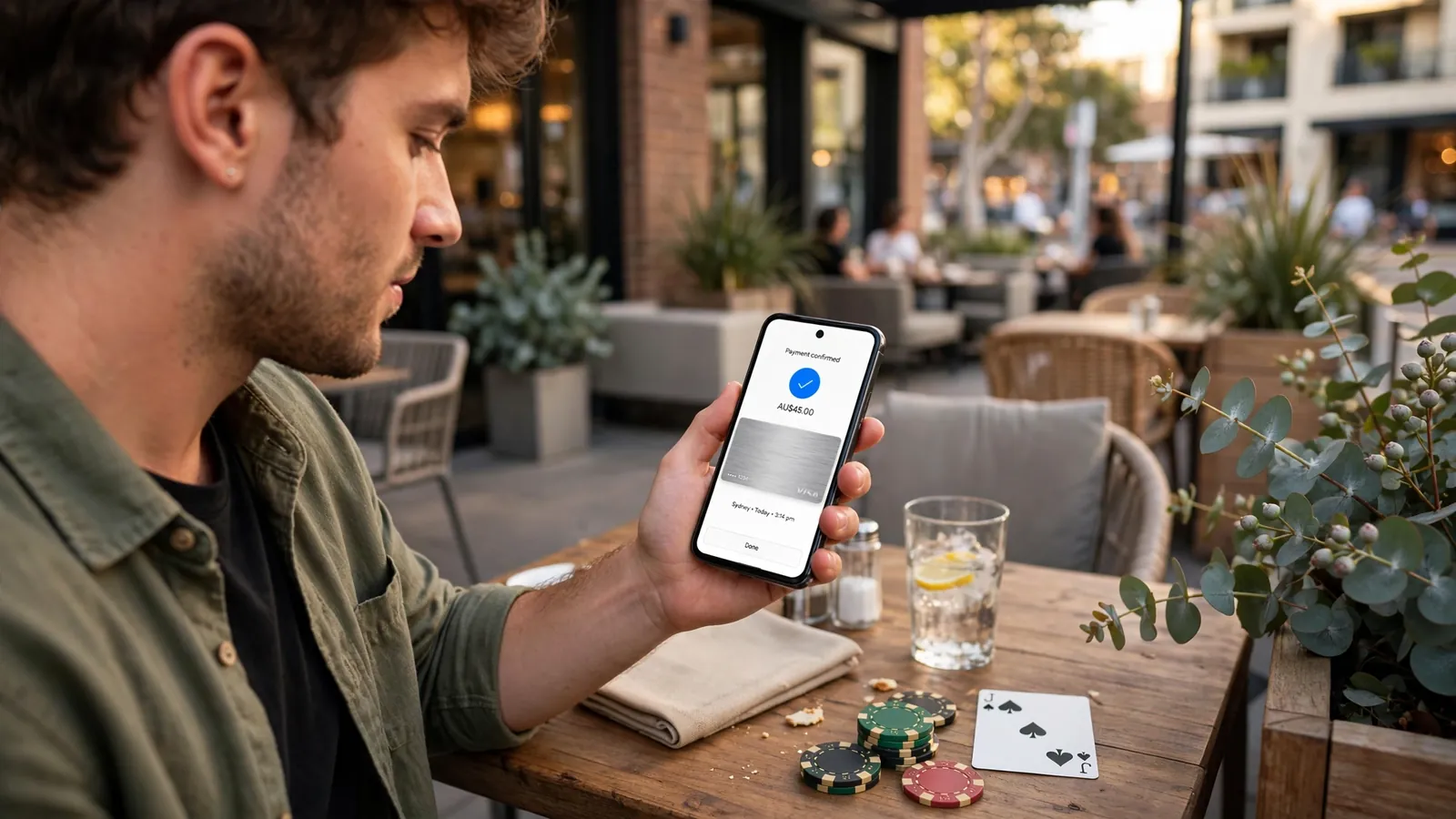
Identity checks are one such stage. Online gambling services commonly ask customers to verify their identity before they can carry out financial transactions. That means a payment label says little about whether an account has passed the checks required by the service, or whether a transaction will be allowed once those checks are considered. The label describes a method, not a completed relationship between a customer, a payment provider and an operator.
Nor does a method’s presence settle the question of where money is held or who is accountable when something goes wrong. A payment service can identify a route for transferring funds; it cannot certify the conduct of the business receiving them. Treating the two as interchangeable gives a cashier button far more authority than it has.
In Australia, that distinction has a particular legal weight. The Interactive Gambling Act 2001 makes it illegal for operators to provide real-money online casino games to people physically in Australia. A payment option does not alter that rule or turn a prohibited service into a lawful one. The Australian Communications and Media Authority enforces the Act. Australian consumer law does not protect players who use offshore casinos. A payment label is no legal shield.
This is not a claim that a player commits an offence merely by using an offshore site; the legal restriction described here is directed at operators providing the service. But the absence of player liability is not the same as consumer protection, nor does it make the service locally regulated. Those are different propositions, and a payment method cannot bridge the gap between them.
Online gambling services commonly require customers to verify their identity before they can carry out financial transactions.
The same caution applies to phrases such as “best” or “trusted” when they are attached to a payment claim. Convenience, familiarity or the presence of a recognised payment brand does not establish that a casino is safe, lawful for Australian residents, or obliged to resolve a complaint under Australian consumer rules. Payment infrastructure and public accountability belong to different ledgers.
So the useful meaning of “accepts PayID” is limited: it is a claim about a payment facility, whose practical availability would need to be confirmed through the service’s own current information. It is not evidence of licensing, regulatory approval, consumer remedies or the legality of the underlying gambling service. A narrow claim should stay narrow.
Games and Payment Rails Are Separate Questions
A payment rail answers a narrow question: how money is moved. A game is a different matter, defined by the service being offered and the rules that govern it. Linking the two in a phrase such as “casino games using PayID” can make them sound like one product, but the payment method does not determine whether the underlying activity is lawful.
That distinction matters in Australia. Under the Interactive Gambling Act 2001, operators may not offer online casino games to people in Australia. The rule concerns the service, not the route by which a deposit might be made. A bank-linked transfer, card payment or digital wallet cannot alter the legal character of an online casino service. The rail is not a permission slip.

This is also why a reference to PayID in a cashier, if one is made, would establish only a payment claim. It would not tell the public what games are offered, how an operator is authorised, or whether the service may lawfully be provided in Australia. Those are separate questions, and collapsing them into a single “PayID casino” label obscures the distinction that regulation is meant to preserve.
The law’s focus is on operators providing the prohibited service to people located in Australia. The Australian Communications and Media Authority is responsible for enforcing the Interactive Gambling Act. In that setting, payment language can give an impression of ordinary retail choice: select a method, complete a transfer, proceed to a product. But the regulatory issue comes before the cashier. It does not begin when money moves.
There is a further asymmetry in the phrase “casino payment options”. It sounds like a neutral menu, while the activity to which the menu is attached is not treated as a permitted online service for Australian residents. A familiar payment instrument may make a transaction seem routine; familiarity is not a legal test. Financial infrastructure and gambling regulation simply answer different questions.
The Act does not explicitly make players criminally liable for using offshore sites. That narrow point should not be mistaken for approval, protection, or a finding that a particular service is lawful. The distinction is between the operator’s prohibition and the player’s position under the Act, not between safer and less safe payment buttons. Nor does the presence of a payment method establish that a service falls outside the law.
Legal vs Practical Access
- The Interactive Gambling Act prohibits operators from offering real-money casino games to people in Australia.
- Payment availability does not equal legal authorisation or consumer protection.
- The ACMA is responsible for enforcing the legal prohibition on operators.
- Absence of explicit player criminalisation is not the same as regulatory approval.
People often encounter payment claims first because they are concrete: a name, a logo, a transfer option. The legal classification is less visible, but more important. A payment route can move funds. It cannot convert a prohibited service into an allowed one. Plainly separate matters.
Australian Payment Habits, Beyond the Casino Cashier
Australian payment culture is not tied to a single piece of plastic or one route through a bank. Contactless credit and debit cards are accepted almost everywhere in the country, making a tap an ordinary part of everyday commerce. Mobile wallets, including Google Pay and Apple Pay, are accepted just as widely. The physical card has not disappeared; it has acquired a digital companion.
That familiarity matters because payment habits are built in ordinary settings: shops, cafés and journeys where people move between a card and a phone without treating the change as a major decision. A wallet can hold a card without carrying its shape. The gesture is simple; the infrastructure behind it is less visible.
People are also comfortable moving among cards, mobile wallets and services connected to bank accounts, such as PayPal. This is a practical kind of flexibility rather than allegiance to one brand or format. Different transactions invite different tools, and consumers have grown accustomed to shifting between them.
PayID belongs to a broader landscape of bank-linked payments, but the existence of that landscape does not show that a particular online service accepts PayID. National familiarity with digital banking and payment choice says something about consumers’ habits. It does not establish the cashier options of an individual business. Those are separate questions.

The distinction is easy to lose because the same words—fast, digital, familiar—can be used to describe very different systems. A contactless card payment in a local shop is not evidence about an online gambling service, and broad use of mobile wallets does not tell us what a casino cashier supports. One describes the surrounding payment culture; the other requires information about a specific operator and its transaction arrangements.
There is a distinctly modern comfort in carrying several ways to pay at once: a card in a pocket, a wallet on a phone, and a bank-linked service ready for online use. That comfort is real, but it is not a blank cheque for inference. Popularity in everyday commerce cannot be carried across unchanged into every sector, still less into a sector whose legal status in Australia is sharply different from routine retail.
A national habit is not a cashier menu. The difference is small in wording and large in consequence.
Withdrawals: The Part a Deposit Claim May Leave Out
A payment method shown for deposits does not, by itself, tell the whole story about getting money out. Cashiers can treat incoming and outgoing transactions differently: a method may be available for adding funds while withdrawals follow separate conditions. That distinction matters whenever a casino is described as supporting a particular payment option.
Do
- Read withdrawal terms independently
- Check for specific payout conditions
- Verify eligible withdrawal methods
Don’t
- Assume deposits and withdrawals use same route
- Infer payout timing from deposit speed
- Assume a deposit label guarantees a payout
Amex provides a documented illustration. A specialist review reports that a withdrawal through Amex may not be available, or may carry an additional fee. It also gives a clearing time of up to five days for Amex casino withdrawals. These are reported conditions, not a guarantee that every operator applies the same process; payment terms can depend on the casino and may change.
There is also a prior-deposit condition: a player must have deposited using Amex before making a withdrawal through it. In other words, the route used to send funds in can affect whether the same route is available on the way out. A deposit confirmation is not a promise of a matching payout method.
The same distinction is important when a cashier advertises PayID for deposits. The presence of PayID on an incoming-payment screen cannot establish that winnings can be withdrawn through PayID, how a withdrawal would be handled, or how long it would take. Those are separate details, not automatic consequences of a deposit option. No timing should be inferred from the word “instant” when it describes a deposit rather than a withdrawal.
Before treating a payment label as a complete account of the transaction, the withdrawal terms need to be read on their own. They may specify eligible methods, fees, or conditions that do not appear beside the deposit button. With Amex, the prior-deposit requirement and the possibility of a fee or unavailable withdrawal make the separation plain.
Money going in is one question. Money coming back is another.

Real-Money Play and the Limits of the Payment Question
A payment label can describe a route for moving money; it cannot determine whether the service receiving it is lawful or what protection follows if something goes wrong. That distinction matters whenever a search for real-money online casino play turns on whether a cashier appears to accept PayID, a debit card or another bank-linked method. The rail is not a licence, a guarantee of access or a substitute for consumer rights.
In Australia, the Interactive Gambling Act 2001 places the central prohibition on operators: offering real-money online casino services to people in the country is unlawful. The Australian Communications and Media Authority (ACMA) is responsible for enforcing that law. Its focus is the provision of the service, not whether a payment button carries a familiar name. A method that appears available does not change the legal character of the underlying offer.
The law does not explicitly make an individual player’s use of an offshore site a criminal offence. That distinction should not be mistaken for a promise of safety. Australian consumer law does not protect people who use offshore casinos. If a dispute arises over an account, a balance or a transaction, the familiar protections attached to domestic consumer dealings cannot simply be assumed to travel with the payment.
A PayID reference, therefore, answers a narrow operational question at most: whether a payment route is being presented. It says nothing by itself about the operator’s status, whether the service may lawfully target Australians, or what recourse exists if the relationship breaks down. Searches for casinos accepting PayID for real-money play often compress all these questions into one. The compression is neat. The consequences are not.
Narrow Conclusion
A payment label describes a transaction route but cannot establish the legality or regulatory protection of a gambling service.
This is not a reason to treat payment convenience as evidence of legitimacy, nor to mistake the absence of explicit player criminalisation for regulatory approval. The statutory arrangement draws a line between the operator’s conduct and the player’s position, while leaving offshore customers outside Australian consumer protections. A transaction can move. Protection may not follow.
Comparing Payment Methods Without Assuming PayID Is Available
A payment method’s familiarity does not establish that a particular casino accepts it. That distinction matters when comparing PayID with card and bank options: availability at a cashier is an operator-specific detail, not a quality that can be inferred from how widely Australians use a service elsewhere.
A specialist review has described Visa as potentially more broadly accepted at Australian online casinos than Amex. That is a qualified comparison, not a guarantee about any individual cashier or a permanent market rule. Amex can also meet an obstacle before a transaction reaches the operator: Australian banks may block gambling-related payments at the issuer level. A card listed by a site, then, may still fail at the bank’s door.
Bank transfers present a different trade-off. A specialist review notes that they may take longer and carry higher fees. Those costs and delays are not fixed across providers, so the category alone cannot predict what a particular transaction would involve. It does, however, caution against treating a bank-linked payment as automatically cheaper or quicker than a card.
PayID is often spoken of as though a familiar bank-linked service must be available wherever a cashier offers other transfer routes. That leap is not warranted. A claim that a casino supports PayID needs confirmation in that operator’s current payment information; neither Visa’s relative reach nor the limitations of Amex establish PayID availability.

The comparisons also have boundaries. They describe reported possibilities, not a recommendation to use an offshore casino or a promise that any payment will work. In Australia, the Interactive Gambling Act 2001 prohibits operators from providing real-money online casino games to people in the country. Australian consumer law does not protect players using offshore casinos. The payment rail is a narrow detail beside that larger legal and consumer-protection question.
Bonuses and PayID: No Verified Link to Report
A payment method and a bonus are separate claims. A cashier label saying PayID, if encountered, would describe a proposed way to move money; it would not establish that a promotion exists, who could qualify for it, or what conditions would apply. The distinction matters because “PayID bonus” can sound like a single product when it actually joins two questions.
The same applies to a no-deposit offer associated with PayID. The phrase alone cannot show that an offer is genuine, available to Australian residents, or connected to a particular payment service. Nor does it explain whether a bonus has conditions attached. Those details belong to the terms of a specific promotion, not to the name of a payment rail.

Bonuses are inducements, and gambling advertising in Australia is subject to restrictions. That setting makes promotional language more than decoration: an offer can be described in ways that leave important limits out of view. A payment brand in a headline does not make the underlying terms clearer, or the service lawful for people in Australia.
This is where the language often does too much work. “PayID casino bonus” compresses a payment claim, a promotional claim and an implication of availability into a few words. None proves the others. The neat phrase is not the same as a complete set of terms.
A careful account therefore cannot attach bonus eligibility, a no-deposit offer or any other inducement to PayID without specific, current terms establishing that connection. No bonus should be inferred from the payment name alone. In this market, the gap between a persuasive label and a usable, lawful offer is not a minor footnote. It is the point.
What are the deposit and withdrawal limits at the best Amex casinos?
Limits are set by each casino and can differ between deposits and withdrawals. Check the casino’s cashier or payment terms for the limits that apply to your account.
Which online casinos accept American Express for deposits?
Jackpot City Casino, Spin Palace, Ruby Fortune, Ignition Casino, Joe Fortune and PlayAmo are listed as supporting Amex deposits. This does not establish that they may lawfully offer online casino games to people in Australia; the Interactive Gambling Act prohibits operators from doing so.
Are there any fees associated with using American Express at online casinos?
Deposits are typically free, but a casino may add a 1.5% surcharge, and Amex cards may incur a 3% currency conversion fee. Withdrawal fees may also apply.
Are there any limits on how much I can deposit or withdraw using American Express?
Yes. Each casino sets its own Amex deposit and withdrawal limits, so check the cashier or payment terms for the limits on your account.
Why does my Amex deposit get declined at some casinos but not others?
Amex or your Australian bank may block gambling transactions to a particular website. Some casinos also do not accept American Express.
Can you use an American Express gift card at an online casino?
Yes, at casinos that accept American Express, but gift cards can be used for deposits only.
Can I withdraw winnings directly to my American Express card?
Not at every casino: some do not allow withdrawals to Amex, and withdrawals generally require that you previously deposited with Amex. Where available, they can take up to five days to clear, and fees may apply.
Are there any fees for depositing with American Express?
Amex deposits are typically free, but a casino may charge a 1.5% surcharge and a 3% currency conversion fee may apply.
Created by the ”Cuntspin Casino” editorial team.