Bonus Buy Slots in Australia: Rules and Features
 Available in AU
A practical look at bonus-buy mechanics, game versions, demo play and the legal boundary around offshore online pokies in Australia.

Table of Contents
- Bonus Buys in a Market That Keeps Its Distance
- Sweet Bonanza’s Versions and the RTP Hidden Behind the Lobby Tile
- What a Bonus Buy Changes—and What It Leaves to Chance
- Where the Bonus-Buy Feature Is Actually Available
- Free Play Is a Test of the Game, Not Its Stakes
- Online Pokies, PayID and the Offshore Boundary
- What Free Demo Spins Can Reveal About a Bonus Buy
- The Bonus Feature, in Sweet Bonanza’s Case
- A Slot With a Buy Feature Still Has a Stake Range
- Choosing a Bonus Buy Without Calling It the Best
Bonus Buys in a Market That Keeps Its Distance
A bonus-buy feature belongs to the machinery of a slot: it offers a route into a bonus round rather than requiring that round to arrive through ordinary play. In Australia, though, the first question is not which game offers the feature. It is where the game is being supplied from, and under what law. The distinction is easy to lose when an offshore website presents itself in familiar language and currency. The legal boundary does not move with the interface.
The Interactive Gambling Act 2001 prohibits operators from offering online pokies to people in Australia. The restriction concerns the service provider, not a separate offence created for an individual who plays at an offshore site: players are not penalised under this rule merely for doing so. That distinction can sound like permission when stripped of its context. It is not a local licensing system for online casinos, nor does it make the operator’s service lawful in Australia.
There is no locally licensed Australian online-pokies market in which a casino can lawfully supply these games to residents. A website may be accessible from an Australian connection and still be operating beyond the domestic framework. The word “licensed”, when used by an offshore operator, refers to a licence elsewhere; it does not turn that business into an Australian-licensed casino. A label is not a jurisdiction.
Bonus-buy availability can depend on the individual slot, so check the game catalogue and terms before choosing where to play. This list highlights the practical details provided for each operator.
License: Curacao · Payout speed: crypto 30-60 minutes, fiat 1-5 days · Min. deposit: A$10 Wild Tokyo lists a A$10 minimum deposit. Its stated payout times are 30–60 minutes for crypto and 1–5 days for fiat.
License: Curacao Golden Pokies is listed with a Curacao licence. No other operator details were provided.
License: international iGaming licence – jurisdiction not named in the source · Payout speed: PayID 1-24 hours · Min. deposit: A$30 (PayID from A$10) House of Pokies lists PayID payouts of 1–24 hours and a A$30 minimum deposit, or A$10 for PayID. Its source describes its licence as an international iGaming licence without naming the jurisdiction.
License: Curacao eGaming (Dama N.V.) JeetCity Casino is listed as licensed by Curacao eGaming (Dama N.V.).
License: Curacao Gaming Control Board JustCasino is listed with a Curacao Gaming Control Board licence.
License: Curacao Gaming Control Board OGL/2023/176/0095 (Hollycorn N.V.) Rollero Casino is listed with Curacao Gaming Control Board licence OGL/2023/176/0095, held by Hollycorn N.V.
License: Curacao (operating since 2017) · Min. deposit: A$20 Uptown Pokies is listed as operating since 2017 and gives a A$20 minimum deposit. Its stated licensing jurisdiction is Curacao.
License: Curacao Gaming Authority (Jumpman Gaming Ltd) DragonSlots Casino is listed with a Curacao Gaming Authority licence, with Jumpman Gaming Ltd named.
License: Curacao Gaming Control Board OGL/2023/176/0095 (Hollycorn N.V.) Neospin is listed with Curacao Gaming Control Board licence OGL/2023/176/0095, held by Hollycorn N.V.
Payout speed: crypto under 1 hour, PayID 1-3 business days · Min. deposit: A$20 (A$30 to qualify for the bonus) Ricky Casino lists crypto payouts under one hour and PayID payouts in 1–3 business days. The minimum deposit is A$20, or A$30 to qualify for the bonus.
That matters for a feature such as a bonus buy because its availability is attached to the game and the operator supplying it. It does not establish that the service is locally authorised. Nor does a polished lobby, an Australian-facing page or an apparently ordinary account process supply the protections that come with a domestic consumer regime. Offshore operators sit outside Australian consumer protection, as a specialist review of the market has noted. The distance is institutional, not merely geographical.
The federal regulator is the Australian Communications and Media Authority, generally known as ACMA. Its remit includes enforcing the Interactive Gambling Act and overseeing compliance with federal interactive-gambling rules. Where a website supplies prohibited services, ACMA can ask Australian internet service providers to block access to it; the same power applies to sites advertising those services. The regulator’s work therefore reaches beyond naming a prohibition. It can affect whether a domain remains reachable from within the country.
The scale of that enforcement is visible in the figures ACMA reports: more than 1,455 illegal gambling and affiliate websites have been blocked since November 2019, following enforcement action. The history of market withdrawals is less tidy. One published count says more than 210 illegal services have left Australia since ACMA began enforcing the rules in 2017; another gives the figure as more than 190 over the same period. Both describe withdrawals, not a count of currently accessible sites. The disagreement is part of the public record, not a reason to turn either number into a precise census.


Blocking also explains why “available” can be an unstable word in this setting. A domain may be reachable at one time and blocked at another; a site may change address, while the underlying legal position remains the same. None of that makes access a sign of Australian approval. Enforcement and the commercial persistence of offshore websites can exist at once. The internet is good at making distance look decorative.
The market language can blur the distinction further. “Casino” suggests a familiar venue, while “bonus buy” sounds like a feature that can be compared across products. Yet a local venue and an offshore online service occupy different legal arrangements. Australia’s rules do not create an exception for a particular bonus mechanic, game title or style of interface. Online pokies remain within the prohibited service category when offered to customers in Australia.
The age threshold is another part of the frame: play is restricted to adults aged 18 or over. That condition does not change the status of the operator, and meeting it does not create a local licence where none exists. Age, access and legal supply are separate questions, even when a website compresses them into a registration screen.
The tension is characteristic of the Australian approach: the law targets the supply of online casino games, while individuals are not penalised simply for playing at offshore sites. Meanwhile, ACMA can pursue blocking and monitor compliance, and offshore businesses remain beyond Australian consumer protections. It is a market encountered across a border that the screen cannot show. A tidy lobby; an untidy jurisdiction.
Legal Warning
The Interactive Gambling Act 2001 prohibits operators from offering online pokies to people in Australia, and offshore operators sit outside Australian consumer protection.
Sweet Bonanza’s Versions and the RTP Hidden Behind the Lobby Tile
A game’s name can stay the same while its return setting changes. Sweet Bonanza illustrates the distinction between a familiar title and the particular version made available by an operator. A lobby tile may show the artwork and identify the game, but it does not reveal which RTP build sits behind it. The figure that matters is the one attached to the configured version, not a number remembered from another casino or repeated beside the same picture.
A specialist review reports an RTP of 96.51% for Sweet Bonanza, while also noting that versions can show a different figure. That is a report about a stated configuration, not a guarantee that every copy of the game carries that setting. The number can be useful as a reference point; it cannot settle what a particular lobby offers. A matching title is not proof of a matching build.
RTP, or return to player, is a theoretical calculation across a vast quantity of spins, often millions. It describes an expected proportion over that scale, not a schedule of payments or a forecast for a single session. Each spin is an independent random event generated by a Random Number Generator. Previous results do not push the next one towards a particular outcome. Even when a game displays a precise percentage, the precision belongs to the statistical model, not to any short run of play.


That distinction is easy to lose in a lobby. Game tiles are designed to make recognition quick: title, image, perhaps a provider mark. They are not usually a place for the terms that define a specific configuration. The operator selects the RTP build, according to a specialist review, and the selection is not apparent from the tile itself. The game’s in-play information panel is therefore the relevant place to inspect the configured figure before wagering.
The routine is less glamorous than the artwork. Open the game information or rules panel, find the RTP entry, and read the value displayed for that version. If the panel gives no figure, or the figure differs from one encountered elsewhere, the lobby label cannot resolve the discrepancy. The displayed game information describes the build being offered; a remembered number from a review, another operator, or an old page does not replace it.
There is a wider habit at work here. Digital products are often presented as if a name were a stable object, when the details depend on a version, a setting or a market. A familiar title encourages the assumption that the experience is identical wherever it appears. In this case, the assumption can conceal a material difference. The game’s identity is visible; its return setting may not be.
An RTP comparison is meaningful only when the figures refer to the versions actually being compared. Placing a figure from a review beside a figure shown in a game panel can look like a direct contest, but the two may describe different builds. Nor does a higher theoretical RTP promise a better outcome in any particular session. It indicates a higher expected return over a sufficiently large number of spins, all else being equal; random variation remains present at the level of individual results.
Checking Game RTP
Access the game information or rules panel within the slot.
Find the specific RTP entry listed for that version of the game.
Read the displayed figure to identify the configured return for that particular build.
This is why the in-game panel deserves more attention than a headline figure. It is attached to the version at hand, whereas a general description may be accurate only for the version its writer examined. The lobby is a catalogue, not a specification sheet. Small distinction. Real consequence.
The same care applies when information is copied from one page to another. A precise percentage can acquire the air of a universal property simply through repetition. For Sweet Bonanza, 96.51% is a figure reported by a specialist review, not a reliable label for every available version. When another value appears in the game’s own information, that is evidence that the configuration differs, not necessarily that either figure is a mistake.
The practical point is narrow but important: identify the RTP shown for the game version in front of the player, rather than treating Sweet Bonanza as a single immutable setting. The title helps locate the game. It does not answer the more consequential question of which build is running.
What a Bonus Buy Changes—and What It Leaves to Chance
A bonus-buy feature changes the route into a slot’s bonus round. Instead of waiting for the feature to arrive through ordinary spins, a player can pay to enter it directly where the game offers that option. The purchase is access, not a result: it does not purchase a win, nor does it make the bonus round predictable.
That distinction is easy to lose in the language of the feature. “Buy” sounds like a transaction with a deliverable; in a pokies game, the deliverable is an opportunity to play a different phase. What happens within that phase remains governed by randomness. The button may shorten the wait for a bonus, but it does not turn chance into a contract.
A slot uses a Random Number Generator (RNG), and each spin is a separate event. Its outcome is not determined by the spins before it, and it does not set the outcome of the next one. This applies to ordinary play and to bonus play: purchasing entry does not make the random events inside the feature follow a favourable sequence. A previous loss is not a reason that a bonus must now pay, and a successful bonus does not make another one due.
The feature therefore changes the structure of play, not the underlying uncertainty. Ordinary spins may lead to a bonus through the game’s own conditions; a buy option, when present, provides another way to reach that phase. The difference concerns how entry is obtained. It is not evidence that the purchased route has better odds, or that a bonus reached by purchase has a dependable value.
This matters because the purchase can feel more purposeful than a sequence of spins. A visible price gives the decision a neat edge: pay, then proceed. The game’s mathematics is less neat. A bonus may produce a return, a small return or none that compensates for the entry cost. Its presence is not a promise of profit, and the name “bonus” describes a feature of the game, not a guarantee of generosity.
RTP belongs to a different part of the picture. It is a theoretical calculation of a game’s expected performance across a vast volume of spins, often millions. A higher RTP theoretically returns more over time than a lower one, but that comparison does not predict the result of a particular session or bonus. Nor does a single feature purchase provide enough evidence to judge a game’s long-run behaviour. The scale of the calculation is precisely what makes it a poor forecast for one short run.
A commonly used selection threshold for comparing theoretical return is an RTP of 96% or higher.
The figure is generally listed in the game’s rules or paytable, alongside other information about how the game works. A commonly used selection threshold is an RTP of 96% or higher. That is a way to compare theoretical return, not a quality stamp and not a promise that every version or every session will behave alike. The number describes the model over time; the spin in front of it remains random.
A bonus-buy slot can consequently be assessed on two separate questions: what it costs to enter the feature, and what the game’s stated RTP says about long-run theoretical return. Neither answer erases chance. Treating those as separate facts is more useful than treating the buy option as a shortcut to a result.
The appeal is understandable. Waiting is part of the ordinary rhythm of a slot, and a purchase can remove that particular wait. But it cannot remove uncertainty without ceasing to be a random game. Entry can be bought. Certainty cannot.
Where the Bonus-Buy Feature Is Actually Available
For Australian players, availability is not simply a matter of finding a game tile with a purchase button. The legal setting determines which operators may provide online pokies at all. Under the Interactive Gambling Act 2001, Australian-licensed operators cannot offer pokies online. That restriction applies to Sweet Bonanza as it does to other online slot games.
A specialist affiliate review describes Sweet Bonanza as available to Australian players only through offshore-licensed casinos. That is a report about access, not an endorsement or a guarantee that a particular site will remain reachable. An offshore licence is not an Australian licence, and it does not turn a prohibited online casino service into a locally authorised one.

This distinction can make the phrase “slots where the bonus can be bought” sound more straightforward than it is. A game may include a bonus-buy option in a version offered by an offshore operator, while Australian-licensed operators cannot provide the online pokie in the first place. The feature’s presence in the game does not create a lawful local route to it.
Nor does an image in a lobby establish that the feature is available in a playable version. A listing can indicate that a title exists on a site; it does not settle whether the game loads, whether a particular feature is enabled, or what legal position applies to the service. Availability in a catalogue and permission to provide the service are separate matters. A button is not a licence.
The same distinction answers the broader question of what casino games can be bought as a bonus. Bonus-buy mechanics belong to particular slot games and configurations; they do not change the rules governing online casino services in Australia. The Interactive Gambling Act 2001 also restricts online casino services offering table games. Naming a purchase feature does not move a game outside that framework.
Offshore sites may be encountered by Australian residents, but access is not the same as local regulation. The Australian Communications and Media Authority can ask internet service providers to block websites offering prohibited interactive gambling services or advertising them. A site appearing in a search result, or having been reachable before, is no assurance of continuing access. Enforcement is part of the landscape, not a footnote to the game menu.
Attention: The presence of a bonus-buy button in a lobby does not establish that the service is locally authorised or protected by Australian consumer law.
For Sweet Bonanza, then, the practical answer needs that qualification: an affiliate review reports offshore availability, while Australian-licensed operators cannot offer the online pokie. This describes the market boundary, not a recommendation to cross it. The game’s feature cannot be separated from the service providing it, and an offshore licence does not supply Australian consumer protection.
That is the limit of the availability question. Whether a bonus-buy control appears depends on the game version and the operator’s offering; whether an online casino may provide that game to people in Australia is a different question, governed by Australian law. The two are often collapsed into one small button. They are not the same thing.
Free Play Is a Test of the Game, Not Its Stakes
A free-play version can make a slot easier to understand. With no real-money stake attached, its purpose is modest: showing how the screen responds, where the rules are displayed and what happens as play moves from one spin to the next. It offers a view of the game’s machinery, not a rehearsal of a future cash result.
That distinction matters when looking for bonus-buy slots in free play. The demo can help establish whether the game’s layout and pace make sense, and whether its instructions are clear. It cannot establish that a later real-money session will follow the same pattern, or that a favourable sequence is becoming due. A free session is not a forecast wearing a harmless costume.
The reason is built into the way online pokies work. Each spin is generated independently through a Random Number Generator; one result does not set up the next. A run of wins in a demo does not make another win more likely, just as a barren stretch does not create a debt that the game must repay. Randomness has no memory. Players may supply one, but the mechanism does not.
A demo also has limits as a test of cost. It can show how the game behaves without real money at stake, but it does not recreate the financial pressure of wagering. The numbers on screen may feel abstract when nothing is being risked. That is not a defect in the demo; it is simply the boundary of what free play can teach.
Nor does a promising demo result identify the best slots for bonus buy. “Best” depends on what is being measured, and a short, cost-free run cannot settle that question. Online pokies have theoretical RTP percentages, but a demo session is not a practical measurement of long-run return. A handful of outcomes cannot confirm or overturn a theoretical figure.
Free versions are therefore useful for orientation rather than prediction. They can familiarise someone with a game’s presentation and help distinguish a feature’s written rules from the assumptions brought to it. They cannot show what a real-money session will return, and they cannot make chance less uncertain.
There is a small social history in the appeal of free play. Games have long offered a safe threshold before commitment: a way to inspect the rules before the stakes begin. In digital gambling, that threshold is useful, but easily mistaken for evidence. A demo may feel like practice; it does not train the random number generator, or teach it a player’s preferences.
Do
- Use demos to understand game layout and pace
- Review written instructions via free play
Don’t
- Treat demo results as a forecast for cash play
- Assume a demo win makes a real win more likely
Free play is a window, not a wager. It shows the game; it does not show the future.
Online Pokies, PayID and the Offshore Boundary
The phrase “online pokies” can make the market sound like an ordinary extension of the pub floor: familiar games, now reached through a screen. The legal structure is less familiar. Under the Interactive Gambling Act 2001, online casino services that provide pokies and table games to people in Australia are prohibited. Australian-licensed operators cannot offer those games online. The restriction falls on the service provider; an individual player is not penalised merely for using an offshore site.
That distinction does not make offshore access equivalent to a locally regulated service. Offshore operators sit outside Australian consumer protection, and the Australian Communications and Media Authority (ACMA) enforces the federal rules. It can ask internet service providers to block websites carrying prohibited gambling services or their advertising. Access, where it occurs, is therefore neither a sign of local approval nor a stable feature of the online landscape. Domains may be blocked; the boundary is active, not ceremonial.
PayID appears in some reporting about offshore gambling payments, but the detail should be kept narrow. A specialist review reported that several offshore operators it tested accepted PayID. That is a finding about those operators at the time of the review, not a claim that every site accepts it, that it will remain available, or that a payment method changes the legal status of the service. PayID is a payment rail, not a licence.
The distinction matters because payment language can lend a service an air of local familiarity. A recognisable method does not bring an offshore casino within Australian oversight, and it does not supply the protections attached to a locally authorised gambling product. The interface may be designed to feel seamless. The jurisdiction is not.

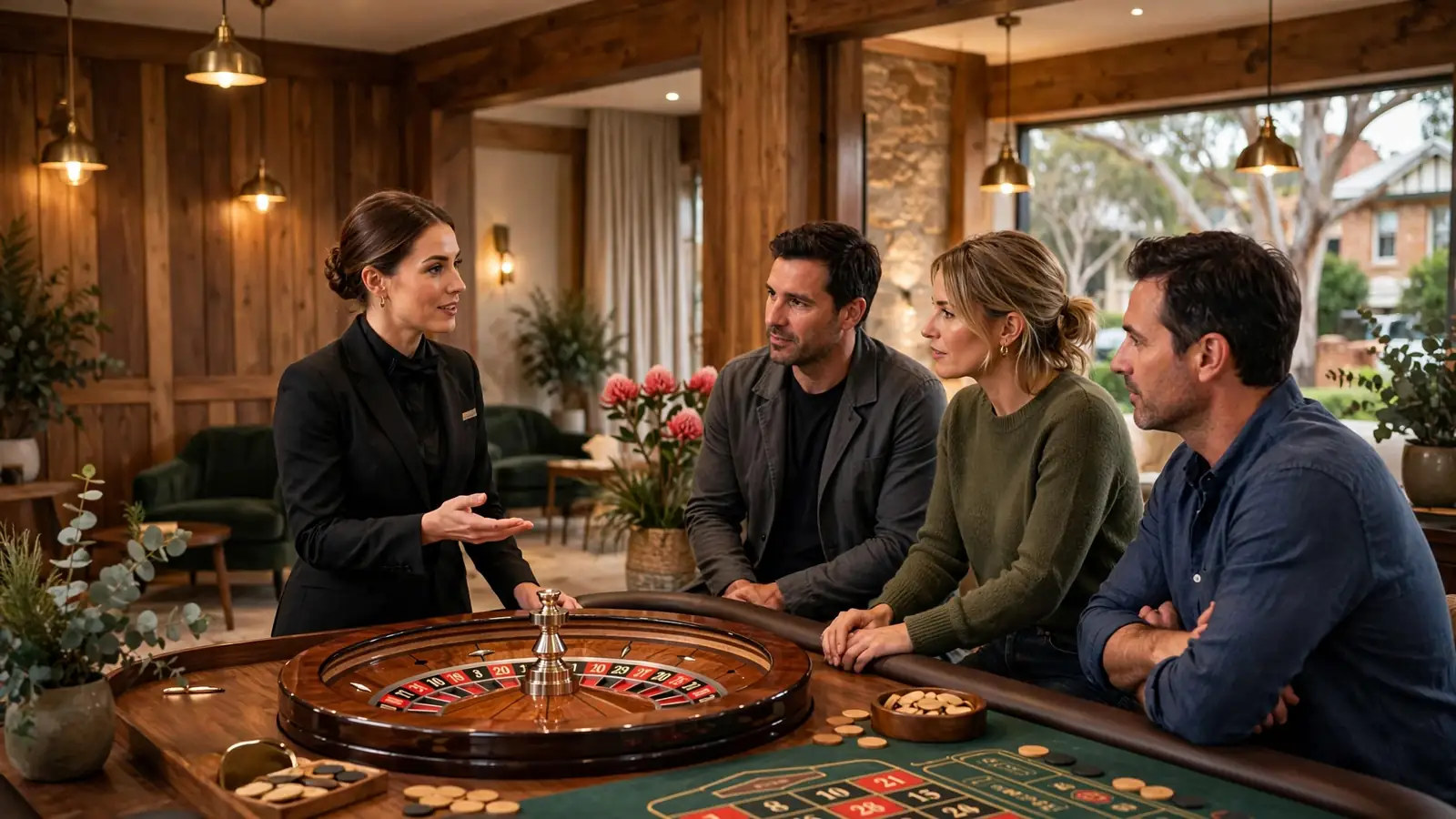
For bonus-buy pokies, the online setting can mean encountering a feature through an offshore casino rather than through an Australian-licensed online casino. That is the boundary around the subject, not an endorsement of crossing it. A button offering a buy bonus feature does not alter the rules governing the service behind it, just as a familiar checkout option does not turn an offshore operator into a domestic one.
Australia’s approach is notably asymmetric: operators are barred from supplying online casino games to residents, while players are not punished simply for playing offshore. Enforcement instead targets services and access, including through domain blocking. The result is a market that can be visible without being locally authorised. Familiar screen, different protections.
What Free Demo Spins Can Reveal About a Bonus Buy
A free-play mode, where one is available, can show how a bonus-buy control is presented and what happens when the feature is activated without staking real money. That is a narrow kind of evidence: it reveals the game’s sequence and interface, not the value of a future session. A demo is rehearsal, not a forecast.
Sweet Bonanza offers a useful illustration. A specialist review describes four or more scatters as awarding 10 free spins, while multiplier bombs may appear during those spins. The review says their values are combined before being applied to a winning tumble. In a demo, those events can be watched as they unfold: whether the feature starts, how the free spins are counted, and how the game displays a tumble and its multiplier. Those details make the buy feature less opaque. They do not make it predictable.
Sweet Bonanza Bonus Mechanics
Four or more scatters award 10 free spins. During these spins, multiplier bombs may appear; if multiple bombs land, their values are combined and applied to a winning tumble.
The distinction matters because the buy price, where the feature is offered, and the game’s presentation can make the bonus feel like a separate product. It is still part of a slot whose outcomes are generated randomly. Each spin is an independent event produced by a Random Number Generator; previous spins do not dictate what comes next. A demo run therefore cannot establish that a paid feature will trigger a particular result, or that a sequence seen in free play will recur.
Nor does a long stretch of free play become a useful sample of what a real-money session will deliver. It can help identify controls, transitions and rules that might otherwise be missed. It can also make the bonus sequence vivid, which is precisely where caution is needed: vividness is not evidence.
For anyone examining bonus-buy slots in free play, the sensible object of attention is the operation of the feature, not a pretend balance or a memorable result. The demo can show how the game explains its own mechanics. It cannot show what the next random event will be.
The Bonus Feature, in Sweet Bonanza’s Case
Sweet Bonanza’s bonus round is described as a free-spins feature triggered by scatters. A specialist review reports that four or more scatter symbols award 10 free spins. That is a description of the version covered by that review, not a guarantee about every game build: the rules shown inside the game are the relevant account of how a particular version operates.

The distinction matters because a bonus round is not simply a separate prize waiting behind a symbol. Scatters provide the trigger; what follows is a sequence of spins in which the game’s tumble mechanic can continue to produce winning combinations. The free spins change the setting in which outcomes occur, but do not make any particular combination inevitable. Each spin remains random.
The feature’s other notable element is the multiplier bomb. During free spins, these bombs may appear, according to the same specialist review. When more than one appears, their multiplier values are added together before being applied to a winning tumble. The order is important: the combined multiplier acts on a qualifying win, rather than creating one by itself. Without a winning tumble to apply it to, a multiplier is not a payout.
That interaction can make the bonus round feel more dramatic than an ordinary spin: a scatter trigger opens the feature, and multiplier bombs can amplify a win within it. But animation and arithmetic are not a forecast. The presence of a bonus mechanism says what the game can do, not what a session will return.
There is a small institutional story in the way such features are presented. A lobby tile can compress a game into a title and an image; the rules screen has to do the less glamorous work of specifying what those symbols mean. In a game whose details may vary between versions, that screen is more useful than a familiar name.
Bonus Feature Summary
- Scatter symbols trigger the free spins feature
- Multiplier bombs amplify winning tumbles during the bonus
- Feature rules and outcomes are version-specific and random
The reported trigger and spin count should therefore be read as version-specific information, not as a universal promise attached to every Sweet Bonanza listing. The multiplier description is similarly conditional: bombs can appear during free spins, and their values can combine when a winning tumble gives them something to multiply. The feature has rules. It has no memory of earlier outcomes, and no obligation to repeat them.
A Slot With a Buy Feature Still Has a Stake Range
A bonus-buy option can make a slot sound as though its cost is defined by the feature. In practice, Sweet Bonanza also has an ordinary stake for each spin, and that amount is a separate part of the game’s price structure. The feature’s presence does not erase the base stake or make every spin cost the same.
A specialist review reports a Sweet Bonanza stake range of A$0.20 to A$100 per spin. That is a reported range, not a universal setting across every casino offering the game. The upper limit can vary by operator, so the figure shown in one version should not be treated as a promise about another. The game’s own stake controls are the relevant place to see which amounts are available in a particular build.
This distinction matters because two different costs can sit beside one another in a slot: the cost of an ordinary spin and the price attached to entering a bonus directly. They are not interchangeable measures. The stake range describes the first; it does not establish the price of the second. Nor does a high maximum stake make a bonus-buy feature more valuable. It only means that the available ordinary wagers may extend further at that operator.

There is a social history in the small print of such controls. A slot may travel under the same name while its permitted stakes change with the setting in which it is offered. The familiar title suggests sameness; the controls quietly qualify it. For people comparing slots with a buy bonus, the useful detail is not merely whether the feature appears, but what a normal spin can cost in that particular version.
A broad range is not a recommendation. The difference between a minimum and a maximum is a choice presented by the interface, not evidence that either end is suitable or that a bonus will repay its price. The ordinary stake remains a real cost even when attention is drawn to the more theatrical option. The lobby tile is the least informative place to assess it.
Choosing a Bonus Buy Without Calling It the Best
There is no sound way to name a single bonus-buy slot the best for every player. A feature that looks attractive in a game’s lobby tile says little about its return, and a purchase option does not turn uncertainty into a dependable outcome. A more useful comparison begins with the game’s own information, not its packaging.
The RTP, or return to player, is generally set out in the rules or paytable. That is where the configured figure can be checked before any decision involving real money. A higher RTP theoretically offers a better return over time than a lower one. The phrase “over time” carries most of the weight: RTP describes an aggregate expectation across many spins, not what a particular session will produce.

This distinction matters especially when a bonus can be bought. The feature may change how a player reaches a bonus round, but it does not make an individual result predictable. A displayed RTP is not a forecast for the next purchase, nor a measure of how generous a short run will feel. The arithmetic is patient. People rarely are.
So the best bonus to buy is not an objective category waiting to be crowned. The more defensible choice is a game whose rules are clear and whose in-game paytable shows the RTP configuration being used. If the figure is absent or unclear, the lobby’s presentation cannot fill that gap.
Even then, RTP is only one comparison point, not a promise of value in a particular session. Treating it as a long-run measure keeps the number in its proper place: useful for comparing theoretical returns, and incapable of settling what happens next.
Are there any strategies for choosing slot games based on RTP?
Yes. Compare the RTP figures shown in each game’s rules or paytable, and look for slots with an RTP of 96% or higher. Check the in-game information panel because the operator may offer a version with a different RTP.
Why is understanding slot RTP important for players?
RTP indicates a slot’s theoretical return over a very large number of spins, so it helps players compare games. A higher RTP theoretically offers a better return over time, but it does not predict the result of an individual spin.
Do higher RTP slots guarantee bigger wins?
No. RTP is a long-term theoretical calculation, and each spin is a separate random event, so a higher RTP does not guarantee bigger wins.
Are three-reel pokies legal for Australian players in 2026?
The number of reels does not create an exception: operators cannot legally offer online pokies to people in Australia. Individuals are not penalised under this rule merely for playing at an offshore site.
What is the RTP number?
RTP, or return to player, is the percentage of wagered money a slot is theoretically expected to return across a very large number of spins. It is not a prediction of what a player will win in a particular session.
Prepared by the Cuntspin Casino editorial staff.