Real Money Casino Table Games in Australia
 Available in AU
See how live streams differ from RNG tables, and how Australian legal boundaries, Bitcoin payments and game odds fit into the picture.
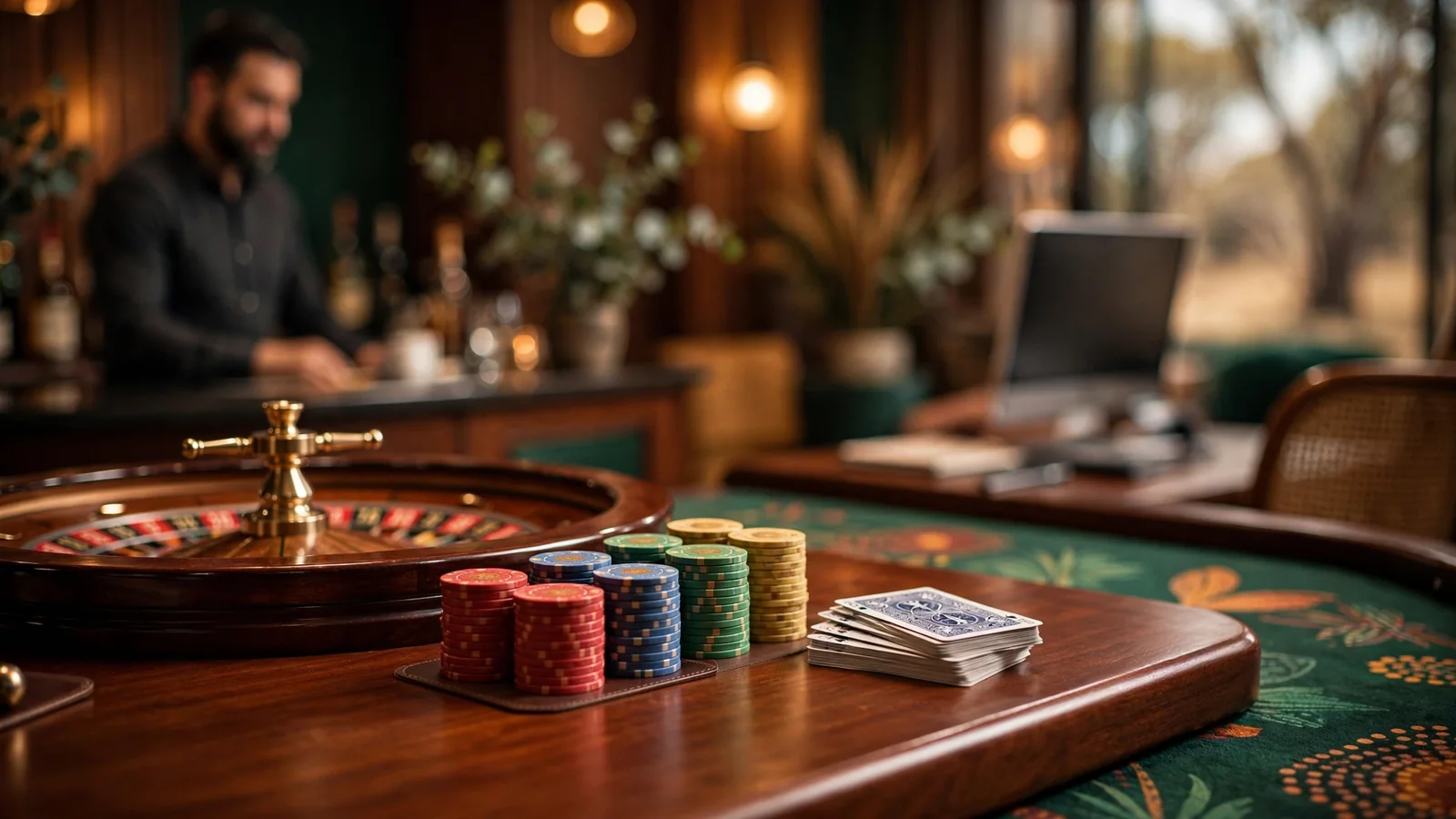
Table of Contents
- Table Games Online: The Dealer, the Stream and the Software
- The Australian Legal Boundary Around Online Tables
- Bitcoin at the Table: A Payment Rail, Not a Different Game
- What the Odds Can—and Cannot—Tell Us
- A Hand Against the Dealer, a Hand Against the Table
- What Counts as a Table Game Online
- The Table as a Small Social Stage
- Cards, Hands and the Dealer
- Roulette’s Green Zeroes and the Shape of Chance
- Poker at the Casino Table
Table Games Online: The Dealer, the Stream and the Software
An online table can present itself in two quite different ways. In one, a real dealer works with real casino equipment while a live video stream carries the scene to viewers. In the other, software determines the outcome: which cards are dealt, for instance, or where the ball lands on a roulette wheel. Both may be called online table games, but the visible surface and the mechanism beneath it are not the same.
The distinction matters because a screen can make different processes look deceptively alike. A dealer’s hands may appear on one screen; a digital table may occupy another. Either way, the viewer sees a game presented through a device. But in a live-dealer format, the image is of an event taking place in front of a camera. In a software-based format, the displayed game is the interface through which an outcome determined by a Random Number Generator is shown.
The streamed table
A live-dealer game has a person at its centre. The dealer handles real casino equipment, and the video is streamed live to players. The screen is therefore not simply illustrating a game: it is transmitting a scene in which a dealer and physical equipment are present.
Choosing a real-money casino for table games in Australia calls for attention to the operator details available, such as licensing and payment terms. Use these notes as a concise reference when considering your options.
License: Curacao · Payout speed: crypto 30-60 minutes, fiat 1-5 days · Min. deposit: A$10 Wild Tokyo lists a Curacao licence and a minimum deposit of A$10. Its stated payout times are 30–60 minutes for crypto and 1–5 days for fiat.
License: Curacao Golden Pokies lists a Curacao licence. The available information provides no further operator-specific details.
License: international iGaming licence – jurisdiction not named in the source · Payout speed: PayID 1-24 hours · Min. deposit: A$30 (PayID from A$10) House of Pokies lists an international iGaming licence, though the source does not name the jurisdiction. PayID payouts are stated as 1–24 hours; the minimum deposit is A$30, or A$10 with PayID.
License: Curacao eGaming (Dama N.V.) JeetCity Casino lists a Curacao eGaming licence held by Dama N.V.
License: Curacao Gaming Control Board JustCasino lists a Curacao Gaming Control Board licence.
License: Curacao Gaming Control Board OGL/2023/176/0095 (Hollycorn N.V.) Rollero Casino lists a Curacao Gaming Control Board licence, OGL/2023/176/0095, held by Hollycorn N.V.
License: Curacao (operating since 2017) · Min. deposit: A$20 Uptown Pokies lists a Curacao licence, has operated since 2017, and has a minimum deposit of A$20.
License: Curacao Gaming Authority (Jumpman Gaming Ltd) DragonSlots Casino lists a Curacao Gaming Authority licence held by Jumpman Gaming Ltd.
License: Curacao Gaming Control Board OGL/2023/176/0095 (Hollycorn N.V.) Neospin lists a Curacao Gaming Control Board licence, OGL/2023/176/0095, held by Hollycorn N.V.
Payout speed: crypto under 1 hour, PayID 1-3 business days · Min. deposit: A$20 (A$30 to qualify for the bonus) Ricky Casino states crypto payouts under 1 hour and PayID payouts in 1–3 business days. Its minimum deposit is A$20, or A$30 to qualify for the bonus.
That arrangement retains something of the older table’s theatre. There is a human figure whose actions give the sequence a visible beginning and end; there is equipment in the frame; there is a camera making the table available at a distance. The viewer encounters a mediated event rather than only a graphic representation of one. The machinery is still there, of course, but it has moved partly out of sight: camera, stream and screen stand between the physical table and the person watching.
The dealer’s presence can make the format feel closer to a room shared with other people. Yet a streamed image is not the same thing as being in that room. It shows a dealer and equipment, while the player’s own surroundings remain elsewhere. Online, proximity is manufactured by the frame. A face, a hand or a table can seem near even when the whole encounter depends on a signal travelling to a screen.
There is a small social history folded into that arrangement. The casino table has long been both a mechanism for play and a stage on which roles are legible: dealer, player, observer. Live video preserves that visible division, though at a distance. The dealer remains part of the scene; the player becomes a viewer as well as a participant. Technology has not removed the stage. It has made the stage portable.

The software table
A software-based table game does not need a live dealer or a physical table in view. Its outcome is determined by a Random Number Generator. In a card game, the software determines which cards are dealt; in an online roulette version, it determines where the ball lands. The screen presents the result, but the determining process is computational rather than a filmed physical event.
That difference is easy to overlook when both formats use familiar table imagery. Felt, cards, chips or a wheel may suggest the same old arrangement. But the graphic surface does not establish how an outcome is produced. One format shows real equipment being used by a dealer; the other uses software to determine the result and represents the game on screen. Appearance is not mechanism.
This is not a contest between the human and the machine for the title of “real.” The streamed format depends on technology to carry an event, while the software format uses technology to generate an outcome. Each has a different relationship between what appears and what is happening. In one, the screen relays a physical scene. In the other, it displays a software-determined game.
The distinction also explains why “online table games” is a broad label rather than a description of one uniform experience. It can refer to a live dealer working at real equipment or to a digital version whose outcomes are determined by software. The shared feature is the online presentation; the underlying process differs. A camera and a Random Number Generator do not do the same job.
A live-dealer format where a person handles real equipment and the scene is transmitted via video stream to the player.
A digital format where outcomes are determined by a Random Number Generator and presented through a computational interface.
What the screen conceals
Screens flatten differences. A streamed table and a software table can both be encountered through the same general device, in the same quiet posture, with the same attention fixed on a rectangle of light. The interface can make them seem like variations in style. The more useful distinction is between transmission and determination: is the screen carrying a live scene, or showing an outcome produced by software?
That distinction says little about which format is preferable, and it need not. It identifies what each format is. The live-dealer table keeps a person and physical equipment visible; the software table places the determining work in the game’s code. One has a camera-facing event. The other has a generated outcome. Both are mediated, but not in the same way.
The old table has acquired two electronic lives: one streamed from a room, the other rendered by software. Same screen. Different table.
The Australian Legal Boundary Around Online Tables
A search for a nearby table-game venue can blur two different things: a physical casino and an online service. The distinction matters under Australian law. The Interactive Gambling Act 2001 regulates online gambling, and its boundary is not drawn by the distance between a player and a table. It concerns whether a real-money casino service is being provided to people in Australia.
Section 5 of the Act places the restriction on the provider. An operator established in Australia cannot offer residents real-money interactive casino games. The wider framework bars Australian companies from running online casinos for customers here. In practical terms, the screen does not turn a prohibited service into an ordinary local business; the relevant question is who is offering the remote game and to whom.

That rule sits within a broader regulatory choice. The law treats online casino gambling as a service that local businesses may not provide, rather than as a digital extension of the familiar casino floor. A table visible on a screen may resemble a physical one, but its presence in a home does not make the service a venue down the street. Online access changes the setting; it does not erase the legal category.
The Australian Communications and Media Authority, or ACMA, is responsible for enforcement. Its role includes acting against unlicensed domestic platforms and blocking them. This gives the prohibition an operational edge: it is not merely a statement about how local companies should describe their business. The regulator can intervene when platforms breach the framework.
The phrase “near me” belongs naturally to the geography of buildings: a casino has an address, a neighbourhood and a route to its entrance. Online casino services unsettle that language because the apparent table has no local street address. Yet proximity is not a legal shortcut. A service does not become permissible simply because it appears in a local search, nor does its digital form place it beyond the rules that govern providers serving people in Australia.
That distinction is important when describing the law accurately. The policy boundary concerns the provision of real-money interactive casino games to people located in Australia; it should not be rewritten as a claim that a person who encounters an online table has committed an offence.
There is a dryly administrative quality to this arrangement. The game may present itself as leisure, but the law classifies the service by its commercial function and audience. The regulator’s task is to enforce that line, not to settle whether a digital table feels socially like a casino. For online tables, the boundary is set before the cards are dealt: Australian-based operators cannot offer them for real money to residents, and ACMA is charged with enforcement.
Legal Prohibition
Under the Interactive Gambling Act 2001, operators established in Australia are prohibited from offering real-money interactive casino games to residents.
Bitcoin at the Table: A Payment Rail, Not a Different Game
Bitcoin belongs to the account’s money movement, not to the table’s rules. A balance funded or withdrawn through a cryptocurrency remains separate from the mechanism that decides a game’s outcome. The distinction is easy to blur because both activities appear on the same screen, but they answer different questions: one concerns how value moves; the other concerns what happens in a hand or round.
That makes “Bitcoin table games” a description of payment context, not a new family of games. The felt, cards, dice or wheel do not acquire different rules because an account uses Bitcoin. Nor does the payment method, by itself, tell anything about a game’s odds or fairness. Those belong to the game’s design and its outcome mechanism, not to the currency used around it.
The comparison between Bitcoin casino tables and conventional casino tables is therefore less dramatic than the wording suggests. At the table, the contest remains the contest. In the account, the payment rail may differ. Treating those as interchangeable is like assuming that changing the route by which money arrives changes what the money can buy. A tidy confusion, but a confusion all the same.
There is one practical point that gives the distinction a clock. A specialist review reports that Bitcoin withdrawals may process within 10–30 minutes, with the time dependent on blockchain confirmations rather than banking bureaucracy. That is a report about a particular payment process, not a standing promise about every transaction or a universal measure of speed. A blockchain confirmation is part of the transfer’s path; it is not a game event and cannot hurry or delay the result at a table.

The wording matters. “Processed” can describe a step taken by a platform, while a transfer’s confirmation depends on the blockchain. Those are related stages, not a guarantee that funds will be available at a fixed moment. The specialist review’s timing should be read as its reported experience, not as a reliable forecast for every account, platform or withdrawal. Payment systems have their own conditions, and the table does not control them.
The same separation helps make sense of searches for the best Bitcoin table games or the best table games for Bitcoin. The payment method cannot establish which game is preferable, and the word “best” needs a criterion beyond the currency involved. A player interested in card contests, dice outcomes or a wheel is considering the game; someone interested in Bitcoin is considering how funds may move. Combining those interests does not make one answer the other.
Nor does a Bitcoin label make a game a better-odds choice. Odds are not a property of the coin used to make a payment. Confusing the two gives a payment method a mystique it has not earned: the currency can be technologically distinctive without lending any special quality to the table. A payment rail is not a strategy.
This distinction also matters in Australia, where the legal setting for real-money online casino services remains restrictive. A payment method does not alter the legal character of a service. Bitcoin is neither a loophole nor a different category of table play; it is simply a means of moving value in contexts where it is used. The rules governing a service and the mechanics of a game do not disappear because the account uses a different currency.
Payment Processing
Bitcoin withdrawals may process within 10–30 minutes, though this timing depends on blockchain confirmations rather than banking bureaucracy.
The table keeps its own logic. The account keeps its own plumbing. Confusing them makes both harder to understand.
What the Odds Can—and Cannot—Tell Us
The question of which casino table games offer the best odds sounds as though it should have a tidy answer: arrange the tables in order, from generous to unforgiving, and publish the chart. But a ranking needs comparable information. A game’s name alone cannot tell how its odds have been calculated, what rules apply or what a particular payout means.
Online table-game outcomes are determined by a Random Number Generator (RNG). For a card game, the software determines which cards are dealt; for roulette, it determines where the ball lands. That describes how an outcome is produced. It does not, by itself, describe the probability of each outcome or the relationship between a wager and its payout.
Those are separate questions. Probability concerns how likely an outcome is; a payout concerns what is returned when a wager succeeds. The balance between the two shapes the mathematical advantage associated with a game or bet. A house-edge chart can make comparisons look precise, but only if its figures use the same assumptions and the relevant rules are clear. Without those details, a neat column of percentages would be decoration masquerading as measurement.
This is why broad claims about the best odds at casino table games deserve care. “Best” could mean a lower mathematical disadvantage under a particular set of rules, a greater chance of a small win, or a more favourable payout for one specific wager. Those are not interchangeable meanings. Nor does a game become favourable merely because a run of results has felt kind. Random outcomes can form apparent streaks; the feeling of a pattern is not evidence that the next result has been altered.

The RNG matters here, but not as a guarantee of a player-friendly result. It is the mechanism that selects outcomes in the online version. Knowing that mechanism exists does not reveal a game’s full odds, and it cannot turn past results into a reliable forecast. A sequence may be striking; the next outcome is still determined by the software rather than by a story assembled from the previous ones.
So a careful comparison of table-game odds needs more than a label or a headline ranking. It needs the rules, the wagers being compared, the payouts and the assumptions behind any calculation. Change one of those elements and the comparison may no longer describe the same proposition. That is the limit of a house-edge chart: useful when its terms are visible, misleading when they are not.
The search for the “worst” odds has the same problem in reverse. Without a consistent basis for comparison, naming a loser is no more rigorous than naming a winner. A table game is not a single abstract number; its odds depend on what is being wagered and how the game pays. The software’s role is narrower and more concrete: it determines the dealt cards or the roulette result.
There is no honest universal ranking to extract from that fact alone. The RNG explains the source of online outcomes, not which table offers the best odds, the worst odds, or a guaranteed route to a favourable result. Numbers need terms attached. Otherwise, they merely look authoritative.
Attention: A house-edge chart can be misleading if the relevant rules and assumptions behind the calculations are not clearly visible.
A Hand Against the Dealer, a Hand Against the Table
A table game can be understood by asking a simple question: who, or what, is the wager set against? In one familiar arrangement, a player’s hand is measured against the dealer’s. In another, the wager concerns which hand will prevail—or whether the result will be a tie. The distinction changes the social shape of the table, even before any cards are dealt.
Blackjack makes the first arrangement plain. The player competes with the dealer, trying to form a hand whose value is closer to 21. The dealer is not merely the person handling the cards; the dealer’s hand is the opposing measure against which the player’s own is judged. The contest has a direct grammar: one hand, another hand, and a comparison between them.
That structure can feel almost personal, though the dealer is performing a role rather than choosing an opponent. The face across the table gives the contest a human surface. Yet the terms are not a private rivalry between two people. The dealer represents the house’s side of the game, and the player’s task is defined by the hand in front of them. A courteous exchange can sit on top of a strictly bounded contest.
A different structure places the wager on a set of possible outcomes. Players can bet on their own hand, the Banker’s hand, or a tie. Here, the central act is not necessarily to build a hand in direct opposition to the dealer. It is to decide which result the wager will support. The table becomes less like a duel and more like a small public forecast: several possible endings are visible, and money is attached to one of them.

That shift matters. In a direct contest, attention gathers around the player’s hand and the dealer’s. In an outcome wager, attention can move among the named hands and the possibility that neither will outrank the other. The player may still be watching cards, but the wager’s object is different. One arrangement asks, in effect, how a hand will fare against the dealer; the other asks which hand, or result, will be recorded.
Neither form requires a large theory of play to be understood at its most basic level. The first is a comparison between opposing hands. The second is a choice among outcomes. Beyond that, the details depend on the particular table and its rules; the broad distinction does not explain every action or condition. It does, however, show why table games are not all variations on a single contest.
The dealer’s presence can make a game feel like a conversation, while the wager itself remains impersonal. A hand is dealt, a result emerges, and the table’s terms decide what that result means. When the wager attaches to a hand or a tie, the social focus spreads outward: the action is still centred on the table, but not necessarily on a player facing the dealer alone.
Two shapes of attention, then: opposition and prediction. The cards may occupy the same felt, but the wager determines where the contest is understood to be.
Do
- View a direct contest as a comparison between opposing hands
- View an outcome wager as a choice among several possible results
Don’t
- Assume every table game follows a single social script
- Confuse the act of building a hand with the act of predicting an outcome
What Counts as a Table Game Online
A casino table game is defined less by the furniture on screen than by the way play is organised. The useful distinction online is between a game presented through a live dealer and one whose result is generated by software. Both borrow the language and rituals of a casino table; they do not share the same method of producing what happens next.
In a live-dealer game, a real dealer works with real casino equipment, and a video stream carries that scene to players online. The table is a physical place, even when its audience is elsewhere. Cards are handled, or a wheel is set in motion, in front of a camera. The stream makes the dealer and equipment visible rather than asking a player to treat an animated image as the whole event.
That distinction matters because “live” describes the presentation and the human presence, not a different category of wager. A streamed table still turns a casino activity into an online experience. The camera supplies a view of the proceedings; it does not move the player into the room. A small social stage, transmitted at a distance.

Software-based table games work differently. There is no live dealer or physical wheel in the game being shown. A Random Number Generator determines the outcome: it can select the cards dealt or determine where a roulette ball lands. The result appears through a digital interface, but the underlying event is produced by software rather than captured from a real table.
This is why the phrase “casino table games” covers more than one kind of screen. A streamed dealer game presents physical activity through video; an online software version represents play digitally and uses an RNG for its outcomes. The visible layout may suggest the same familiar casino setting, yet the source of the action is different. One is a broadcast of a dealer and equipment; the other is a software-generated result.
The distinction also gives a practical meaning to table-game software. In a game played online, software can be the mechanism that determines what is dealt or where a roulette ball lands. That is not the same as a live video feed, even if both formats use a table-like interface. Nor does the shared appearance make the two processes interchangeable. Presentation and outcome generation are separate questions.

So, what counts as a table game online? In ordinary terms, it is casino-style play organised around a table format, offered either as a live stream of a real dealer and equipment or as a software version whose outcomes come from an RNG. The category is a format, not a promise that every game will look or operate alike. The screen can conceal a rather old distinction: a human performance on one side, a programmed result on the other.
The Table as a Small Social Stage
A table game is less a single kind of contest than a small arrangement of people around uncertainty. In one form, attention settles on hands: the cards are assembled into a poker hand, and the contest is to build the strongest one possible. In another, the wager rests on what a pair of dice will show. The materials change; so does the shape of the suspense.
Poker gives the table a distinctly human centre. Its object is not simply to wait for an outcome but to construct the best possible hand. That effort makes the contest feel like a comparison among players, even when the cards themselves set the limits. The hand becomes a compact argument: a collection of cards offered as the strongest claim at the table. Poker’s enduring appeal is easy to understand in that light. It gives players a shared object of attention and a clear purpose, without making every table game follow the same social script.

Dice play has a different simplicity. Players roll a pair and bet on the outcome. The central event is plain enough to follow: the dice move, then settle. A wager attaches expectation to that result. There is no need for a hand to be built or compared; the interest gathers around the roll itself. Brief, visible, and final, it gives the table a different rhythm from a contest shaped around poker hands.
Together, these forms suggest why a list of casino table games cannot, by itself, explain what happens at a table. A list can name categories, but the more revealing distinction is what the players are doing: trying to build the strongest hand, or placing a wager on a dice outcome. One form makes the hand the centre of the contest; the other makes the roll the event. Neither requires the table to be socially elaborate. The shared focus does much of the work.
That focus is part of the table’s quiet theatre. Cards invite comparison; dice make a result visible at once. The participants may be gathered around the same surface, but their attention is organised differently by each game. One asks what can be made from a hand. The other asks what the dice will show. A small stage, then—with more than one kind of drama.
Cards, Hands and the Dealer
Card tables organise attention around a small object: the hand. It is held, assessed and compared, while the dealer’s position gives the contest its shape. In blackjack, the player’s task is to make a hand whose value comes closer to 21 than the dealer’s. The opponent is not another player across the table but the person administering the game. That arrangement gives the dealer a peculiar role: both participant in the contest and its official face.
The cards make the comparison legible. A hand has a value, and the aim is not simply to collect more cards or to make a display of them, but to approach the stated target more closely than the dealer does. The contest is therefore direct, even when the table is shared by several players. Each hand meets the dealer’s hand in turn; the other players occupy the same social space without becoming one another’s opponents.
Poker gives the hand a different task. Its players try to build the best possible poker hand, making the contest one of comparison among hands rather than a single player’s effort to come nearer a fixed value than the dealer. The cards still provide the common language, but the object of attention shifts: from the distance between a hand and a target to the strength of one hand beside another.
That distinction helps explain why card tables can feel like separate little societies. In one, authority is visible in the dealer’s seat, and the player’s effort is measured against it. In the other, the players’ hands become the terms of comparison. The table’s rules decide what counts as a stronger hand; the people around it learn to watch for that standard.
Card Table Dynamics
- Blackjack is a direct contest between the player’s hand and the dealer’s hand
- Poker is a contest of comparison among multiple players’ hands
- The dealer’s role shifts from a direct opponent to an official organiser depending on the game
- The social geometry of the table is defined by the objective of the hand
The contrast is elementary, but it is not trivial. A dealer-facing contest gives the table a centre. A hand-building contest distributes attention among the players. Cards can serve both arrangements without changing their appearance much at all. The social geometry changes first.
A hand, then, is more than a bundle of cards. It is the unit by which a table defines its contest: measured against the dealer in blackjack, or assembled as strongly as possible in poker. Different aims, same small stage.
Roulette’s Green Zeroes and the Shape of Chance
Roulette makes chance visible. A ball circles a wheel while a marked layout gives each possible landing place a name; the green zero is the detail that separates familiar versions of the game. Online, the wheel’s image may be part of the presentation, but the result in a software version is determined by a Random Number Generator (RNG).
The main online versions are European, French and American roulette. European and French layouts each have 36 numbered spaces and a green 0. American roulette has a green 0 and a green 00. That extra green marking is not decorative: it is a clear, physical sign that the American layout differs from the other two. The tables can look much alike at a glance. The zeroes say otherwise.
These distinctions matter because “roulette” is not one unchanging arrangement. The layout sets the range of outcomes represented on the table, and its markings are part of the game’s rules. A player looking at a casino table game sees a small map of chance: numbers in sequence, betting areas beneath them, and green spaces set apart from the numbered field. The design turns an abstract random result into something legible.
In a software-based version, however, there is no physical ball whose path can be followed. The RNG determines where it lands, even when the screen presents a wheel and a moving ball. The visual scene borrows the theatre of the traditional table; the software supplies the outcome. It is a neat division of labour.

That distinction is useful when comparing roulette casino table games online. The version’s visible layout identifies whether it is European, French or American, while the software determines the result in digital play. The display may invite the eye to track the ball, but the animation is not evidence of a physical spin or a hidden pattern. The green zeroes tell a more concrete story: which layout is being shown, and how its possibilities are arranged. The drama is visible. The mechanism is not.
Poker at the Casino Table
Poker gives the table a particular kind of tension. The central contest is not simply a player against a dealer: players try to build the best possible poker hand, measuring their own result against the hands of others. That small shift changes the room’s social geometry. The dealer may organise the game, but the players are the ones whose prospects are set against one another.

The appeal lies partly in comparison. A hand has meaning not in isolation but in relation to the hands around it. Poker therefore makes a private calculation public: each player’s aim is clear, while the strength of the result is revealed through the contest. The table becomes a compact theatre of judgement, with cards serving as the evidence and the hand as the argument.
This is why poker sits distinctly among casino table games. Its defining idea is not merely that cards are dealt, but that players are trying to assemble the strongest possible hand. The aim sounds simple; the social pressure is less so. Every participant is pursuing the same kind of advantage, and only the comparison can settle whose hand stands best.
The table’s ritual gives that comparison a frame. Players occupy the same space, follow the same contest and wait for the relative strength of their hands to become apparent. The rules make the encounter legible; the uncertainty makes it compelling. Poker’s durable place in casino culture rests on this plain structure: a shared contest, an individual hand, and a common measure of strength.
No grand machinery required. Just comparison.
What is the legal status of online table games for Australian players in 2026?
Australian-based operators are prohibited from offering residents real-money interactive casino games under the Interactive Gambling Act 2001. Offshore platforms accept Australian players, while the ACMA enforces the rules and blocks unlicensed domestic platforms.
Can you play table games online for real money?
Yes, Australians can play real-money table games through offshore platforms. Australian-based operators are prohibited from offering these games to residents.
Are online casinos legal in Australia?
Australian companies cannot offer online casinos to residents under the Interactive Gambling Act 2001. Offshore platforms accept Australian players.
Prepared by the Cuntspin Casino editorial staff.