Mines Casino Game in Australia: Rules and Risks
 Available in AU
Explore how online availability, free play, bonuses and cashouts fit into the wider Australian pokies debate.

Table of Contents
- The Pokies Australia Made Familiar
- Mines, Casino Rules and the Australian Border
- What Online Availability Means Under ACMA Enforcement
- Free Play: A Search Term, Not a Cash Balance
- The Demo Question the Available Facts Cannot Settle
- Bonus Codes and the Arithmetic Behind the Offer
- Real-Money Play and the Friction of Cashing Out
- Where Play Meets the Wider Pokies Debate
- Strategy, Risk and the Limits of Jackpot Rules
- Casino Guru Searches and What They Can Establish
The Pokies Australia Made Familiar
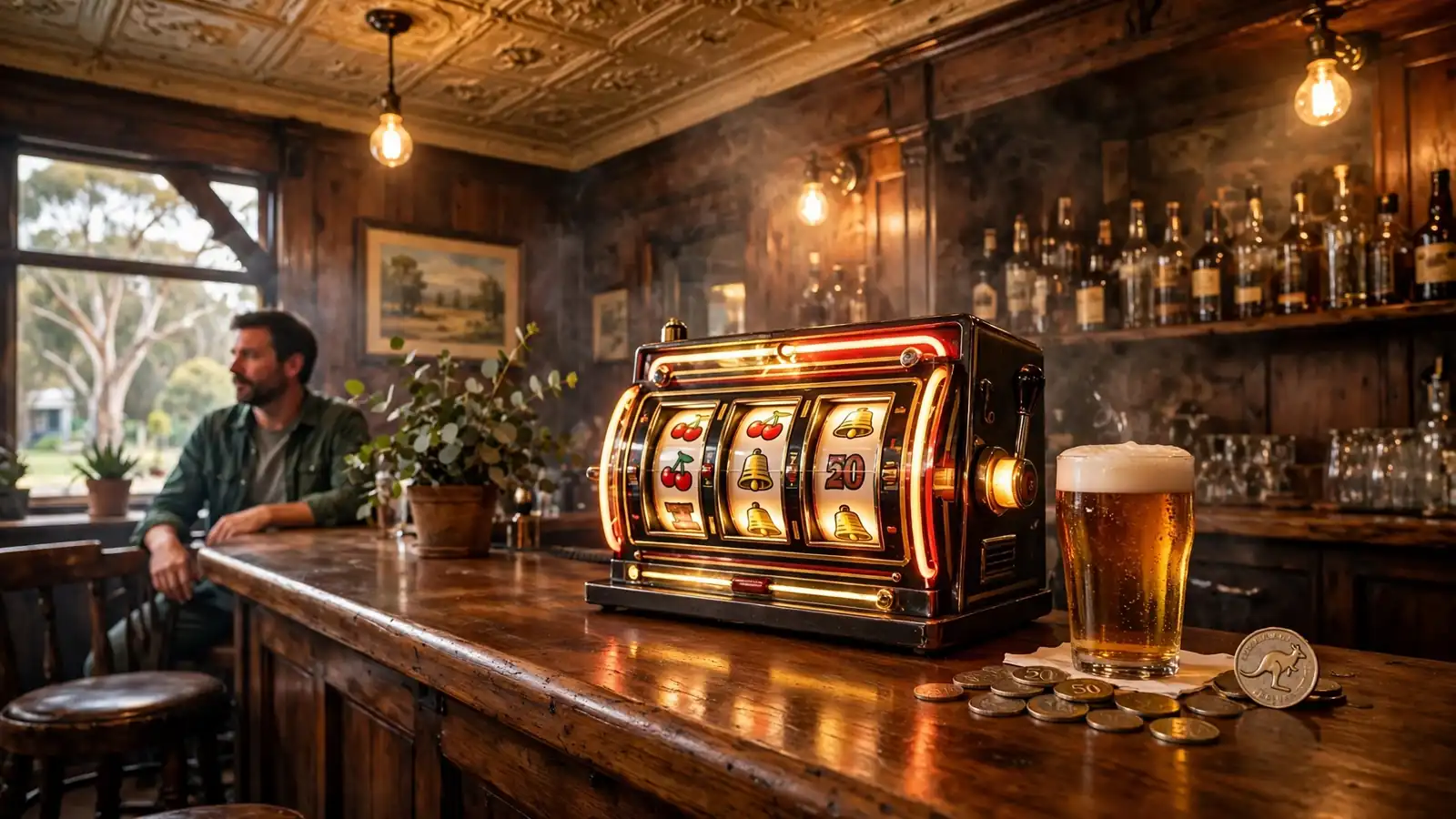
Pokies belong to a particular Australian landscape: hotel rooms, clubs and venues where electronic machines became part of ordinary leisure, and then part of an argument about what ordinary leisure can cost. Their names often borrow from the country’s wildlife, colours and comic sense of scale. Big Red, Queen of the Nile and Lightning Link sit alongside titles such as Boomerang Bonanza, Kangaliens, Red Sands and Redroo. The names make a local gesture, though the machines themselves belong to a global entertainment industry.
That industry is built from software as much as cabinets. Providers including Aristocrat, KA Gaming, Microgaming, NetEnt, Play’n GO, Pragmatic Play, Quickspin and Evolution Gaming supply different kinds of casino games. Their products range across pokies and table games; the presence of a provider’s name says something about who made the software, not about the experience or outcome a player should expect. In a market where a familiar animal or landmark can become a theme, the machinery behind the theme is international.

A return-to-player figure is one measure sometimes attached to a game. KA Gaming pokies typically list RTP percentages in a range from 94% to 96%. That is a theoretical calculation over extended play, not a promise about what any individual will receive. A percentage can look like a forecast when printed beside a title; it is not one. The distinction matters in a country where machine gambling is familiar enough to be both entertainment and a continuing public concern.
The Victorian figures give that concern a scale. A report published by gamble.com.au said players in the state lost $2.6 billion on poker machines over the year covered, more than $44.7 million above the figure for 2015. The same reporting put the Epping Plaza Hotel in Melbourne’s north at more than $21 million generated by 100 machines over the last year. These are reported figures tied to particular periods, not timeless measures of what every venue or player experiences. Still, they show how concentrated the sums can be: one venue, a fixed bank of machines, and a total large enough to become a matter of public policy.
The machine is often presented as a small, private encounter: a person, a screen, a sequence of symbols. The losses are not private in the same way. They accumulate across venues and households, then return to public discussion as questions about regulation, revenue and harm. Poker-machine play can cause serious harm, particularly for vulnerable people; treating it as a harmless backdrop to hospitality would miss the point. Nor does familiarity make the activity a source of income. The machine’s cultural presence is not evidence of safety.

Reform proposals have reflected that tension. Senator Nick Xenophon and MP Andrew Wilkie called for poker-machine bets to be capped at $1. The proposal made a simple wager size stand in for a larger dispute: whether the design and availability of machines should be changed to reduce the speed or scale of losses. A limit is a political instrument, not a description of how all machines currently operate. Its significance lies in what it assumes—that individual choice is shaped by the terms built into the machine and the setting around it.
Australian-themed pokies trade on recognition. A red kangaroo, a boomerang or an outback reference can make a product feel locally legible, even when the software comes from a multinational supply chain. That familiarity has an odd double edge. It makes the games easy to place in the national imagination, while the debate around them is less cosy: who benefits from the revenue, who carries the losses, and what responsibility belongs to the venue, the designer or the rules.
The language of the industry is polished; the sums are not. For adults aged 18 or older, pokies remain a form of gambling, not a dependable way to make money. Their cultural familiarity explains why they are so visible. It does not settle whether that visibility is benign.
Mines, Casino Rules and the Australian Border
Choosing a casino for Mines in Australia involves checking the practical details available for each operator, such as licensing, deposits and withdrawals. These verdicts summarise only the information provided for each listing.
License: Curacao · Payout speed: crypto 30-60 minutes, fiat 1-5 days · Min. deposit: A$10 Wild Tokyo lists a minimum deposit of A$10 and offers crypto payouts in 30–60 minutes, while fiat payouts take 1–5 days. Its listed licence is from Curacao.
License: Curacao Golden Pokies is listed with a Curacao licence. The available information for this operator is limited to its licensing.
License: international iGaming licence – jurisdiction not named in the source · Payout speed: PayID 1-24 hours · Min. deposit: A$30 (PayID from A$10) House of Pokies lists PayID payouts in 1–24 hours and a minimum deposit of A$30, reduced to A$10 for PayID. Its source describes the licence as an international iGaming licence but does not name the jurisdiction.
License: Curacao eGaming (Dama N.V.) JeetCity Casino is listed as holding a Curacao eGaming licence through Dama N.V. The available information is limited to its licensing.
License: Curacao Gaming Control Board JustCasino is listed with a Curacao Gaming Control Board licence. The available information is limited to its licensing.
License: Curacao Gaming Control Board OGL/2023/176/0095 (Hollycorn N.V.) Rollero Casino is listed with Curacao Gaming Control Board licence OGL/2023/176/0095, held by Hollycorn N.V. The available information is limited to its licensing.
License: Curacao (operating since 2017) · Min. deposit: A$20 Uptown Pokies is listed as operating since 2017 under a Curacao licence. Its minimum deposit is A$20.
License: Curacao Gaming Authority (Jumpman Gaming Ltd) DragonSlots Casino is listed with a Curacao Gaming Authority licence through Jumpman Gaming Ltd. The available information is limited to its licensing.
License: Curacao Gaming Control Board OGL/2023/176/0095 (Hollycorn N.V.) Neospin is listed with Curacao Gaming Control Board licence OGL/2023/176/0095, held by Hollycorn N.V. The available information is limited to its licensing.
Payout speed: crypto under 1 hour, PayID 1-3 business days · Min. deposit: A$20 (A$30 to qualify for the bonus) Ricky Casino lists crypto payouts in under an hour and PayID payouts in 1–3 business days. The minimum deposit is A$20, or A$30 to qualify for the bonus.
A Mines game may be presented as a small online casino title, but its compact format does not place it outside Australia’s gambling rules. The relevant boundary is not between one game design and another. It is between a service offered to people in Australia and the law governing that offer.
The Interactive Gambling Act 2001 restricts operators from providing online casino services to people physically located in Australia. That category covers casino-style games offered for real money; changing the title, theme or layout does not turn an online casino service into a different kind of legal product. For someone looking up a Mines casino game, the first question is therefore not how the game works, but who is offering it and to whom.
The distinction matters because a website can look distant while its intended audience is not. A company based offshore may hold a gambling licence issued outside Australia and may accept payments from Australians. Those details describe how the operator presents its business and handles transactions; they do not make the service lawful to provide to people in Australia. An offshore licence is not an Australian authorisation.
Legal Restriction
Under the Interactive Gambling Act 2001, it is prohibited for operators to provide online casino services to people physically located in Australia.
This is the uneasy geography behind many online casino pages. The operator may be registered elsewhere, its licence may be issued elsewhere, and its payment arrangements may cross borders. Yet the law is concerned with the service being offered to a person in Australia. A foreign address does not move that person across the legal border. Nor does a payment method, by itself, settle the status of the underlying service.
That can make the distinction between a Mines game casino and other online casino games feel less like a matter of design than of setting. The game’s name may be distinctive, but the legal question arises from the real-money casino service around it. A familiar label, an Australian-facing page or the ability to submit an Australian payment does not alter the central restriction on operators.
There is also an important difference between the operator’s position and the player’s. The Act restricts the provision of online casino services to people in Australia; players are not criminalised simply for using an offshore site. That does not convert the operator’s offer into a lawful local service. It means the law’s treatment of the provider and the person using the site is not identical.

That distinction is easy to lose in the language of online gambling, where “licensed” can sound like a complete answer. It is not. A licence from another jurisdiction may show that an operator claims oversight under that jurisdiction’s rules. It does not displace Australian law or create permission to provide prohibited casino services to Australians. The word can carry weight on a site without carrying the weight a local reader might assume.
For the same reason, the presence of Australian payment options should be read narrowly. Offshore casinos often accept Australian payments, but payment acceptance is not proof of Australian approval. A transaction may be possible even where the service itself is restricted. These are separate facts, and collapsing them into one gives a misleading impression of the border.
The law’s scope is not confined to a single title called Mines. Online casino-style games, including slots and table games, are treated as prohibited interactive gambling services when offered to customers in Australia. Whether a site groups Mines with other casino games, or gives it a dedicated page, does not change that category. The market language may vary; the legal frame does not.
This leaves a plain, if sometimes inconvenient, conclusion: an offshore site’s willingness to accept Australian payments and its possession of a foreign licence do not establish that it may lawfully offer real-money casino play in Australia. At the same time, the player is not criminalised merely for using such a site. Those two points can coexist. One concerns the legality of the offer; the other concerns the person on the receiving end of it.
Legal Distinction
While the law restricts the provision of online casino services to people in Australia, players are not criminalised simply for using an offshore site.
The border is legal, not theatrical. A game can be reached through a screen and still be part of a service restricted by Australian law. The name on the tile is the least decisive detail.
What Online Availability Means Under ACMA Enforcement
For someone in Australia looking for Mines online, availability is not simply a matter of whether a website appears on a screen. The Australian Communications and Media Authority (ACMA) monitors compliance with federal interactive gambling laws and enforces the Interactive Gambling Act 2001. Its work gives online access a distinctly local complication: a site’s presence on the internet does not mean it remains reachable through Australian internet providers.
ACMA can ask Australian internet service providers to block websites that provide prohibited interactive gambling services or advertise them in Australia. The regulator’s action is directed at access through those providers. It is not the same as removing a website from the internet everywhere, and a block does not, by itself, establish what may happen to a particular site in another country. The practical consequence for a person in Australia is narrower but immediate: a page that once loaded may no longer be available through the usual connection.
That distinction matters for searches involving an online Mines game. A result, a saved address or a link shared elsewhere can continue to exist while access from Australia is blocked. Conversely, being able to see a page does not establish that the service complies with Australian rules. Availability and compliance are separate questions. The internet is not a national register with a neat green tick beside every permitted page.

The scale of ACMA’s blocking activity shows that this is an ongoing enforcement tool, not a one-off intervention. Since November 2019, the regulator has blocked more than 1,455 illegal gambling and affiliate websites after enforcement action. That figure covers gambling sites and affiliate pages together; it should not be read as a count of Mines games or of individual casino operators. A blocked address is the visible endpoint of a regulatory process, not a full account of every service involved.
ACMA’s stated enforcement record also includes services leaving the Australian market. Since the regulator began enforcing the rules in 2017, one reported total says more than 210 illegal services have withdrawn. Another account gives a lower figure: over 190. The two totals should not be quietly folded into a single precise count. They indicate that withdrawals have formed part of enforcement, while leaving a disagreement about the number.
Blocking and withdrawal describe different outcomes. A block concerns whether Australian users can reach a website through their internet provider; a withdrawal means a service has stopped operating in the Australian market. The distinction is useful because enforcement is not a single switch. A website can be targeted with a block, while a service’s departure is a separate change in its activity. Neither figure tells how many people visited a particular page, or whether a particular Mines listing has been removed.
ACMA Enforcement
- ACMA monitors compliance with federal interactive gambling laws.
- The regulator can request internet providers to block prohibited gambling or affiliate websites.
- Blocking is a separate outcome from a service entirely withdrawing from the Australian market.
- A reachable page does not imply official approval or compliance with Australian rules.
The same principle applies to pages advertising gambling services. ACMA may request blocking not only where a website provides a prohibited interactive gambling service, but also where it advertises one in Australia. That brings affiliate websites into the enforcement picture. A page that appears to be commentary or a directory may still be part of the material the regulator acts against; its label alone does not settle the matter.
For an Australian audience, then, “online” describes a connection that can be constrained by domestic enforcement. A Mines page may be mentioned, indexed or discussed elsewhere without being accessible here. A blocked page does not prove that every related page has vanished, and a reachable page does not turn access into official approval. The regulator’s numbers show the reach of its interventions; they do not certify individual sites or games.
That is the practical meaning of ACMA enforcement around online casino material: federal monitoring, requests to providers to block specified websites, and recorded cases of services withdrawing from the market. The machinery is administrative rather than theatrical. No flashing barrier. Just a page that does not open.
Free Play: A Search Term, Not a Cash Balance
“Free play” sounds straightforward until it is attached to a casino game. It might describe a version that costs nothing to use, a balance displayed on a screen, or simply a phrase placed beside a game’s name. Those meanings are not interchangeable. In particular, seeing Mines described as free does not establish that a particular service provides a no-cost way to play.
The distinction matters because a balance can look like money without being money. A number shown in a game may be a score, a virtual total or a promotional amount subject to conditions. Appearance alone does not settle what it represents, whether it can be withdrawn, or whether using it involves a payment elsewhere. The label is not the terms.

Nor does the word “free” explain what happens after a session begins. It says nothing by itself about registration, access restrictions, data collection or whether a later step asks for a deposit. A claim of cost-free access needs to be understood in context: what can be done without paying, what information is requested, and whether the arrangement changes once play moves beyond the initial screen. Without those distinctions, “free” is less a description than a small, conveniently open door.
That ambiguity is especially important around casino-themed games. A free-to-use presentation should not be mistaken for a cash balance, and a cash balance should not be inferred from a game’s imagery or terminology. The name Mines does not settle the question either. A search result, advertisement or page title can repeat the word “free” without demonstrating the conditions under which any play is available.
There is also a difference between entertainment that costs nothing and gambling that is merely presented without an immediate charge. The first describes a clear absence of payment for the activity in question. The second may leave important details unstated, including whether money is required later or whether the displayed funds carry restrictions. In casino settings, those details are not fine print in the literary sense. They determine what the offer amounts to.
For Australian audiences, that distinction sits within a wider setting in which real-money online casino services are prohibited from being offered to people in the country. A free label does not turn a prohibited real-money service into something else, nor does it establish that an online casino is providing a lawful, locally authorised product. At the same time, the word alone cannot show that a particular game involves real-money gambling. Claims need to be read for what they actually describe, rather than for what a familiar casino vocabulary seems to promise.
Attention: A “free” label does not guarantee a lack of cost, nor does it establish that a real-money service is lawful or authorised in Australia.
The appeal of a cost-free option is easy to understand. It appears to remove the most immediate financial risk and offers a way to approach a game without committing money. But “free” should not be allowed to do more work than the facts support. It cannot prove that the game is available without payment, that a balance is withdrawable, or that a service has no other conditions. A label is not a guarantee.
The same caution applies to imitation or “fake” casino versions. The phrase can mean a game that resembles a casino product but does not handle real stakes; it can also be used loosely, with no precise account of what the player receives. A convincing appearance is not evidence of a particular payment model. What matters is the actual function and terms, not the costume.
People must be at least eighteen to gamble. Gambling can cause serious harm, particularly for vulnerable people, and removing a payment at the first step does not erase that wider concern. Free play, when it genuinely means play without a financial stake, is different from wagering. It should not be confused with a cash balance or treated as proof that money can be won.
The word is simple. Its conditions are not.
The Demo Question the Available Facts Cannot Settle
A demo version of a Mines casino game sounds like a small, clear thing: a way to open the game and see how it behaves without staking cash. The label, however, is not a description of what is actually supplied. It does not establish that a playable version exists, that it can be opened in Australia, or that it reproduces the paid game’s features.

That distinction matters because “demo” can be used loosely. It might mean an interactive simulation, a preview that shows only part of a game, or a page that describes play without offering a playable version at all. Those are different experiences, despite the same reassuring word. A result carrying the label is not, by itself, proof of any particular one.
The useful questions are concrete. Does the page launch a game, or merely advertise one? Are its credits virtual? Can play continue after those credits run out, and does the version include the same controls and outcomes as the paid product? Are there access conditions, regional limits or terms that alter what “demo” means? Unless the answers are visible in the product itself and its terms, the label leaves the central question open.
Nor can a preview establish what real-money play would be like. A demonstration may be simplified, separated from the cash game, or unavailable altogether; no assumption about matching versions is safe without an explicit description. Even when a playable sample exists, it says nothing on its own about an operator’s legal position or the protections attached to a real-money service. A screen is not a licence.
For Australian readers, this uncertainty sits within a wider setting in which real-money online casino services are prohibited for operators offering them to people in the country. That context does not turn a demo label into evidence of a lawful cash option, nor does it tell whether a particular sample exists. The modest conclusion is the accurate one: a Mines demo cannot be confirmed simply from the wording used to describe it.

The word promises a window. It may only be a sign. Gambling can cause serious harm, particularly for vulnerable people, and a simulated screen does not make the wider risks disappear.
Bonus Codes and the Arithmetic Behind the Offer
A code attached to a Mines-themed casino offer can sound like money arriving before play begins. The distinction is less glamorous: bonus funds are not cash. They are conditional credit, and the conditions determine whether any winnings derived from them can be withdrawn.
The central condition is wagering: a stated amount must be bet before bonus-linked winnings become eligible for withdrawal. Specialist reviews describe requirements in the range of 30–50 times the bonus, but that range is not a promise about any particular offer. Terms can differ, and the wording attached to a code matters more than its label.
The arithmetic is unforgiving. One specialist review illustrates a 40-times requirement on a $100 bonus: the player would need to place $4,000 in bets before bonus-derived winnings could be withdrawn. The bonus is not a $100 cash balance, and reaching the stated turnover does not erase other terms. A code may have eligibility rules, a deadline or restrictions on which games count; those details belong to the offer itself, not to the phrase “no deposit.”
That phrase can imply a gift without asking what follows it. In practice, the relevant question is what must happen before winnings become cashable. If the bonus is available without an initial deposit, that still does not establish that winnings are unrestricted or immediately withdrawable. Promotional language describes the entrance. The wagering clause describes the gate.
Games may also count differently toward the required turnover. A specialist review gives blackjack as an example of a game contributing only 10% toward wagering requirements. Under such a rule, the apparent size of a bonus tells little about how much qualifying play it can support. Contribution rates can make one game count less than another, while a player may be tempted to treat all bets as equivalent. They are not.
The fine print therefore has its own arithmetic: bonus amount, wagering multiple, eligible games and contribution rates. If any part is unclear, the offer cannot be assessed from its code or headline alone. Nor does a bonus code establish that a particular Mines game offers a promotion, or that the promotion is available to people in Australia.
There is no free lunch in the ledger. And no cash balance, yet. Gambling is for adults aged 18 or older; bonus credit does not change the nature of the risk.
Real-Money Play and the Friction of Cashing Out
The phrase “Mines for real money” compresses a simple expectation: a balance goes in, a result follows, and any remaining balance can be brought back out. In Australia, that expectation sits against a legal boundary. The Interactive Gambling Act 2001 prohibits operators from providing real-money online casino games to people in the country. Payment details do not change that boundary; they describe how offshore services may handle money, not a local route to lawful casino play.
Do
- Check the operator’s specific withdrawal thresholds
- Account for potential KYC identity document reviews
- Consider network fees and conversion spreads for crypto
Don’t
- Assume a displayed balance is immediately withdrawable
- Expect all payment methods to have the same transfer speed
- Mistake payment acceptance for local legal approval
The practical details can be less immediate than the game interface suggests. A specialist review has reported that a BPAY transfer may take a bank day. That is a payment-specific estimate, not a promise about every transfer or provider. A separate specialist review describes crypto withdrawals as often clearing fastest, while noting that network fees and the spread between conversion rates can reduce what arrives. Speed and value are not the same thing.
Withdrawal thresholds create another small but consequential gap between a displayed balance and money that can be requested. Offshore casino services commonly set minimum withdrawals in the A$75–A$150 range. A balance below the stated threshold may therefore remain unavailable for withdrawal until it meets the operator’s conditions. The amount shown on screen is not necessarily an amount ready to leave.
The first cashout can also involve KYC checks. Identity documents may include a passport or driver’s licence, alongside a utility bill. This turns a financial transaction into a document review, and the process can take place only after a withdrawal request has already been made. That sequencing matters: the apparent simplicity of depositing does not tell much about how quickly a later payout will be processed.
For anyone comparing casino Mines payment claims, the useful distinction is between a payment method’s possible transfer speed and the operator’s own withdrawal rules. Fees, conversion spreads, thresholds and identity checks all affect the final movement of funds. None of them makes an offshore real-money casino service lawful in Australia. Cashing out is not the same as being regulated.

Where Play Meets the Wider Pokies Debate
The impulse to find a place for a Mines game belongs to a wider Australian habit of locating chance in familiar surroundings: the pub, the club, the venue where a row of pokies sits beside ordinary social life. The games are not interchangeable, and an online search does not turn Mines into a poker machine. But both sit within a culture in which gambling has become part of the landscape—and in which the scale of machine play has prompted sustained argument.
A report published by gamble.com.au put Victorian poker-machine losses at $2.6 billion over the year it examined, exceeding the 2015 figure by more than $44.7 million. The same report singled out the Epping Plaza Hotel in Melbourne’s north: its 100 machines generated more than $21 million over the year. Those figures describe money lost by players and revenue recorded at one venue, not a measure of the value of the games to the people who played them. The distinction matters. A machine’s takings can be counted; the private cost of a losing session is less easily displayed.
The scale has also made reform proposals part of the public conversation. Senator Nick Xenophon and MP Andrew Wilkie advocated limiting poker-machine bets to one dollar. The proposal was a political response to the pace and potential cost of machine play, not a rule that can be assumed to govern every game or setting. It points to an enduring Australian question: whether gambling should be treated chiefly as entertainment, or as a commercial activity whose design and reach deserve tighter limits.
Victorian Poker Machine Statistics
According to a report by gamble.com.au, players in Victoria lost $2.6 billion on poker machines over the covered year, which was $44.7 million more than in 2015. For example, the Epping Plaza Hotel in Melbourne’s north generated over $21 million from 100 machines in one year.
That debate gives “where to play” a social meaning beyond a pin on a map. For some, a venue is a place to meet; for others, repeated access to pokies can become a source of serious harm, particularly for vulnerable people. Gambling is for adults aged 18 and over, but an age threshold alone cannot settle what communities owe those exposed to its risks. The atmosphere may be casual. The consequences are not always so.
Strategy, Risk and the Limits of Jackpot Rules
Talk of Mines strategy can blur two different things: decisions within a game and the eligibility rules attached to a progressive jackpot. They are not interchangeable. A jackpot rule for linked pokies does not describe Mines, and it should not be used to infer that a Mines game has a progressive prize.
Progressive jackpots accumulate as people play machines connected to the same prize pool. A standalone version grows from play on a local machine; a networked one can draw contributions across many machines or an operator’s online fleet. The scale of the pool changes, but the essential condition remains: the prize belongs to a particular game and its stated rules, not to casino play in general.

That distinction matters when “strategy” becomes a question of risk. In a game with a progressive prize, a wager may need to meet a specified minimum before it qualifies. Some games set that threshold at A$1.00, but that is an example, not a general rule. A specialist review advises checking both the contribution rate and the qualifying minimum bet. Those details determine whether a wager enters the jackpot mechanism at all.
A larger stake is not automatically a better decision. If a player raises a bet solely to cross a jackpot threshold, the extra exposure is real even when eligibility is not. The jackpot’s size can make that trade feel smaller than it is. It isn’t.
For anyone considering Mines strategy, the useful boundary is conceptual: a strategy claim about one game cannot be borrowed from the rules of another. Jackpot eligibility belongs to the specific pokie’s terms, while Mines play has its own structure and risks. Confusing the two turns a feature of linked-machine gambling into an imagined advantage elsewhere.

The same caution applies to the word “strategy” itself. It can describe a way of organising decisions, but it cannot erase uncertainty or guarantee a result. A jackpot threshold is a condition for eligibility, not evidence that the cost of reaching it is worthwhile. When the rules concern a different game, they offer no shortcut.
Casino Guru Searches and What They Can Establish
A reference to Casino Guru alongside Mines may look like a shortcut to a verdict. It is better treated as a pointer to material that would need to be read on its own terms. A name in a heading, snippet or discussion does not establish that a particular game has been reviewed, rated or endorsed.
The useful distinction is between a claim and the evidence behind it. If a third-party page discusses Mines, its scope matters: does it identify the game, describe what was checked and distinguish direct evidence from commentary? A general page about casino services cannot, by itself, settle details about a particular game. Nor does a prominent placement turn an opinion into a verified fact.

Search results are especially thin evidence. They can combine titles, excerpts and references written for different purposes, while leaving out qualifications that appear on the underlying page. Even a clear statement needs context: who made it, what exactly it covers and whether it concerns Mines or a broader category.
That is not a dismissal of outside references. Independent scrutiny can help organise questions and expose claims that deserve closer examination. But the strength of the conclusion should match the material available. A specific, documented assessment can support a specific conclusion; a name association cannot.
For Australian readers, the distinction also keeps the subject narrow. Finding a third-party mention says nothing by itself about the nature or availability of a game, and it should not be mistaken for an invitation or recommendation. The cautious reading is the plain one: Casino Guru and Mines appearing together is a lead to inspect, not a verdict. A name is not evidence.
Can I play Aristocrat pokies online in Australia?
Not through a real-money online casino service lawfully offered to people in Australia: the Interactive Gambling Act 2001 restricts operators from providing these services, regardless of the game’s provider. Players themselves are not criminalised for using offshore sites.
How can I tell which provider made a casino game?
Check the provider name displayed with the game; it identifies who made the software, rather than predicting the experience or outcome.
What should I look for in a casino’s terms and conditions?
Check bonus wagering requirements, which games count toward them and at what contribution rate, plus withdrawal limits and any minimum bet needed to qualify for a progressive jackpot.
Published by the Cuntspin Casino team.